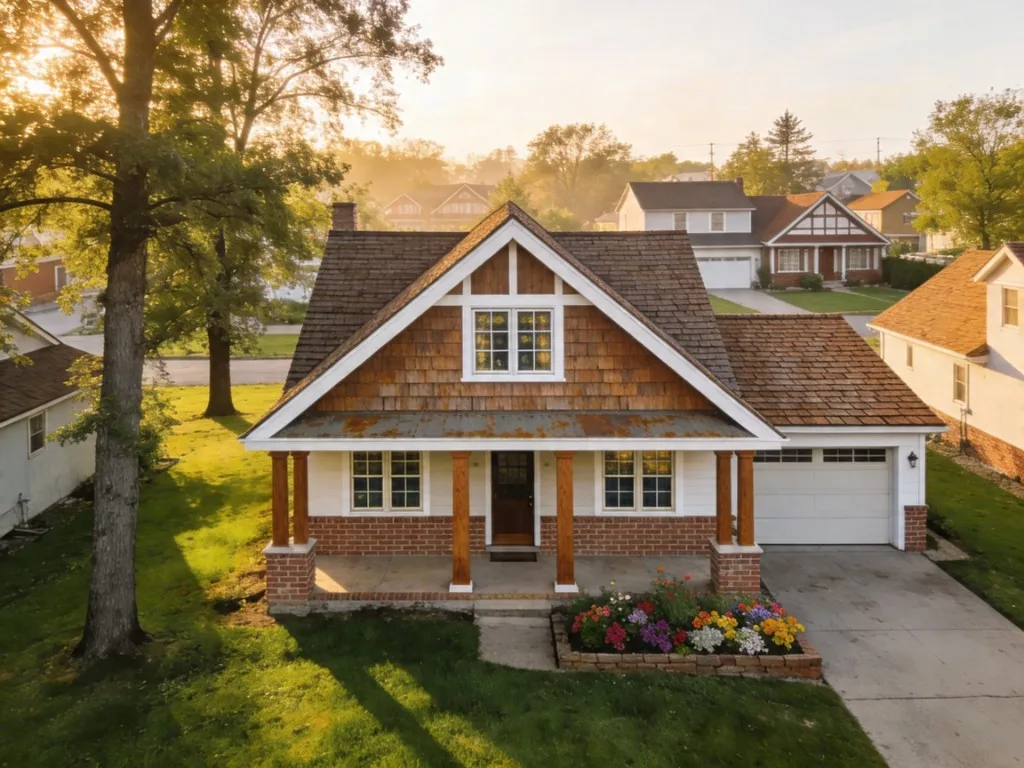
Home Pros (Balint Holdings, LLC) is a veteran-owned cash home buyer that buys North Carolina houses directly from owners, and this guide sits under our North Carolina seller hub. The rules below come from the North Carolina General Statutes, the Department of Revenue's 2026 Form AV-9, the IRS and CMS. We read each one on November 23, 2026. If you're on the circuit breaker, jump to the deferred tax section first, because that's where the money is.
How does a North Carolina senior sell a paid-off house without repairs or showings?
You sell to a buyer who prices the house as it stands today, popcorn ceilings and all. Nobody asks you to paint.
For most downsizers the hard part is the basement, with thirty-five years of Christmas boxes and a piano nobody plays. A listing agent will want that cleared and the rooms staged before the first showing. With a direct sale you pack what's going to the condo in Cary or the cottage near your son in Wilmington, and the rest stays put. We haul it after closing.
North Carolina closings run through an attorney's office. When the house is paid off, that file is thin. There's no lender payoff to chase, so the attorney searches title, collects any taxes owed and records the deed.
One line on your settlement statement is worth knowing ahead of time. The state charges an excise tax of $1 for every $500 of the price, and G.S. 105-228.30 says the transferor pays it before the deed can record. On a $300,000 sale that's $600. When you sell to Home Pros it comes out of our side of the settlement statement.
Home Pros puts an offer in writing within 24 hours of a walkthrough, and you choose the closing day.
What happens to my North Carolina homestead exclusion when I sell?
It ends with the sale. The exclusion attaches to a permanent residence you own and occupy, so once the deed records, that house no longer qualifies under your name.
G.S. 105-277.1 removes the greater of $25,000 or 50 percent of your home's appraised value from taxation. If the county appraises your house at $240,000, you're taxed on $120,000. To qualify you have to be 65 or older (or totally and permanently disabled) on January 1, live in North Carolina, and have income at or under the limit. For the 2026 tax year that limit is $38,800, according to the Department of Revenue's Form AV-9. It moves every year with the Social Security cost-of-living adjustment. For a married couple living together, both incomes count even when only one name is on the deed.
Buying a smaller place in North Carolina? You can apply on the new home. The form goes to the county assessor, never to Raleigh, and the deadline is June 1. Age, income and residency are measured as of January 1, so ask the assessor in the new county how they treat a mid-year purchase before you pick a closing date.
You also get one program per owner. The statute says an owner who takes the exclusion can't receive other property tax relief, and that makes the choice between the three programs below worth an hour with the assessor.
| North Carolina program | What it does | Who qualifies for 2026 | What a sale does to it |
|---|---|---|---|
| Elderly or disabled exclusion (G.S. 105-277.1) | Excludes the greater of $25,000 or 50% of appraised value | Age 65+ or totally and permanently disabled, with income of $38,800 or less | Stops; file Form AV-9 again on your next permanent residence |
| Circuit breaker deferment (G.S. 105-277.1B) | Limits the yearly tax to 4% or 5% of income and defers the rest as a lien | Age 65+ or disabled, income up to $58,200, home owned and lived in for 5 years, new application every year | Transfer is a disqualifying event; the last 3 years of deferred taxes plus interest are collected |
| Disabled veteran exclusion (G.S. 105-277.1C) | Excludes up to the first $45,000 of appraised value | Veterans with a total and permanent service-connected disability and certain unremarried surviving spouses; no age or income limit | Tied to the permanent residence; apply again after you move |
Do I owe deferred taxes if I'm on the circuit breaker and sell?
Yes. Selling is a disqualifying event, and the last three fiscal years of deferred taxes come due, with interest, on the day the house transfers.
The circuit breaker in G.S. 105-277.1B works like a loan against the house, even though the yearly bill looks like a discount. If your income is $38,800 or less, your tax is limited to 4 percent of income. Up to $58,200, it's 5 percent. Everything above that line is deferred and sits as a lien on the property.
Take a simple illustration. A widow in Greensboro has $36,000 of income and a $3,400 combined county and city tax bill. Four percent of her income is $1,440, so $1,960 gets deferred each year. After three years on the program, $5,880 plus interest would be collected at closing. Under G.S. 105-277.1F the interest runs as if each year's tax had been payable on its original due date. We made those numbers up to show the math.
Only the most recent three years come due, even if you've deferred for ten. And by September 1 each year the tax collector has to mail a notice stating what you'd owe if a disqualifying event happened. Find that letter before you price the house.
What if you move to a nursing home first? That doesn't trigger the bill. The statute protects an extended stay in a rest home or nursing home as long as the house sits empty or your spouse or another dependent lives there. A tenant in the house falls outside that protection, so call the assessor before you rent it out.
Will I owe North Carolina income tax on the gain from selling my house?
For most long-time owners, no. When some gain is left over, North Carolina taxes it at the same flat rate as the rest of your income.
The federal exclusion covers most sellers. Own the house and live in it as your main home for two of the five years before the sale, and you can exclude up to $250,000 of gain, or $500,000 on a joint return (IRS Topic No. 701). North Carolina builds its tax on your federal adjusted gross income under G.S. 105-153.4, so gain the IRS excludes never reaches your state return.
What about gain above the exclusion? The state doesn't set a separate rate for it. It's taxed with everything else at the flat individual rate, which G.S. 105-153.7 puts at 3.99 percent for tax years after 2025. Say a couple in Asheville bought in 1988 and clear $540,000 of gain. They'd have $40,000 exposed, and the state's share of that comes to $1,596. The same statute can cut the rate again starting in 2027 if state revenue passes set targets.
The harder case is the owner who already moved out. If you left for assisted living more than three years ago, the two-of-five test gets tight. The IRS points to Publication 523 for exceptions, and we wouldn't assume the exclusion is gone until a preparer has read them against your dates. Bring your purchase papers and receipts for anything you added to the house. This is general information and it isn't tax advice.
Will selling my house now hurt my Medicaid eligibility later?
A sale at a fair price to an unrelated buyer shouldn't. The look-back punishes giving property away, and you'd be getting paid.
Congress set the rule in the Deficit Reduction Act. When someone applies for long-term care coverage, the state reviews the 60 months before the application for assets transferred for less than fair market value (CMS, Transfer of Assets in the Medicaid Program). Deeding the house to a grandson for a dollar counts. So does selling it to a niece at half its value. A written offer, a signed contract and a settlement statement from the closing attorney's office show that you received what the house was worth.
North Carolina gives you a second reason to think about timing. Under G.S. 108A-70.5 the state runs a Medicaid Estate Recovery Plan. If you're 55 or older and Medicaid pays for nursing facility care, home and community-based services, hospital care, prescription drugs or personal care, the Department of Health and Human Services can make a claim against your estate after you die. It ranks as a sixth-class creditor and can't recover more than it paid. The statute counts real property in that estate, and the department has to adopt hardship waiver rules.
Ask a North Carolina elder law attorney how the sale proceeds will be counted, because money in the bank isn't treated the way a home you live in may be. My opinion: if care looks likely in the next five years, don't sign with any buyer, us included, until that attorney has looked at your timing.
Does selling now make my estate easier for my kids to settle?
In North Carolina it usually does, mostly because of a two-year rule that few families hear about until a buyer's attorney brings it up.
Title to your house passes to your heirs the moment you die, or to the people named in your will once it's probated (G.S. 28A-15-2(b)). G.S. 28A-17-12 complicates that. If the estate's notice to creditors is published within two years of your death, a sale your heirs made on their own before that notice is void as to creditors. After the notice, the personal representative has to join in the deed. So for two years after a death, expect a buyer's attorney to ask for an open estate and a personal representative's signature.
The small estate shortcut won't move a house. The affidavit in G.S. 28A-25-1 collects personal property worth $20,000 or less ($30,000 when the surviving spouse is the sole heir), and only after 30 days. The heir has to describe any real estate you owned in that affidavit, and it still transfers none of it.
Sell while you can sign for yourself and none of that touches the house. Your kids inherit an account with a beneficiary on it, and nobody has to insure and mow a vacant house in Gastonia from three states away. Our guide to selling an inherited house in North Carolina covers what they'd face otherwise.
What does this mean if you sell to a cash buyer like Home Pros?
You set the calendar, and you see the tax items before you commit.
We walk the house once and send a written cash offer within 24 hours. Then we leave you alone to think. Show it to your daughter or your attorney. If you accept, we can close in as little as 7 days, though most sellers pick a date 14 to 30 days out so the move isn't rushed. There's no commission and we cover standard closing costs. Leave the furniture you don't want.
A cash offer usually lands below what a repaired, staged house could bring on the open market after a few months. Some sellers should list. If you've got the energy for repairs and showings and no deadline, listing may net more. Check it yourself with the cash offer calculator, and read how we calculate an offer before you decide.
| Item at a North Carolina closing | Where the rule comes from | What to do before you sign |
|---|---|---|
| Excise tax on the deed | G.S. 105-228.30: $1 per $500 of the price, owed by the seller unless the buyer covers it | Check which side of the settlement statement it's on ($600 on a $300,000 sale); we cover it on our purchases |
| Deferred circuit breaker taxes | G.S. 105-277.1B and 105-277.1F: last 3 fiscal years plus interest | Give the collector's September notice to the closing attorney |
| Homestead exclusion on the next home | G.S. 105-277.1: one program per owner | File Form AV-9 with the new county's assessor by June 1 |
| Gain above the federal exclusion | G.S. 105-153.7: 3.99% flat rate | Hand your preparer the purchase records and improvement receipts |
| Medicaid look-back | 60 months, transfers below fair market value (CMS) | Keep the contract and the settlement statement |
The Home Pros team has 11 years and 500+ deals behind it. If property taxes have already slipped behind, our North Carolina delinquent property tax guide explains how they're paid off at closing. Sellers in the two biggest metros can start with our Charlotte page or Raleigh page.
Frequently Asked Questions
Do I lose my North Carolina homestead exclusion when I sell my house?
Yes. G.S. 105-277.1 covers a permanent residence that a qualifying owner owns and occupies, so the exclusion stops when the house transfers. You can file Form AV-9 with the county assessor on your next North Carolina home if you still meet the age and income tests.
What is the income limit for North Carolina senior property tax relief in 2026?
For the 2026 tax year the income eligibility limit is $38,800 for the elderly or disabled exclusion. The circuit breaker allows income up to 150 percent of that figure, which is $58,200. The Department of Revenue resets the number each year using the Social Security cost-of-living adjustment.
How much deferred tax is due if I sell a house on the circuit breaker?
The deferred taxes for the preceding three fiscal years, plus interest figured as if each year's tax had been payable on its original due date. They're a lien on the property, so the closing attorney pays them from your proceeds. Your tax collector mails the current amount by September 1 each year.
Does North Carolina tax the profit when a senior sells a long-time home?
Usually there's nothing to tax. The federal exclusion covers up to $250,000 of gain, or $500,000 on a joint return, and North Carolina starts from federal adjusted gross income. Gain above the exclusion is taxed at the state's flat individual rate, 3.99 percent for tax years after 2025.
Can my kids use a small estate affidavit to sell my North Carolina house?
No. The affidavit in G.S. 28A-25-1 collects personal property of $20,000 or less, or $30,000 for a sole-heir surviving spouse. Real estate passes to heirs at death, but under G.S. 28A-17-12 a sale within two years can be void as to creditors unless a personal representative is involved.
Can North Carolina Medicaid make a claim on my house after I die?
It can if the house is part of your estate. Under G.S. 108A-70.5 the state may recover what Medicaid paid for long-term care and related services for recipients 55 or older. The claim is capped at the amount paid, and the statute requires rules for waiving recovery in cases of undue hardship.
Do I have to clean out the house before Home Pros buys it?
No. Take what you're keeping and leave the rest. We buy the house as it sits and clear it out after closing, and there's no repair list to work through first.
Sources
- N.C. Gen. Stat. 105-277.1: the elderly or disabled homestead exclusion, the January 1 tests, the June 1 application date and the one-program rule.
- NC Department of Revenue, Form AV-9 for 2026: the $38,800 and $58,200 income limits, the disabled veteran exclusion and the yearly circuit breaker application.
- N.C. Gen. Stat. 105-277.1B: the circuit breaker's 4 and 5 percent limits, disqualifying events, the three-year rule, the September 1 notice and the nursing home absence.
- N.C. Gen. Stat. 105-277.1F: when deferred taxes are payable and how interest accrues.
- N.C. Gen. Stat. 105-153.7 and 105-153.4: the 3.99 percent individual rate, the 2027 rate triggers and the federal adjusted gross income starting point.
- N.C. Gen. Stat. 105-228.30: the excise tax of $1 per $500 paid by the transferor.
- IRS, Topic No. 701, Sale of Your Home: the $250,000 and $500,000 exclusion and the ownership and use tests.
- CMS, Transfer of Assets in the Medicaid Program: the 60-month look-back on transfers for less than fair market value.
- N.C. Gen. Stat. 108A-70.5: the Medicaid Estate Recovery Plan.
- N.C. Gen. Stat. 28A-15-2, 28A-17-12 and 28A-25-1: title at death, heir sales within two years and the small estate affidavit.
Income limits, tax rates and probate thresholds change; confirm current figures with your county assessor, the NC Department of Revenue or a North Carolina attorney before relying on them. This article is educational and not financial, tax, or legal advice.

Co-founder of Home Pros (Balint Holdings, LLC) and a licensed Texas real estate agent. Trevor runs the acquisitions side of the business, pricing and closing offers directly with sellers. More about Trevor →