Key Takeaways
- No Oregon statute names or prohibits a novation. The rules that bite are the 2024 wholesaling law (ORS 696.650 to 696.670) and the broker license law.
- "Market" includes contracting with someone else to advertise, so handing the house to a listing broker can still be marketing by the investor under ORS 696.650(1).
- Since July 1, 2025, the investor needs a residential property wholesaler registration ($300) or an Oregon broker license.
- ORS 696.662(1)(b) sends the wholesaler disclosure to the listing broker as well as the seller and buyer.
- An Oregon broker can't share a commission with an unlicensed person (ORS 696.290), so the investor's money comes from the contract position.
Not legal advice. This is a plain-language reading of Oregon Revised Statutes chapter 696 (2025 edition, oregonlegislature.gov) and the Oregon Real Estate Agency's wholesaling pages, all read on November 16, 2026. Have an Oregon real estate attorney review your contract, addendum, and disclosure before you use them.
Is a novation legal in Oregon?
Yes. We searched ORS chapter 696 for the word, and it isn't there. Nothing in the license law, the escrow law, or the 2024 wholesaling sections bans a seller from listing a house while an investor's purchase contract sits beside the listing. That's the whole novation: the seller stays on title, a licensed broker lists the house, a retail buyer contracts with the seller, and the investor's contract is replaced at closing.
What Oregon does regulate is the investor's role. In 2024 the Legislature passed House Bill 4058 (Oregon Laws 2024, chapter 3), and the Oregon Real Estate Agency says it took effect July 1, 2025. Since then, anyone marketing a home they hold only by contract has to be a registered residential property wholesaler or a licensed broker or principal broker. A novation run by an unregistered, unlicensed investor isn't illegal because it's a novation. It's a problem because it's unregistered wholesaling.
So the honest answer has two halves. The structure is lawful. The person running it has to be in the right lane before the listing goes live. Our novation hub covers the structure itself; this guide covers Oregon's lane rules, and our Oregon wholesaling law guide walks the full registration process.
Does an Oregon novation count as residential property wholesaling?
Usually, yes. The test lives in ORS 696.650, and a typical novation lands inside it. Subsection (4) defines residential property wholesaling as marketing residential property "for which the marketer has only an equitable interest or an option to purchase," where at the time of marketing the marketer has held that interest for fewer than 90 days and invested less than $10,000 in land development or improvement costs.
The trap is subsection (1). "Market" means "to advertise, or contract with another person or entity to advertise, or to solicit purchasers." A lot of investors assume the broker is the one marketing, so they're off the hook. Read the words again. If you signed a deal with the seller, then arranged for a broker to put the house on the MLS, you contracted with another person to advertise. That's marketing.
| Question | Typical novation answer | Where |
|---|---|---|
| Is it residential property? | Yes, if zoned residential or an existing condo unit | ORS 696.650(2) |
| Does the investor hold only an equitable interest? | Yes, a purchase contract with no deed | ORS 696.650(4) |
| Is the house being marketed? | Yes, through the listing broker the investor lined up | ORS 696.650(1) |
| Held fewer than 90 days at marketing? | Almost always; most novations list within weeks | ORS 696.650(4)(a) |
| Under $10,000 in improvements? | Often; light prep rarely clears that bar | ORS 696.650(4)(b) |
| How many deals before it counts? | One | ORS 696.653(3) |
If you've held the contract 90 days or more, or put $10,000 or more into improvements, the definition doesn't fit. That doesn't make the deal unregulated. The broker license law still applies to anyone who lists or negotiates for another person, and we'd treat any plan built around beating the 90-day clock as a question for your attorney, not a loophole.
Who has to be registered or licensed on an Oregon novation?
Four parties touch an Oregon novation, and each sits under a different rule. Get one wrong and the closing stalls.
| Party | What they need | Source |
|---|---|---|
| Investor holding the contract | Residential property wholesaler registration, or an Oregon broker or principal broker license | ORS 696.653(1) and (4); OREA FAQ |
| Listing broker | Active Oregon license; listing real estate for another for compensation is professional real estate activity | ORS 696.010(18)(d); ORS 696.020(2) |
| Seller | Nothing; an owner selling their own home isn't acting "for another" | ORS 696.010(18) |
| Escrow | An escrow agent with an active Oregon license | ORS 696.511(1) |
The registration isn't a broker license. ORS 696.656 says the agency issues it only to an individual, and if your company is the buyer on the contract, the person doing the wholesaling for it is the one who registers. The agency's FAQ lists the steps: apply through eLicense, get fingerprinted, clear a background check, and pay a $300 fee. A broker who wholesales skips the registration under ORS 696.653(4) but still owes the written disclosure on every deal.
The listing broker is the easier half. ORS 696.010(18)(d) puts anyone who "lists, offers, attempts or agrees to list real estate for sale" for another and for compensation inside professional real estate activity, and ORS 696.020(2) says that takes an active license. ORS 696.040 adds that one act is enough. That's why the listing goes to an Oregon-licensed broker and never to the investor's own MLS login from another state.
Which disclosures does an Oregon novation need?
The wholesaler disclosure goes to more people on a novation than on a plain assignment. ORS 696.662(1) lists four places it has to land: (a) potential buyers and sellers before any written contract, (b) any licensed broker "engaged to assist the residential property wholesaler in marketing or listing the property," (c) any broker helping a buyer purchase it, and (d) all advertising for the property. On a novation, (b) is your listing broker and (c) is every buyer's agent who writes an offer.
The form itself is set by the agency. The statute requires at least 10-point bold type stating that the wholesaler has only an equitable interest, doesn't hold legal title and "might be unable to directly transfer title to the buyer," and might not be a licensed broker or appraiser. The agency publishes one disclosure for registered wholesalers and a separate one for brokers who wholesale. Use the one that matches your status.
| Who gets it | When | Where |
|---|---|---|
| The seller | Before the purchase contract is signed | ORS 696.662(1)(a) |
| Your listing broker | When engaged to market or list the house | ORS 696.662(1)(b) |
| Buyer's agents | When assisting a buyer with the property | ORS 696.662(1)(c) |
| The public | In all advertising for the property | ORS 696.662(1)(d) |
Two details matter in practice. The seller can cancel without penalty until midnight at the end of the third business day after getting the disclosure, and that right can't be waived. And per the agency FAQ, social media posts are exempt from the advertising rule only if they link to a separate page that complies. If the seller never got the disclosure before signing, ORS 696.662(4) lets them terminate any time and keep the earnest money. On a novation that's already listed, that's a very expensive way to learn the rule.
Where does a limited authorization to sign listing documents fit?
Home Pros asks novation sellers to sign one extra document: a limited authorization that lets partner agents sign listing paperwork for the house. It's a convenience for the seller, who stays the owner and signs the retail sale. It isn't a workaround, and in Oregon it doesn't change anything ORS 696.650 says about who's marketing.
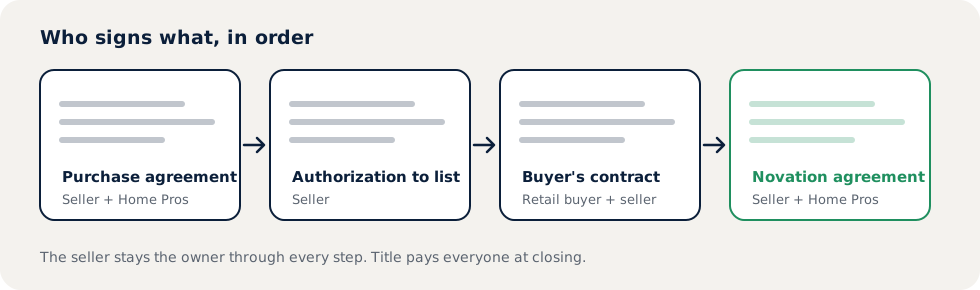
Oregon's license law speaks to powers of attorney directly. ORS 696.030(2) exempts a nonlicensed attorney in fact from the license law only when the power of attorney is recorded in the county, specifically describes the real estate, and isn't used "as a device to engage in professional real estate activity without obtaining the necessary real estate license." Read that as a warning label. Any authorization in a novation should run to the licensed broker for listing documents only, and the seller should keep signing the sale contract. If your paperwork lets an unlicensed investor do the broker's job on the seller's behalf, rewrite it before it goes anywhere near an Oregon escrow office.
How does the investor get paid without a commission split?
From the contract, not the commission. ORS 696.290(1)(a) bars an Oregon licensee from paying any part of their compensation, or a finder's fee, to a person who isn't licensed under ORS 696.022. A registered wholesaler isn't a licensee, so the listing broker can't cut the investor in on the commission.
The money flows the way the novation is built. The seller agreed to a net price. The retail buyer pays more. After the loan payoff, escrow and title costs, the listing broker's fee, and any agreed buyer-agent pay, the seller gets their net and the investor's share comes out of what's left, shown as its own line on the settlement statement. Escrow handles all of it, and under ORS 696.511 nobody may act as an escrow agent in Oregon without a license.
When a partner brings a novation to Home Pros, the partner keeps 60% of the net profit and Home Pros keeps 40%. The seller pays one $500 transaction coordination fee from proceeds at closing, and Home Pros covers the seller's closing costs. Those terms go in writing before the listing starts, and the seller sees them. The novation agreement guide shows where each number sits in the contract.
What should you never do on an Oregon novation?
Most Oregon novation trouble comes from the same handful of shortcuts. Skip every one of these.
- Don't market before you're registered or licensed. One deal is enough under ORS 696.653(3), and an Instagram post counts as advertising.
- Don't hide the novation, the partner, or the fee from the seller. Our scripts disclose all three, and ORS 696.665(1) lets the commissioner act on material misrepresentation whether or not anyone was hurt.
- Don't skip the listing broker's copy of the disclosure. ORS 696.662(1)(b) names them specifically.
- Don't ask the broker for a piece of the commission. ORS 696.290 says no.
- Don't use an authorization to do the broker's job. See ORS 696.030(2)(c).
The downside is real. ORS 696.997 makes knowingly violating the registration, disclosure, or conduct sections a Class A misdemeanor, reaches officers and members who personally take part. For unregistered wholesaling, the commissioner can add civil penalties of $1,000 to $2,500 for a first offense and $2,500 to $5,000 after that, plus up to the profit made on the deal. We cover the penalty math in more detail in the Oregon wholesaling guide.
How does Home Pros run a novation in Oregon?
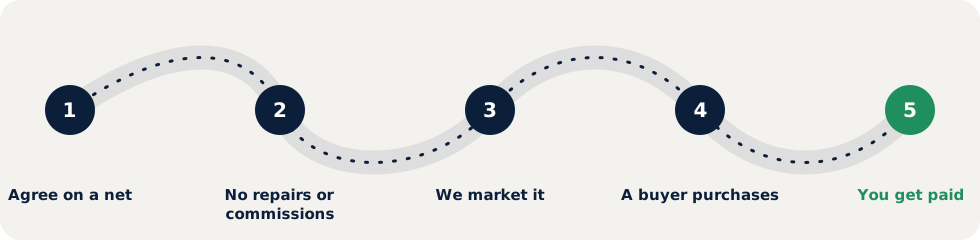
Oregon is one of our service states, so a novation here follows the same five steps as anywhere else, with Oregon's paperwork layered on. The seller and Home Pros agree on a net price. The seller pays no repairs and no commissions, and Home Pros covers closing costs. A licensed Oregon broker markets the house. A retail buyer purchases. The seller is paid the agreed net at closing.
We work with 300+ investor-friendly agents and have closed hundreds of deals. Partners who want to run Oregon deals through us can start at the partner section of our novation page or submit a deal directly. If a house is too rough to list, we'll price a cash exit through our buyer network or the deal marketplace instead. Sellers comparing options can read our Oregon selling guide. Before a seller signs anything, they can check a cash number with our cash offer calculator and read how to verify Home Pros or any other buyer. Questions on a specific deal go to Trevor Rice at (210) 672-1674.
Send the Oregon deal and we'll price both exits
Trevor Rice reviews submitted deals for a cash bid and for a novation listing. You'll get both numbers and the Oregon paperwork list in writing.
Get a cash offer List with Home Pros
Wholesaler with a deal under contract? See the Home Pros novation program or submit the deal.
Frequently Asked Questions
Is a novation legal in Oregon?
Yes. No Oregon statute bans or even names a novation. The investor running it, though, usually counts as a residential property wholesaler under ORS 696.650 and has to be registered with the Oregon Real Estate Agency or hold a broker license, and the listing itself has to be handled by an Oregon-licensed broker.
Do I need a wholesaler registration if a broker lists the house for me?
Probably. ORS 696.650(1) defines "market" to include contracting with another person to advertise, so lining up a broker to list the house is still marketing by you. If you've held the contract under 90 days and invested under $10,000, the registration rule in ORS 696.653 applies unless you're a licensed broker.
Does the listing broker need to see my wholesaler disclosure?
Yes. ORS 696.662(1)(b) requires the disclosure to go to any licensed broker engaged to help market or list the property, and (1)(c) adds any broker helping a buyer. The seller gets it before signing the purchase contract, and it has to appear in all advertising for the house.
Can the listing agent pay me part of the commission in Oregon?
Not unless you're licensed. ORS 696.290 bars an Oregon licensee from sharing compensation or paying a finder's fee to anyone who isn't licensed under ORS 696.022. Your share comes from the difference between the seller's net and the sale price, shown as its own line at escrow.
Can the seller back out after signing an Oregon novation contract?
Yes, for a short window. Under ORS 696.662(3) the seller can cancel without penalty until midnight at the end of the third business day after receiving the wholesaler disclosure, and that right can't be waived. If the disclosure was never given, the seller can terminate at any time and keep the earnest money.
What does Oregon wholesaler registration cost?
The Oregon Real Estate Agency lists a $300 fee, plus fingerprinting paid by the applicant and a criminal background check. Registration is issued only to an individual. A licensed broker or principal broker doesn't need to register but must still give the written disclosure on every wholesale deal.
Sources
Sources were read on November 16, 2026.
- Oregon Revised Statutes chapter 696 (2025 edition): sections 696.010, 696.020, 696.030, 696.040, 696.290, 696.511, 696.650, 696.653, 696.656, 696.662, 696.665, and 696.997
- Oregon Real Estate Agency, Property Wholesaling FAQs: July 1, 2025 effective date, $300 fee, covered parties, social media rule
- Oregon Real Estate Agency, Registered Residential Property Wholesaler: who must register and the background check
- Residential Property Wholesaler Written Disclosure: the agency's form for registered wholesalers

Trevor Rice is Head of Acquisitions at Home Pros (Balint Holdings, LLC) and a licensed Texas real estate agent. He runs the Home Pros novation program. Reach him at (210) 672-1674 or trevor@selltohomepros.com. This article is general information, not legal or tax advice.