
Home Pros (Balint Holdings, LLC) is a veteran-owned cash home buyer, and we also run novation sales, so we make both kinds of offer. Weigh what follows with that in mind. This page is part of our novation guides, and the tax and lending rules in it come from the IRS, the Consumer Financial Protection Bureau, HUD and the Texas Occupations Code, all read on November 25, 2026. Already holding two offers? Skip to the line-by-line table.
What's the difference between a novation and a cash offer?
With a cash offer, we buy your house. With a novation, we sell it alongside you while we're under contract, and a retail buyer ends up with the keys.
The two start out identical. You get the same walkthrough and sign the same purchase agreement with the same buyer. A cash purchase then runs the long way around: we close with a lender's money, renovate, stage the house, list it, and close a second time with the family who moves in. A novation cuts out the middle. You stay the owner, our partner agents put the house on the market, and when a buyer shows up they contract with you directly. The title company pays you the net figure you chose at the start.
On our program page we tell sellers it's "just like a cash offer," except that we do the resale with you while we're under contract. The script ends: "Because of that we get savings, and we pass those savings over to you as a higher offer."
That only works on a house a retail buyer would want as it sits, or close to it. If you're new to the term, our seller's guide to novation agreements covers the contract itself.
Why does a cash offer come in lower?
A cash buyer has to pay for owning your house before they can sell it, and every one of those bills comes out of your price.
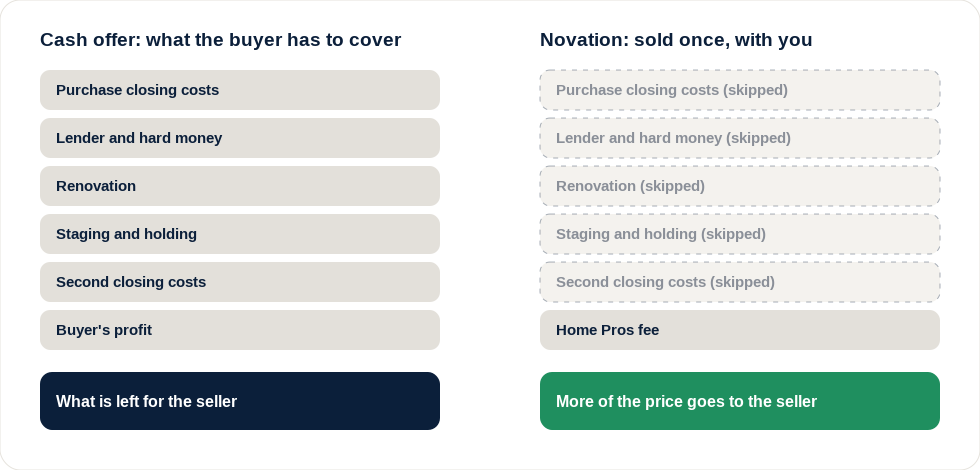
Count the layers. First come closing costs on the purchase, then interest and points to a hard money lender, then the renovation itself. Staging, insurance, taxes and utilities run the whole time the work gets done. The resale brings a second round of closing costs. Last is the buyer's profit, because nobody ties up money for six months to break even.
That's simply what buying, fixing and reselling a house costs, and our offer math is public. But five of the six layers exist only because the house changes hands twice. Sell it once and they're gone. What's left is a fee for whoever ran the sale.
A flat "we pay 70 percent" quote hides all six inside one number. Ask any cash buyer, us included, to write the layers out. If they can't, you're looking at a guess.
What does a seller net on each, line by line?
On a house in decent shape, the novation column usually ends higher, and the gap is roughly the five skipped layers minus the weeks you keep carrying the house.
The table below is an illustration. Every dollar figure in it is a round placeholder we picked to show where the money goes. They aren't Home Pros averages and they aren't market data, so put your own offers in their place.
| Line | Cash offer | Novation |
|---|---|---|
| Price a retail buyer pays | $250,000, after the investor renovates | $235,000, sold close to as-is |
| Purchase closing costs | $4,000 | Skipped |
| Lender and hard money | $9,000 | Skipped |
| Renovation | $15,000 | Skipped |
| Staging and holding | $5,000 | Skipped |
| Resale closing costs and commissions | $17,000 | $16,000, paid out of the sale and kept off your net |
| Buyer's profit or Home Pros fee | $25,000 | $19,000 |
| Your agreed number | $175,000 | $200,000 |
| Fees on your side | $0 | $500 transaction coordination fee |
| Paid to you at closing | $175,000 | $199,500 |
| Your carrying costs while it's listed | Little, if you close in a week or two | About $4,500 at $1,500 a month for three months |
That last row is the one sellers forget. You're still the owner during a novation, so the mortgage, taxes and insurance keep coming until the buyer closes. In this example the real gap is closer to $20,000 than $24,500. If your payment is $3,000 a month, or the house sits for six months, it shrinks again.
Compare what's paid to you at closing, never the headline price. Our cash offer calculator lets you run the cash column with your own repair numbers.
What do you sign in a novation that you don't sign in a cash sale?
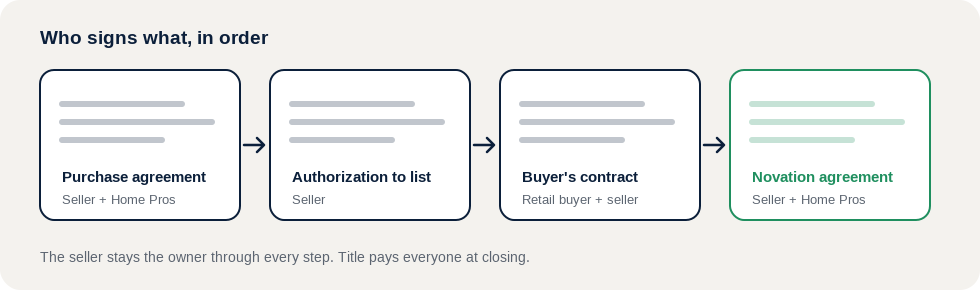
One extra document up front, and two more when a buyer appears.
A cash sale is a purchase agreement and a closing. A Home Pros novation starts with that same purchase agreement, then adds a limited authorization to sign listing documents. It lets us sign the listing paperwork so our partner agents can put the house on the MLS. It doesn't transfer ownership, and you can read every line of it before you sign. Later you sign the retail buyer's contract, and a novation agreement that replaces our original contract with theirs.
State law cares about how a house gets marketed by someone who doesn't own it. In Texas, Occupations Code Section 1101.0045 lets a person sell or assign an interest in a purchase contract without a license only if they don't use it to engage in real estate brokerage and they disclose "in writing the nature of the equitable interest to any seller or potential buyer." We aren't giving legal advice here. Other states draw the line in other places, and our novation hub lists the license acts we've read, state by state. For anything not on that list, call the state real estate commission or an attorney before you sign.
How long does each one take?
A cash sale can close in as little as 7 days. A novation can't, and nobody should tell you otherwise.
Home Pros puts a cash offer in writing within 24 hours of seeing the house, and most cash closings land 14 to 30 days out because that's the date sellers ask for. A novation needs a retail buyer first, and that part isn't up to us or you. It depends on how many people are shopping your neighborhood that month.
Once a buyer signs, their lender sets the pace. Under federal mortgage rules the lender has to give the buyer a Closing Disclosure at least three business days before closing, the CFPB explains. The appraisal and underwriting come before that. So even a buyer who shows up on day one won't close in a week.
Here's the question we ask every seller before we suggest a novation: "If we closed in 60 days instead of 30 and it got you more money, would you be opposed to that?" If the answer is yes, take the cash offer. A foreclosure sale date settles it, and so does a job that starts in another state on the first of the month.
What happens if the retail buyer falls through?
You still own the house, and with Home Pros the cash offer is still there as your backup.
Financed buyers fall out for reasons that have nothing to do with you. Their loan gets denied, the appraisal comes in low, or the inspection scares them. A cash buyer has none of those exits, which is most of what you're paying for when you accept the lower number.
The appraisal deserves a closer look. If the buyer is using an FHA-insured loan, the appraiser has to check the house against HUD's property acceptability criteria, which include its minimum property requirements. Where a house falls short, Handbook 4000.1 has the appraiser note every repair needed to comply, along with an estimated cost to cure. So a leaking roof can stall the sale even when the buyer loves the kitchen.
Before you sign a novation with anyone, find the paragraph that says what happens when the marketing period ends without a closing. It should say in plain words whether you get a cash purchase at a stated price, an extension, or your house back with no strings. Our comparison of a novation and a wholesale assignment shows what it looks like when that paragraph is missing.
Does the IRS care which one you pick?
No. The IRS taxes the gain, and the formula is the same for both.
Publication 523 lays it out: selling price, minus selling expenses, gives your amount realized. Subtract your adjusted basis and what's left is gain or loss. If the house was your main home, Topic 701 says you may exclude up to $250,000 of that gain, or $500,000 on a joint return, as long as you owned and lived in it for at least 24 months of the 5 years before the sale.
A novation changes the inputs. A bigger check means a bigger gain, which only matters once you're past the exclusion or the house was a rental. Publication 523's worksheet also counts "any other fees or costs to sell your home" as selling expenses, so keep the settlement statement showing the $500 fee.
Two questions for the title company before closing day. Which figure will go in the gross proceeds box of Form 1099-S, the retail price or your net? And how does the investor's fee appear on your settlement statement? We don't answer those for you, because we're not your tax preparer. Hand both answers to whoever is.
When is the cash offer the better number?
When the house won't pass a lender's appraisal, when you have a date you can't move, or when three more months of payments would eat the difference.
We turn down novations ourselves for those reasons. A house that needs a roof, a foundation repair or a full gut is a cash deal, and on our own program page heavy rehab is on the "not a fit" list. So is a seller who's only curious about price. A novation suits a clean, dated house in a neighborhood where families are buying, owned by someone with a couple of months to spare.
You don't have to guess which one you have. Ask for both numbers. The Home Pros team has 11 years and 500+ deals behind it, and on a novation we work with 300+ investor-friendly agents, so we can price a house both ways in one visit. If the cash number wins, we'll close on your date and cover standard closing costs. If the novation wins, you'll see the net in writing before anything gets listed.
Texas sellers can start at our Texas hub or read how the Home Pros novation program works. Trevor takes novation calls directly at (210) 672-1674. Not sure we're real? Check us out first. And if you'd rather weigh a plain listing against cash, we wrote up that choice too.
Frequently Asked Questions
Is a novation the same as a cash offer?
It starts the same way, with the same purchase agreement. In a cash sale the investor buys your house and resells it later. In a novation the house is sold once, to a retail buyer, while the investor is under contract with you, and you're paid a net figure you agreed to up front.
Does a seller always net more with a novation?
No. It depends on the house and the wait. A house that needs heavy repairs may not qualify for a buyer's loan, and you keep paying the mortgage, taxes and insurance until closing. Compare the amount paid to you at closing, then subtract your carrying costs for the extra months.
What fees does a seller pay in a Home Pros novation?
One. A $500 transaction coordination fee comes out of your proceeds at closing, so you pay nothing up front. Home Pros covers the closing costs and there's no commission on your side.
Can I still take the cash offer if the novation doesn't sell?
With Home Pros, yes. Our cash offer stays available as your backup. With any other buyer, look for that promise in the written agreement, along with the date the marketing period ends, before you sign.
How fast can a novation close compared with cash?
Home Pros can close a cash purchase in as little as 7 days, typically 14 to 30. A novation waits on a retail buyer and their lender. Federal rules require the buyer to receive a Closing Disclosure at least three business days before closing, after the appraisal and underwriting are done.
Do I pay more tax on a novation?
Only if your gain is taxable. The IRS formula is the same either way: selling price minus selling expenses minus adjusted basis. Up to $250,000 of gain on a main home is excluded, or $500,000 on a joint return, if you meet the ownership and use tests in Topic 701.
Sources
- IRS, Publication 523, Selling Your Home: the gain formula and the selling expense lines in Worksheet 2.
- IRS, Topic No. 701, Sale of Your Home: the $250,000 and $500,000 exclusion and the 24-month ownership and use tests.
- Consumer Financial Protection Bureau, What is a Closing Disclosure?: the three-business-day rule before a mortgage closing.
- HUD, Single Family Housing Policy Handbook 4000.1: minimum property requirements for FHA-insured loans and the appraiser's repair notes.
- Texas Occupations Code Section 1101.0045: written disclosure of an equitable interest when a contract interest is sold or assigned.
The dollar figures in the comparison table are an illustration and not an offer, an average or a promise of results. Tax rules, lending rules and state license laws change; confirm them with a tax preparer, the state real estate commission or an attorney before relying on them. This article is educational and not financial, tax, or legal advice.

Co-founder of Home Pros (Balint Holdings, LLC) and a licensed Texas real estate agent. Trevor runs the acquisitions side of the business, pricing and closing offers directly with sellers. More about Trevor →