
Key Takeaways
- Kansas has no wholesaling statute. A 2022 bill to require a license for selling an equitable interest, SB 382, passed the Senate 38 to 2 and died on the House calendar.
- The broker definition in K.S.A. 58-3035(f) reaches anyone who lists, offers or procures buyers for someone else for compensation, so the listing belongs to a Kansas licensee.
- The power-of-attorney exemption in K.S.A. 58-3037(b) only covers someone who takes no commission or other compensation, direct or indirect. An investor who profits from the deal doesn't fit it.
- A Kansas licensee can't pay compensation to an unlicensed person for licensed work (K.S.A. 58-3062(a)(10)), so the investor's money comes from the contract spread.
- Since July 1, 2024, the Kansas Real Estate Commission can issue cease and desist orders against unlicensed activity (K.S.A. 58-3065(c)).
Not legal advice. This is a plain-language reading of the Kansas real estate brokers' and salespersons' license act and the brokerage relationships in real estate transactions act (BRRETA), as published by the Kansas Office of Revisor of Statutes and read on November 17, 2026. Have a Kansas real estate attorney review your contract, addendum and listing paperwork before you use them.
Is a novation legal in Kansas?
Yes. We read the license act's definitions, licensing, exemption, conduct and penalty sections, and the word "novation" isn't in any of them. Neither is "wholesaler." Nothing stops a Kansas owner from listing their house with a licensed broker while an investor's purchase contract sits alongside, and that's all a novation is: the seller stays on title, a broker markets the house, a retail buyer signs with the seller, and the investor's contract is replaced at closing.
Kansas came close to writing a rule. In January 2022 the Kansas Real Estate Commission asked the Legislature for SB 382, which would have required a Kansas license for anyone who "attempts to sell an equitable interest in a contract for the purchase of real estate." The commission said it chose licensing over a ban. The bill history shows it passed the Senate 38 to 2 on February 23, 2022, then died on the House calendar on May 23, 2022.
So you're working under the general license act, not a wholesaling statute. That cuts both ways. There's no registration form to file, and there's also no safe harbor that says what an unlicensed investor may do. Our Kansas wholesaling law guide covers plain assignments. This page is about the novation, where a listing is involved and the broker rules get sharper.
Does running a Kansas novation make the investor a broker?
It can, and the answer turns on what you do, not what you call it. K.S.A. 58-3035(f) defines a broker two ways. The first has no pay requirement at all: anyone who "advertises or represents that such individual engages in the business of buying, selling, exchanging or leasing real estate." The second covers anyone who, for compensation and on behalf of an owner or buyer, does one of ten things. Four of them sit right on top of a novation.
| Novation task | Matching broker activity | Where |
|---|---|---|
| Getting the house on the MLS | Lists or offers, attempts or agrees to list real estate for sale | 58-3035(f)(4) |
| Running ads and showings | Offers to sell real estate | 58-3035(f)(2) |
| Rounding up retail buyers | Assists or directs in the procuring of prospects | 58-3035(f)(7) |
| Haggling over the retail offer | Negotiates or offers to negotiate the sale | 58-3035(f)(3) |
Section (n) adds that "real estate" means "any interest or estate in land," which is broad enough that we wouldn't bet a deal on a purchase contract falling outside it. K.S.A. 58-3036 then bars anyone without a license from performing any of those acts "whether as a part of a transaction or as an entire transaction." Part of a transaction is enough. The clean way through is boring: let a Kansas licensee do every task in that table.
Who has to be licensed on a Kansas novation?
Three parties touch the deal before closing, and only one of them is safe without a license.
| Party | License needed? | Source |
|---|---|---|
| Seller | No. Owners acting on their own property are exempt | K.S.A. 58-3037(a) |
| Listing broker | Yes. Listing, offering and negotiating for the seller are broker acts | K.S.A. 58-3035(f), 58-3036 |
| Investor holding the contract | No license if they stay out of the broker acts; a license if they list, advertise as a buyer and seller, or procure buyers for pay | K.S.A. 58-3035(f), 58-3036 |
The owner exemption in K.S.A. 58-3037(a) covers a person dealing "with reference to such person's own property." The seller is plainly covered. Whether an investor's contract counts as "own property" is something the statute doesn't answer, and we wouldn't build a listing plan on it.
If the investor holds a Kansas license, a different trap opens. K.S.A. 58-3062(a)(15) makes it a violation for a licensee to fail to tell a seller "any interest the licensee will have in the real estate the licensee is purchasing." A licensed investor on a novation discloses the license and the interest in writing, every time.
Does a limited authorization or power of attorney change anything in Kansas?
Not for the investor. Home Pros asks novation sellers to sign one extra document, a limited authorization that lets partner agents sign listing paperwork for the house. It's a convenience. The seller is still the owner and still signs the retail sale. In Kansas it doesn't move anyone out of the license act, and here's the sentence that settles it.
K.S.A. 58-3037(b) exempts a person acting under a power of attorney from the owner "provided that such person receives no commission or other compensation, direct or indirect, for performing any such act." An investor on a novation is there to earn a spread. That's indirect compensation by any plain reading, so the exemption doesn't reach them. Kansas is stricter here than states that only ask for a recorded power.
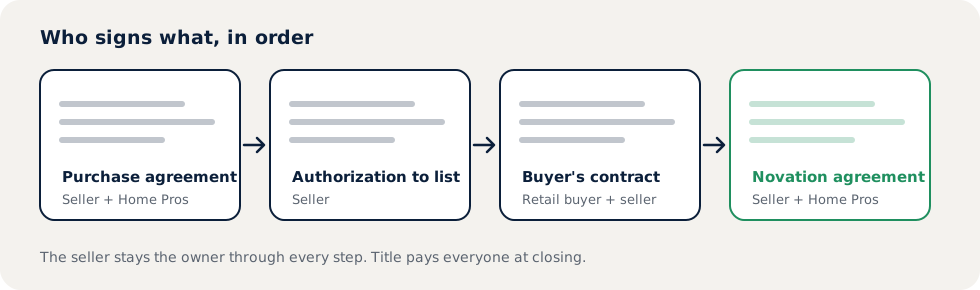
Two more lines in K.S.A. 58-3062(a) frame how the authorization should read. Subsection (25) bars a licensee from signing "any contractual agreement on behalf of another person" unless a "duly executed power of attorney" allows it. Subsection (8) bars offering a house for sale "without the knowledge and consent of the owner" or on terms the owner didn't authorize. So keep the authorization narrow, have it name the licensed agent, list the exact price and terms the seller approved, and have the seller sign the retail purchase contract personally. Your attorney should draft it.
What does the Kansas listing agreement need?
Kansas spells this out in BRRETA, and a novation listing is still a listing. Under K.S.A. 58-30,103(d)(1), a broker who wants to act as the seller's agent has to sign a written agency agreement before doing any of the 58-3035(f) activities on the seller's behalf. That means before the photos go up, not after.
Subsection (f) lists what goes in it: the terms of the relationship, "a fixed date of expiration," any limit on confidentiality, and "the terms of compensation." It's signed by the party being represented, which is the seller, and the seller gets a copy. If the broker acts as a transaction broker instead, 58-30,103(c) allows an oral or written agreement, but on a novation we'd want it in writing anyway.
| Paperwork item | Kansas rule | Where |
|---|---|---|
| Seller's agency agreement | Written, before listing activity starts | K.S.A. 58-30,103(d)(1) |
| Expiration date | Fixed date required | K.S.A. 58-30,103(f) |
| Compensation terms | Stated in the agreement | K.S.A. 58-30,103(f) |
| Brokerage relationships brochure | Given to the seller at the first practical opportunity | K.S.A. 58-30,110(a)(2) |
| Relationship disclosure | Included in the contract for sale | K.S.A. 58-30,110(c) |
One more duty is worth knowing. Under K.S.A. 58-30,106(d)(1)(E), the seller's agent has to tell buyers about any known "material limitation on the client's ability to perform." A pending investor contract on the same house can be exactly that, which is one more reason to put the novation on the table from day one.
How does the investor get paid without a commission split?
From the contract, never from the commission. K.S.A. 58-3062(a)(10) bars a Kansas licensee from paying "a commission or compensation to any person, not licensed under this act, for performing any activity for which a license is required." Subsection (a)(26) also bars a licensee from contracting with unlicensed people to perform licensed services. So the listing agent can't cut the investor in, and shouldn't be asked to.
The money moves the way the novation is built. The seller agreed to a net price. The retail buyer pays more. After the loan payoff, title and closing costs, and the listing broker's fee, the seller gets their net and the investor's share comes out of what's left, shown as its own line on the settlement statement. Nothing is buried.
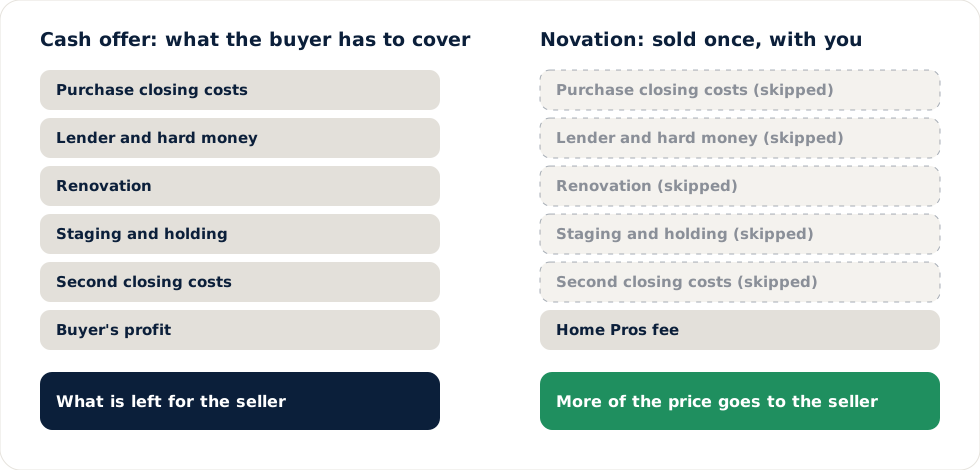
When a partner brings a novation to Home Pros, the partner keeps 60% of the net profit and Home Pros keeps 40%. The seller pays one $500 transaction coordination fee from proceeds at closing, and Home Pros covers the seller's closing costs. All of it goes in writing before the listing starts, and the seller sees every number. Our novation agreement guide shows where each one sits in the contract.
What should you never do on a Kansas novation?
Most Kansas trouble comes from treating "no wholesaling law" as "no rules." Skip these.
- Don't advertise the seller's house yourself. Under K.S.A. 58-3035(f), advertising that you're in the business of buying and selling real estate can make you a broker with no fee attached.
- Don't put the house on the MLS, run the showings or negotiate the retail offer yourself. Those are listed broker acts.
- Don't hide the novation, the partner or the fee from the seller. Our scripts disclose all three, and 58-3062(a)(8) ties every offer to terms the owner actually approved.
- Don't ask the agent for a referral cut. 58-3062(a)(10) says no.
- Don't lean on a power of attorney to do broker work for pay. 58-3037(b) only covers the unpaid.
The penalties aren't theoretical. K.S.A. 58-3065(a) makes a willful violation of the license act or BRRETA a misdemeanor: up to 12 months in jail or a $100 to $1,000 fine for a first offense, and $1,000 to $10,000 after that. Subsection (c), added in 2024, lets the commission issue a cease and desist order against an unlicensed person. A cease and desist in the middle of a listing kills the deal and probably the seller's trust with it.
How does Home Pros run a novation in Kansas?
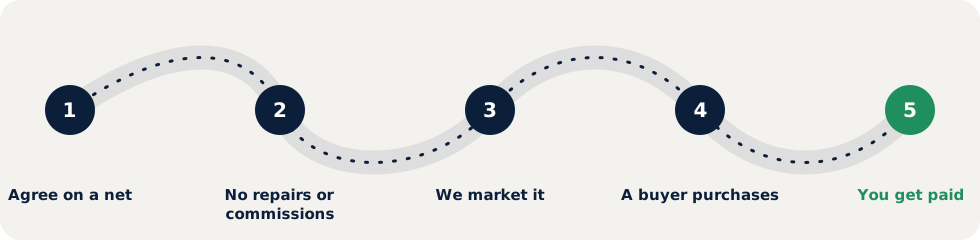
Kansas is one of our service states, and a novation here follows the same five steps as anywhere else. The seller and Home Pros agree on a net price. The seller pays no repairs and no commissions, and Home Pros covers closing costs. A Kansas licensee markets the house under a written agency agreement the seller signs. A retail buyer purchases. The seller is paid the agreed net at closing.
We work with 300+ investor-friendly agents and have closed hundreds of deals. Partners can start at the partner section of our novation page or submit a deal directly. If a house is too rough to list, we'll price a cash exit through our buyer network or the deal marketplace. Sellers can read our Kansas selling guide or the Kansas City, Kansas page, check a number with the cash offer calculator, and read how to verify Home Pros or any buyer. Deal questions go to Trevor Rice at (210) 672-1674. Running deals in Oregon too? Compare its rules in our Oregon novation guide.
Send the Kansas deal and we'll price both exits
Trevor Rice reviews submitted deals for a cash bid and for a novation listing. You'll get both numbers and the Kansas paperwork list in writing.
Get a cash offer List with Home Pros
Wholesaler with a deal under contract? See the Home Pros novation program or submit the deal.
Frequently Asked Questions
Is a novation legal in Kansas?
Yes. No Kansas statute bans or names a novation, and Kansas has no wholesaling law. The real estate license act still applies, so a Kansas licensee has to list, market and negotiate the house, and the investor has to stay out of those broker activities unless licensed.
Do I need a Kansas real estate license to do a novation?
Not if a Kansas licensee handles every broker act: listing, advertising the house, procuring buyers and negotiating. K.S.A. 58-3035(f) makes those broker activities when done for another person for compensation, and K.S.A. 58-3036 bars doing any of them without a license, even as part of a transaction.
Does a power of attorney from the seller let me list the house myself?
No. K.S.A. 58-3037(b) exempts a person acting under the owner's power of attorney only if they receive no commission or other compensation, direct or indirect. An investor earning a spread on the deal doesn't fit that exemption.
Can the Kansas listing agent pay me a referral fee?
No, unless you're licensed. K.S.A. 58-3062(a)(10) bars a Kansas licensee from paying a commission or compensation to an unlicensed person for work that needs a license. The investor's share comes from the gap between the seller's net and the sale price, shown on the settlement statement.
Did Kansas pass a wholesaling law?
Not as of November 17, 2026. SB 382, requested by the Kansas Real Estate Commission in 2022, would have required a license to sell an equitable interest. It passed the Senate 38 to 2 on February 23, 2022 and died on the House calendar on May 23, 2022.
What happens if I violate the Kansas license act?
A willful violation is a misdemeanor under K.S.A. 58-3065: up to 12 months in jail or a $100 to $1,000 fine for a first offense, and up to $10,000 after that. Since 2024 the commission can also issue a cease and desist order against an unlicensed person.
Sources
Sources were read on November 17, 2026.
- K.S.A. 58-3035, 58-3036, 58-3037, 58-3062 and 58-3065, Kansas Office of Revisor of Statutes: broker definition, licensure, exemptions, prohibited acts, penalties
- K.S.A. 58-30,103, 58-30,106 and 58-30,110: written agency agreements, seller's agent duties, brokerage relationship disclosures
- Kansas Real Estate Commission newsletter, January 2022: the commission's request for SB 382 on equitable interest sales
- Kansas Legislature, SB 382 (2021 to 2022 session) bill history: Senate passage and death on the House calendar

Trevor Rice is Head of Acquisitions at Home Pros (Balint Holdings, LLC) and a licensed Texas real estate agent. He runs the Home Pros novation program. Reach him at (210) 672-1674 or trevor@selltohomepros.com. This article is general information, not legal or tax advice.