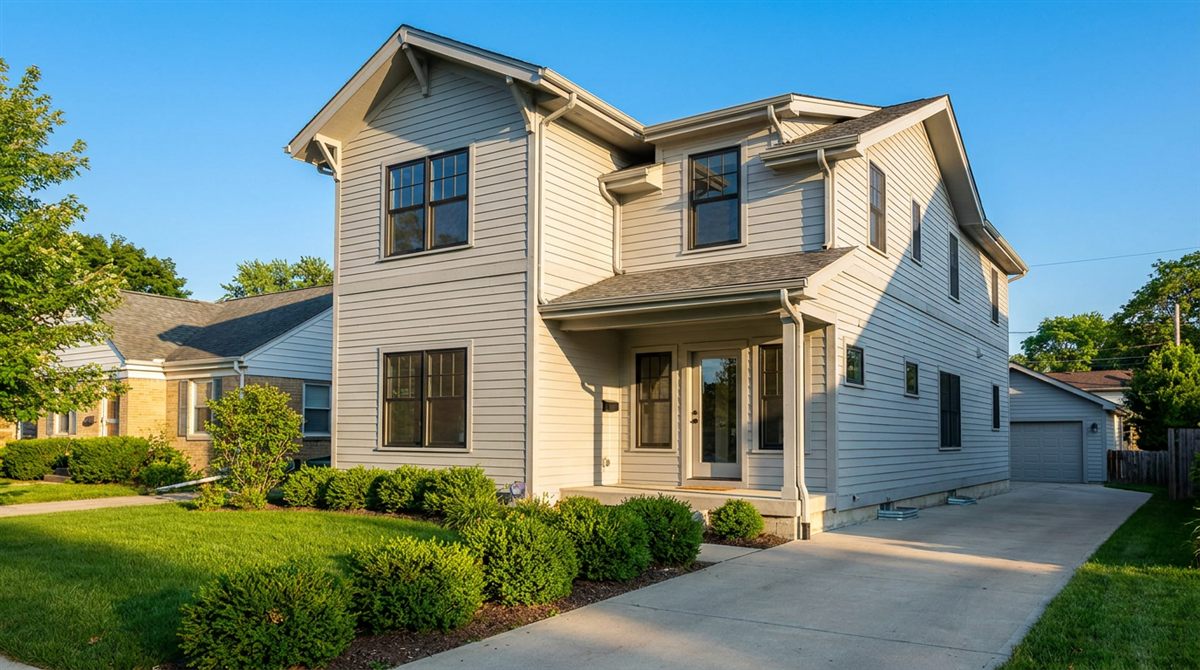
Loan-to-cost (LTC) measures a loan against a project's total cost, purchase plus rehab, while loan-to-value (LTV) measures it against the property's appraised or after-repair value. On value-add deals, lenders fund the lesser of an LTC cap, often 80 to 90 percent, and an LTV cap, often 70 to 75 percent. Whichever produces the smaller loan sets your required equity.
Key Takeaways
- LTC is cost-based: loan divided by purchase plus rehab.
- LTV is value-based: loan divided by appraised or after-repair value.
- On value-add deals lenders lend the lesser of the two caps.
- 2026 LTC caps run 80 to 90 percent; LTV caps run 70 to 75 percent.
- The lower dollar ceiling binds and sets your equity contribution.
- LTV governs at refinance, where there is no cost to measure.
- The lesser-of rule is what makes or breaks a BRRRR refi.
What is the difference between loan-to-cost and loan-to-value?
The difference is the denominator. Loan-to-cost divides the loan by what the project costs you; loan-to-value divides the same loan by what the property is worth. One measures your money going in, the other measures the market's opinion of the finished asset.
That distinction drives which ratio a lender leans on at each stage of a deal. During acquisition and rehab, cost is concrete and value is still a projection, so LTC controls the advance. At refinance, the cost basis is behind you and an appraiser sets the number, so after-repair value and LTV control. Both ratios sit inside the same capital stack, and understanding which one binds is the difference between a deal that closes with the equity you planned and one that needs a surprise cash injection. Glossary definitions at Investopedia treat the two terms separately, but on a value-add deal they operate together.
| Dimension | Loan-to-Cost (LTC) | Loan-to-Value (LTV) |
|---|---|---|
| Denominator | Total project cost (purchase + rehab) | Appraised or after-repair value |
| Formula | Loan ÷ total cost | Loan ÷ value |
| Typical 2026 cap | 80–90% | 70–75% |
| Governs | Acquisition and construction draws | Refinance and stabilized value |
| Protects lender against | Cost overruns | A drop in market value |
How do you calculate loan-to-cost (LTC)?
Loan-to-cost is the loan amount divided by total project cost. To size a loan instead of measure one, multiply total cost by the lender's LTC cap. Total cost means the purchase price plus the full rehab budget, and sometimes closing and carrying costs on construction facilities.
Take a value-add single-family deal: a $150,000 purchase and a $50,000 rehab give a total project cost of $200,000. At an 85 percent LTC cap, the lender funds 0.85 times $200,000, which is $170,000. That leaves a $30,000 equity contribution from the borrower, folded into the cost stack alongside the lender's money. The rehab portion usually funds through a draw schedule, released in stages as work passes inspection rather than handed over at closing. Because LTC keys off your actual numbers, a disciplined rehab cost estimate is not optional. Understate the rehab and the LTC advance comes in short, forcing you to cover the gap out of pocket mid-project.
How do you calculate loan-to-value (LTV)?
Loan-to-value is the loan amount divided by the property's value. On a purchase or refinance the appraised value sets the denominator; on a rehab or bridge loan the after-repair value does. Multiply that value by the LTV cap to find the value-based ceiling.
Continuing the same deal, assume the finished home appraises at a $280,000 after-repair value. At a 70 percent LTV cap, the value-based ceiling is 0.70 times $280,000, which is $196,000. Notice that this ceiling, $196,000, is larger than the $170,000 the LTC math produced. That gap is the whole point of running both: the lender will not simply lend to the higher of the two. LTV exists to keep the loan a safe distance below what the property could actually sell for, so that a soft comp, a slow market, or an optimistic ARV does not leave the lender underwater. Agencies such as Fannie Mae, whose forecasts guide the broader mortgage market, price conforming debt off conservative LTV bands for the same reason.
Which do hard money lenders use, LTC or LTV?
Most hard money and bridge lenders use both, then fund the lesser of the two. They cap the advance at an LTC ratio of total cost and simultaneously cap it at an LTV ratio of the after-repair value, and whichever produces the smaller loan controls. This dual test is standard on value-add lending.
Here is the same $200,000 deal under two different cap structures, showing how the binding constraint can flip from LTC to LTV.
| Scenario | LTC cap → loan | LTV cap → loan | Lesser-of (funded loan) | Borrower equity | Binding cap |
|---|---|---|---|---|---|
| Standard bridge | 85% → $170,000 | 70% → $196,000 | $170,000 | $30,000 | LTC |
| Conservative / institutional | 90% → $180,000 | 60% → $168,000 | $168,000 | $32,000 | LTV |
In the standard case, the 85 percent LTC produces the smaller number, so LTC binds and the loan is $170,000. In the conservative case, the lender is generous on cost, 90 percent, but strict on value, 60 percent, so the value-based ceiling of $168,000 becomes the binding constraint and the borrower brings slightly more cash. Same property, same total cost, different equity check, purely because a different cap won. Comparing hard money against bridge financing and weighing private money versus hard money lenders is really a question of whose LTC and LTV caps leave you the least cash in the deal.
What is a good LTC ratio in 2026?
A strong LTC on a fix-and-flip or bridge loan in 2026 runs 80 to 90 percent of total project cost, with the top of that range reserved for experienced borrowers who have closed and repaid similar deals. Ground-up construction typically caps lower, around 75 to 85 percent.
What counts as good is inseparable from price. With the Freddie Mac Primary Mortgage Market Survey 30-year fixed at 6.43 percent as of July 2, 2026, a seven-week low but still well above the sub-4 percent era, lenders are underwriting cautiously and pricing risk into both rate and points. A borrower who accepts a lower LTC, say 80 percent instead of 90, often earns a lower rate and fewer points because the lender's exposure per dollar of cost is smaller. The Federal Reserve held the fed funds target at 3.50 to 3.75 percent at its June 2026 meeting, so the cost of capital that lenders pass through is not falling quickly. The practical read: chase the highest LTC only if the extra leverage genuinely improves your return after the pricing penalty, a calculation that belongs inside your deal underwriting, not a rule of thumb.
Why does LTV matter more at refinance?
At refinance there is no purchase to measure against, so loan-to-cost drops out and loan-to-value governs alone. A cash-out refinance or a DSCR loan sizes the new loan as a percentage of the appraised value, commonly 70 to 75 percent, regardless of what the project originally cost you.
This is exactly where the BRRRR strategy lives or dies. The refinance is the step that pulls your capital back out, and the amount you recover depends entirely on the appraised value clearing your all-in cost at the lender's LTV cap. If the home from our example appraises at $280,000 and a DSCR loan refinances at 75 percent LTV, the new loan is $210,000, comfortably above the $200,000 all-in, so the investor recovers their equity and then some. Come in with a $250,000 appraisal instead, and 75 percent yields $187,500, stranding roughly $12,500 of capital in the deal. Lenders also impose a seasoning period, often three to twelve months, before they will refinance on the new appraised value rather than your purchase price, which is another way LTV, not LTC, controls the exit.
Can a loan be capped by both LTC and LTV at once?
Yes, and on value-add lending it almost always is. Both caps apply simultaneously, and the smaller of the two dollar amounts wins. This lesser-of test is the single most important mechanic to understand before you sign a term sheet.
The reason lenders use both is that each ratio guards against a different failure. LTC caps their exposure to cost overruns and thin borrower skin in the game; LTV caps their exposure to an inflated or softening value. A loan constrained only by LTC could over-lend on a deal where the ARV is optimistic; a loan constrained only by LTV could over-lend on a cheap purchase with a runaway rehab. Requiring both closes the gap from both sides. For the borrower, the takeaway is to underwrite to whichever cap binds in your specific deal rather than assuming the friendlier number applies. Read your term sheet for both percentages, run the two products, and take the lower one as your real loan.
How do LTC and LTV affect how much cash you bring to closing?
Your cash to close is total project cost minus the funded loan, and the funded loan is the lesser of the LTC and LTV ceilings. So the binding cap directly sets your equity check. A tighter cap means a bigger check.
Return once more to the $200,000 deal. Under the standard bridge structure, LTC binds at $170,000, so the borrower's equity is $200,000 minus $170,000, or $30,000, plus closing costs and reserves. Under the conservative structure, LTV binds at $168,000, nudging the equity to $32,000. The swing looks small on one deal, but across a portfolio it compounds, which is why institutional buyers and build-to-rent operators model both ratios on every acquisition. It also explains why the same investor will accept a lower LTC from one lender to unlock a higher effective loan when that lender's LTV cap is more generous. The capital stack is a negotiation, and LTC and LTV are the two levers that decide how much of it you fund yourself.
Frequently Asked Questions
What is the difference between loan-to-cost and loan-to-value?
Loan-to-cost (LTC) divides the loan by a project's total cost, meaning purchase price plus rehab, while loan-to-value (LTV) divides the loan by the property's appraised or after-repair value. LTC is cost-based and governs acquisition and construction draws. LTV is value-based and governs refinance and stabilized valuation. On a value-add deal a lender applies both caps and lends the lesser of the two dollar amounts.
How do you calculate loan-to-cost (LTC)?
Divide the loan amount by total project cost, or multiply total cost by the lender's LTC cap to size the loan. On a deal with a $150,000 purchase and a $50,000 rehab, total cost is $200,000. At an 85 percent LTC cap the lender funds 0.85 times $200,000, which is $170,000, leaving the borrower to contribute $30,000 of equity into the cost stack.
How do you calculate loan-to-value (LTV)?
Divide the loan amount by the property's appraised value, or after-repair value on a rehab loan, or multiply that value by the LTV cap. If the after-repair value is $280,000 and the LTV cap is 70 percent, the value-based ceiling is 0.70 times $280,000, which is $196,000. On a purchase or refinance the appraisal sets the value; on a construction or bridge loan the ARV does.
Which do hard money lenders use, LTC or LTV?
Most hard money and bridge lenders use both and fund the lesser of the two. They cap the acquisition and rehab advance at an LTC ratio, often 80 to 90 percent of total cost, and simultaneously cap the loan at an LTV ratio of the after-repair value, often 70 to 75 percent. Whichever produces the smaller loan controls, which protects the lender against both cost overruns and an inflated ARV.
What is a good LTC ratio in 2026?
In 2026 a strong LTC on a fix-and-flip or bridge loan runs 80 to 90 percent of total project cost, with the best terms reserved for experienced borrowers with track records. Ground-up construction typically caps lower, around 75 to 85 percent. With the Freddie Mac 30-year fixed near 6.43 percent as of July 2, 2026, lenders are pricing carefully, so a lower LTC often buys a lower rate and fewer points.
Why does LTV matter more at refinance?
At refinance there is no purchase cost to measure against, so LTC becomes irrelevant and LTV governs. A cash-out refinance or a DSCR loan sizes the new loan as a percentage of the appraised value, commonly 70 to 75 percent. This is the exit step in a BRRRR, where the amount of capital you recover depends entirely on the appraised value clearing your all-in cost at the lender's LTV cap.
Can a loan be capped by both LTC and LTV at once?
Yes. On value-add lending both caps apply at the same time and the smaller dollar figure wins. If an 85 percent LTC produces a $170,000 ceiling and a 70 percent LTV produces a $196,000 ceiling, LTC binds and the loan is $170,000. Shift the caps, such as a 90 percent LTC against a 60 percent LTV, and LTV can become the binding constraint instead, changing how much cash you bring.
The Bottom Line
Loan-to-cost and loan-to-value are not competing metrics; they are two guardrails a lender uses at the same time. LTC measures your loan against what the deal costs, LTV measures it against what the property is worth, and on any value-add loan the lender funds the lesser of the two. Learn to run both products on every deal, identify which one binds, and you will know your true loan and your true equity check before you ever sit at closing. In a 2026 market where the 30-year fixed hovers near 6.43 percent and lenders underwrite conservatively, the investor who models both ratios protects both leverage and yield. This is educational information, not investment, tax, or legal advice; confirm any deal's numbers with your own lender and advisors.
Want deal flow that already pencils at conservative LTC and LTV caps? Join the Home Pros Marketplace for off-market inventory across 48 markets with verified comps and rehab estimates ready to drop into your own financing model. Questions on a specific deal's loan sizing? Email contact@selltohomepros.com or call (830) 510-1597.

Founder of Home Pros, operator across 48 markets, with 300+ investor transactions closed since 2021. Trevor writes on institutional real estate underwriting, capital placement, and market analysis. More about Trevor →