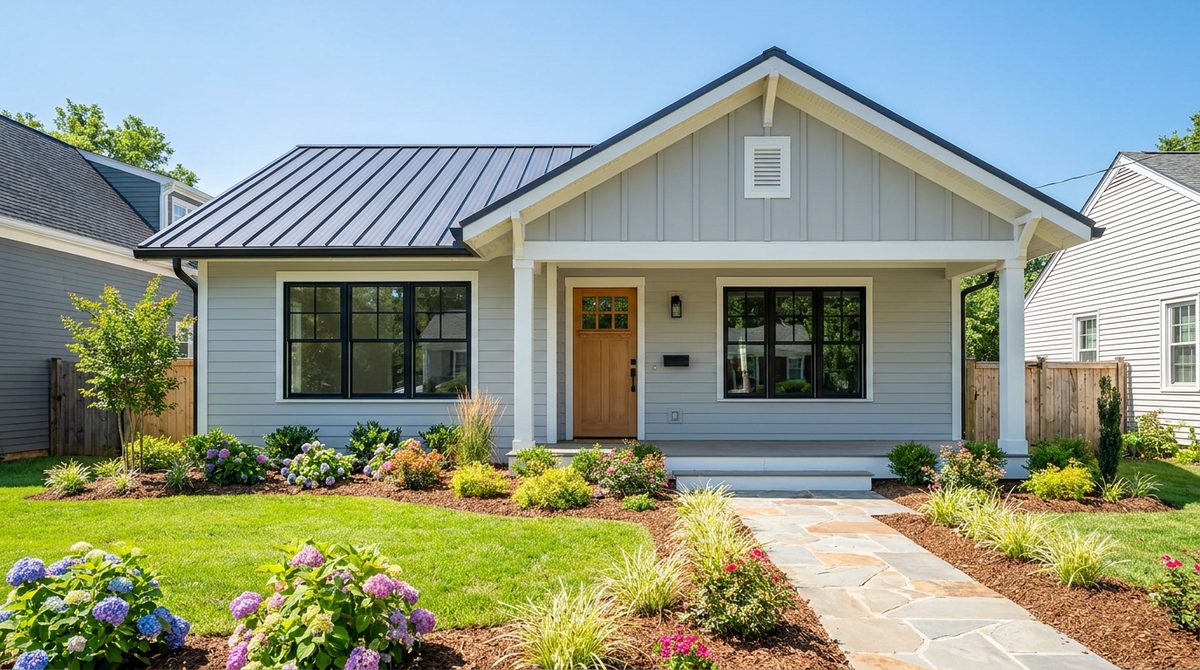
The BRRRR method is a buy-and-hold real estate strategy that stands for Buy, Rehab, Rent, Refinance, Repeat. An investor buys a distressed property below market, renovates it to raise the after-repair value, rents it to a qualified tenant, then completes a cash-out refinance at roughly 70 to 75 percent loan-to-value to recover the invested capital and redeploy it into the next deal. It works best when the all-in cost stays at or below 75 percent of the after-repair value.
What Is the BRRRR Method in Real Estate?
The BRRRR method is a buy-and-hold strategy that stands for Buy, Rehab, Rent, Refinance, Repeat. The core idea is capital efficiency: instead of leaving a 20 to 25 percent down payment trapped in one rental, the investor forces appreciation through renovation, then pulls the invested cash back out in a refinance and reuses it on the next property. The strategy was named and popularized by the real estate education platform BiggerPockets and investor-author Brandon Turner, and it has since become one of the most-searched buy-and-hold frameworks in the United States.
BRRRR sits in the same arithmetic family as the 70 percent rule deal math that fix-and-flip investors use. Both depend on an accurate after-repair value, a disciplined rehab budget, and an acquisition price low enough to leave room for profit or refinance recovery. The difference is the exit. A flipper sells and realizes the spread as taxable income, while a BRRRR investor keeps the asset, harvests monthly cash flow, and lets a tenant pay down the mortgage over time. For a refresher on the valuation input that drives every step, see our framework on how to calculate ARV for investment properties.
How Does the BRRRR Method Work Step by Step?
The BRRRR method works in five sequential phases, each with a clear financial objective. Skip a step or fudge the numbers and the refinance, the entire engine of the strategy, stalls. Here is the standard sequence used by experienced operators in 2026.
- Buy. Acquire a distressed property well below its stabilized market value, usually with cash, hard money, or private money so you can close fast and skip the financing contingency. Direct-to-seller acquisition is common because it avoids retail competition. See our playbook on how to find motivated sellers.
- Rehab. Renovate the property to lift its after-repair value and make it rent-ready. Budget the scope precisely, because every dollar over budget reduces the cash you recover at refinance. Use a line-item estimate, not a guess; our guide to estimating rehab costs walks through the framework.
- Rent. Place a qualified tenant at market rent. Lenders underwrite the refinance partly on the lease, and a signed lease with a paying tenant strengthens both the appraisal narrative and the debt-service-coverage ratio.
- Refinance. Complete a cash-out refinance based on the new appraised after-repair value, typically at 70 to 75 percent loan-to-value. The proceeds pay off the short-term acquisition loan and ideally return your down payment and rehab cash.
- Repeat. Redeploy the recovered capital into the next acquisition and run the loop again. A clean BRRRR lets one pool of cash control a growing portfolio.
The make-or-break phase is the refinance. If your all-in cost exceeds 75 percent of the appraised after-repair value, you will leave some cash stuck in the deal. That is not a failure, it is simply a partial BRRRR, and many strong long-term rentals are partial BRRRRs. Before you buy, underwrite the whole loop end to end using our deal underwriting framework.
A Worked BRRRR Example With Real Numbers
A worked example makes the recycling mechanic concrete. Consider a typical distressed single-family home in a strong rent-to-price market such as Cleveland. The numbers below assume a hard-money acquisition loan, a six-month timeline from purchase to refinance, and a conservative after-repair value confirmed by comparable sales.
| Line Item | Amount | Note |
|---|---|---|
| Purchase price | $72,000 | Distressed, below-market acquisition |
| Rehab budget | $28,000 | Line-item scope, rent-ready finish |
| Holding and closing costs | $8,000 | Hard-money points, interest, title, insurance |
| All-in cost | $108,000 | Total cash and loan deployed |
| After-repair value (ARV) | $150,000 | Confirmed by recent comparable sales |
| Cash-out refinance at 75% LTV | $112,500 | New 30-year DSCR loan on ARV |
| Capital recovered vs all-in | +$4,500 | Full BRRRR; all cash recycled |
In this example the 75 percent refinance proceeds of $112,500 exceed the $108,000 all-in cost, so the investor recovers 100 percent of invested capital plus a small surplus, keeps a cash-flowing rental, and redeploys the same cash into the next property. If the appraisal had come in at $135,000 instead of $150,000, the 75 percent refinance would return only $101,250, leaving roughly $6,750 stuck in the deal. That swing is why the after-repair value estimate is the single most important input in the entire strategy.
What Is the 75% LTV Rule in a BRRRR Refinance?
The 75 percent rule in BRRRR refers to the loan-to-value ceiling lenders apply on a cash-out refinance of a non-owner-occupied rental. As of the first quarter of 2026, Fannie Mae and most debt-service-coverage-ratio lenders cap the cash-out refinance on a single-family investment property at 70 to 75 percent of the appraised value. To recover all of your capital, your all-in cost must land at or below 75 percent of the after-repair value.
This is the same backbone as the 70 percent rule that flippers use, with a five-point adjustment for the fact that a refinancing investor keeps the asset rather than paying a buyer's agent commission and seller closing costs on a resale. The refinance loan that results must still cash flow at current rates, which is where the debt-service-coverage ratio comes in. Lenders want the property's net operating income to cover at least 1.0 to 1.25 times the new mortgage payment. Our DSCR loans guide explains exactly how that ratio is calculated and what minimums to expect in 2026.
How Much Money Do You Need to Start BRRRR?
A BRRRR deal requires the down payment or hard-money points, the rehab budget, and three to six months of holding costs upfront, before the refinance returns any cash. On the $108,000 all-in example above, an investor using hard money at 85 to 90 percent of cost might need $15,000 to $25,000 of their own cash to close, plus 8 to 12 percent annualized interest carried during the rehab and seasoning window. Those carrying costs are real and frequently underestimated by first-time BRRRR investors.
The defining feature of the strategy is that a successful cash-out refinance returns most of that cash, so the same down payment can be reused on the next deal. That is what separates BRRRR from a standard buy-and-hold purchase, where the down payment stays locked in the property indefinitely. The capital source matters too: many investors start with private money or hard money for the acquisition and rehab, then refinance into long-term agency or DSCR debt. The cost difference between those two capital types over a six-month hold can swing the deal from a full BRRRR to a partial one.
What Is the Seasoning Period for a Cash-Out Refinance?
The seasoning period is the minimum time you must own a property before a lender will base your cash-out refinance on the new appraised value rather than your original purchase price. Fannie Mae generally requires a six-month seasoning period for conventional cash-out refinances on investment properties. Many DSCR and portfolio lenders, however, offer three-month or even zero-month seasoning in 2026 at a slightly higher interest rate, which lets disciplined operators recycle capital faster.
Seasoning is the timing constraint that governs how quickly the BRRRR loop can spin. If your lender requires six months and your rehab takes two, you carry three to four months of idle holding cost waiting to refinance. Confirm the seasoning rule with your specific lender in writing before you buy, because a surprise six-month wait can turn a profitable projection into a cash-flow squeeze. The carrying-cost drag during seasoning is also why fast, certain acquisitions matter so much; closing in 7 to 14 days instead of 45 shortens the total capital-out window.
BRRRR vs Fix and Flip: Which Is Better?
BRRRR and fix-and-flip use nearly identical acquisition and renovation math, then diverge at the exit. A flip sells the renovated property for a one-time, taxable profit and frees no long-term wealth. BRRRR keeps the property as a cash-flowing rental, harvests appreciation and loan paydown over time, and defers taxes, but commits the investor to landlording and refinance risk. The table below compares the two side by side.
| Dimension | BRRRR (Buy and Hold) | Fix and Flip |
|---|---|---|
| Exit | Refinance and hold as rental | Sell for one-time profit |
| Typical realized return | Recovered capital plus 6 to 12% cash-on-cash | 15 to 25% net margin per deal |
| Tax treatment | Deferred; depreciation shelters cash flow | Short-term capital gain or ordinary income |
| Capital recycling | Yes, via cash-out refinance | Yes, via sale proceeds |
| Ongoing work | Tenant and property management | None after sale |
| Main risk | Low appraisal or rate spike at refinance | Slow resale or holding-cost overrun |
BRRRR is the better fit for investors building durable monthly cash flow and net worth who can tolerate tenant management. Flipping suits investors who need realized cash quickly and want to avoid landlording. Many operators run both in parallel, flipping the properties that do not cash flow at current rates and BRRRR-ing the ones that do. The decision usually comes down to the local rent-to-price ratio, which our guide on the rent-to-price ratio and the 1% and 2% rules covers in detail.
What Are the Risks of the BRRRR Method?
The biggest BRRRR risk is a low appraisal at refinance, because the entire capital-recovery plan rests on the after-repair value the appraiser assigns. If comparable sales soften between purchase and refinance, or the appraiser is conservative, the 75 percent loan returns less than projected and cash stays trapped in the deal. The second risk is an interest-rate spike: a refinance underwritten at a 6.5 percent assumption that closes at 7.5 percent can fail the debt-service-coverage test entirely.
Three more risks deserve attention. Rehab overruns erode the cash you recover dollar for dollar, so a 20 percent budget miss on a $28,000 rehab quietly removes $5,600 from your refinance proceeds. Extended holding times during a slow rehab or a long seasoning period pile up hard-money interest. And tenant placement delays mean you are carrying the property with no rental income while the clock runs. Each risk is manageable with a conservative after-repair value estimate, a padded rehab budget, and a fast, certain acquisition. Validating cash flow with the cash-on-cash return formula and the cap rate benchmark for the market before you buy is the single best defense.
Is the BRRRR Method Still Worth It in 2026?
BRRRR still works in 2026, but the margin is tighter than during the 2020 to 2021 low-rate window. With the 30-year mortgage rate hovering in the mid 6 to 7 percent range per Freddie Mac Primary Mortgage Market Survey data, and refinance loan-to-value capped near 75 percent, fewer deals return a full 100 percent of invested capital. The Federal Reserve's rate posture, tracked through the FRED 30-year fixed mortgage series, remains the dominant variable in whether a refinanced loan still cash flows.
The strategy now favors markets with a wide gap between distressed acquisition price and stabilized rent. The Cleveland and Cuyahoga County metro is a standout in 2026 precisely because its strong rent-to-price ratio lets a 75 percent refinanced loan still produce positive monthly cash flow at current rates. Our analysis of the best Cleveland neighborhoods for rental cash flow maps the sub-markets where the BRRRR math still pencils. According to Investopedia, the discipline of buying well below the after-repair value is the consistent predictor of BRRRR success across rate environments. In short, BRRRR in 2026 rewards conservative underwriting and a low, certain acquisition price over speculative appreciation.
Frequently Asked Questions
What does BRRRR stand for in real estate?
BRRRR stands for Buy, Rehab, Rent, Refinance, Repeat. It is a buy-and-hold strategy popularized by BiggerPockets in which an investor buys a distressed property below market, renovates it to lift the after-repair value, rents it to a qualified tenant, completes a cash-out refinance on the new appraised value, and recycles the recovered capital into the next deal. The strategy compounds a single down payment across multiple properties when the refinance returns most or all of the invested cash.
What is the 75 percent rule in BRRRR?
The 75 percent rule refers to the loan-to-value ceiling lenders apply on a cash-out refinance of a non-owner-occupied rental. As of early 2026, Fannie Mae and most DSCR lenders cap the cash-out refinance at 70 to 75 percent of appraised after-repair value. To pull all your capital back out, the all-in cost (purchase plus rehab plus holding) must land at or below 75 percent of the after-repair value, the same arithmetic backbone as the 70 percent rule flippers use.
How much money do you need to start the BRRRR method?
A BRRRR deal typically requires the down payment or hard-money points, the rehab budget, and three to six months of holding costs upfront. On a property with a $72,000 purchase and a $28,000 rehab, an investor using hard money at 85 to 90 percent of cost might need $15,000 to $25,000 of their own cash plus 8 to 12 percent annualized interest during the rehab and seasoning window. A successful refinance returns most of that cash for reuse on the next deal.
What is the seasoning period for a BRRRR cash-out refinance?
The seasoning period is the minimum time you must own a property before a lender bases a cash-out refinance on the new appraised value rather than your purchase price. Fannie Mae generally requires six months of seasoning for conventional investment-property cash-out refinances, while many DSCR and portfolio lenders offer three-month or zero-month seasoning at a slightly higher rate in 2026. Confirm the rule with your specific lender before you buy.
Is BRRRR better than fix and flip?
BRRRR and fix-and-flip share acquisition and renovation math but differ at the exit. Flipping sells for a one-time taxable profit of roughly 15 to 25 percent net margin and frees no long-term wealth. BRRRR keeps the property as a cash-flowing rental, harvests appreciation and loan paydown, and defers taxes, but commits you to landlording and refinance risk. BRRRR suits investors building durable cash flow; flipping suits those who need realized cash quickly.
Is the BRRRR method still worth it in 2026?
Yes, but tighter than during the 2020 to 2021 low-rate window. With the 30-year mortgage rate in the mid 6 to 7 percent range per Freddie Mac PMMS and refinance LTVs near 75 percent, fewer deals return 100 percent of invested capital. The method now favors high rent-to-price markets such as Cleveland and Cuyahoga County, where a refinanced loan still cash flows. Conservative after-repair value estimates and a low acquisition price matter more than ever.

Founder of Home Pros, operator across 48 markets, closed 300+ investor transactions since 2021. More about Trevor