Key Takeaways
- Ala. Code 8-42-2 (Act 2023-201) permits a contract buyer to transfer an equitable interest in a single-family house for a fee, "whether by assignment, novation, or other similar method," if three written disclosures are made.
- The seller must be told in writing before any marketing starts, and told the effective date at least three business days ahead. Any potential purchaser must be told the nature of the buyer's interest.
- A violation is a Class C misdemeanor, and the violator may owe three times the fee received (8-42-2(c)).
- Chapter 42 gives no license exemption. Listing, negotiating and procuring prospects for a fee still require a license under 34-27-30, and brokers can't take net listings (34-27-36(b)(19)).
- HB 586 of 2026 would have required a wholesaler license from October 1, 2026. It passed the House and stalled in the Senate.
Not legal advice. This is a plain-language reading of Ala. Code 8-42-1 to 8-42-3 and Title 34, Chapter 27 as published by the Alabama Legislature and read on November 20, 2026. Have an Alabama real estate attorney review your contract, disclosures and listing paperwork before you use them.
Is a novation legal in Alabama?
Yes. Alabama is one of the few states where you don't have to argue about it, because the legislature wrote the word into the code. Ala. Code 8-42-2 says a person "may acquire an equitable interest in a single-family residential property as the buyer under a contract" and "may assign or offer to assign the interest for a fee" if three things are disclosed in writing. Subsection (b) then stretches the rule to any transfer of that interest, "whether by assignment, novation, or other similar method."
Read that twice. Most state codes never mention novation at all. Kentucky's 2023 bill talks about advertising a contract. Pennsylvania's Act 52 says "assign, sell or otherwise transfer." Alabama names the structure outright and attaches a permission slip to it: you may do this, provided you tell people.
The section came from Act 2023-201. The Alabama Association of REALTORS, which backed the bill, reported the changes as effective August 1, 2023. It sits in Title 8, the consumer protection title, and that placement matters. The rule binds anyone who holds a contract on a single-family house, licensed or not. The Home Pros novation hub covers how the structure works; this page is only about what Alabama's statutes say. Home Pros (Balint Holdings, LLC) read every section cited below on the legislature's own site.
What does Ala. Code 8-42-2 require on an Alabama novation?
Three written disclosures. Two go to the seller and one goes to whoever might buy.
| Disclosure | Who receives it | Deadline | Source |
|---|---|---|---|
| The nature of the buyer's equitable interest | Any potential subsequent purchaser or assignee | The statute gives no clock; do it before they sign | 8-42-2(a)(1) |
| The buyer's intent to market its equitable interest | The seller | "Prior to commencing any marketing of the property" | 8-42-2(a)(2) |
| The effective date of any assignment to a subsequent purchaser | The seller | "At least three business days prior to the effective date" | 8-42-2(a)(3) |
The second row is the one a novation should never trip over. A Home Pros novation starts with the seller agreeing to a listing, so the seller already knows the house is going on the market. Put it in writing anyway, in its own paragraph, signed and dated before the sign goes in the yard. A verbal "we're going to list it" isn't what the statute asks for.
The third row needs a calendar. Suppose a retail buyer's offer comes in on a Thursday and everyone wants to paper the novation that afternoon. Don't. The seller has to be told the effective date at least three business days ahead, so a Thursday notice points to the following Tuesday at the earliest. Build that gap into your timeline before you promise anybody a signing date.
Two limits are worth knowing. Subsection (d) says the section applies "only" to single-family residential property, so a duplex or a vacant lot falls outside it. And subsection (e) says the section "shall not infringe on the right of the parties to otherwise agree by contract." A seller can still write "no assignment or novation without my written consent" into the purchase agreement, and that clause holds. My view: on a single-family house, give all three disclosures every time, even when you think the house and not your contract is what's being marketed. It costs one page.
Who has to be licensed on an Alabama novation?
Chapter 42 is a disclosure law. It doesn't hand out a license exemption, and it never touches Title 34. So the second question is still open: who on this deal is doing licensed work?
Ala. Code 34-27-30 makes it unlawful, "for a fee, commission, or other valuable consideration, or with the intention or expectation of receiving" one "from another," to do any of ten listed acts without a license. Item (3) is to "negotiate or attempt to negotiate the listing, sale, exchange, purchase" of Alabama real estate. Item (4) is to "list or offer or attempt or agree to list." Item (8) is to "procure or assist in procuring of prospects."
On a novation the seller still holds title while the house is marketed to a stranger, and the investor gets paid out of that sale. That's uncomfortably close to items (3) and (8) if the unlicensed investor is the one fielding calls and haggling with the retail buyer. The owner exemption in 34-27-2(b)(1) covers "any owner" dealing with "his or her own real estate." A buyer under contract isn't the owner yet. Our Alabama wholesaling law guide walks through that exemption for plain assignments.
| Party | License needed? | Source |
|---|---|---|
| Seller | No. An owner dealing in their own real estate is exempt | 34-27-2(b)(1) |
| Listing agent and company | Yes. Listing and negotiating for a fee are licensed acts | 34-27-30(3), (4) |
| Investor holding the contract | Safest to stay hands-off: the licensee markets, shows and negotiates | 34-27-30(3), (8), (10) |
| Licensed investor | Licensed, with extra written disclosure duties | 34-27-84(a)(6), 34-27-36(b)(17) |
I couldn't find a page on the Alabama Real Estate Commission's site that addresses wholesaling or novations by name, so I'm not going to put words in the Commission's mouth. If a step of your deal sits near that list of ten, ask the Commission or an Alabama attorney first.
Is a novation a net listing under Alabama law?
This is the Alabama question nobody asks until a broker asks it for them. Ala. Code 34-27-36(b)(19) prohibits a broker from accepting a "net listing," defined as one that "stipulates a net price to be received by the owner with the excess due to be received by the broker as his or her commission."
A novation has a net price in it. The seller agrees to a number and the house sells for more. Same thing? No, and the difference is who gets the excess. In a net listing, the broker keeps it as commission. In a properly built novation, the listing company earns a stated commission written into the listing agreement, and the spread belongs to the investor under a separate purchase contract the seller signed first.
It gets thin when the investor and the listing broker are the same person or the same company. Then the "excess" lands in a licensee's pocket, and (b)(19) starts to describe your deal. Two other lines pile on. Subdivision (b)(17) bars "failing to disclose to an owner the licensee's intention to acquire, directly or indirectly, an interest in property which he or she or his or her associates have been employed to sell." And the agency statute, 34-27-84(a)(6), lets a licensee act on their own behalf "only with prior timely written disclosure of this interest to all parties to the transaction."
So keep the roles apart. The listing agreement states the commission as a percentage or a flat fee. The investor's number lives in the purchase agreement and the novation agreement. If you hold an Alabama license and you're also the investor, list the house with a different company or get a written opinion from counsel. Listing your own novation in-house is asking for a complaint.
Does a power of attorney or limited authorization help in Alabama?
Not with licensing. Alabama does exempt "persons acting without compensation and in good faith under a duly executed power of attorney authorizing the consummation of a real estate transaction" (34-27-2(b)(3)). Look at the first three words after "persons." Without compensation. An investor who's paid the spread at closing is compensated, so the exemption doesn't fit. It also speaks to consummating a transaction, which is finishing a sale, not finding a buyer.
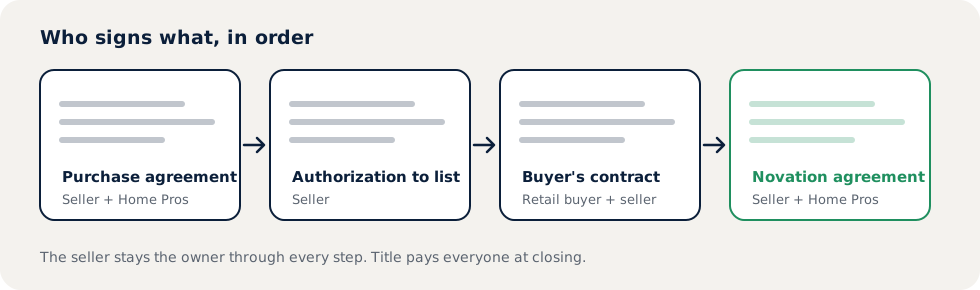
Home Pros asks novation sellers to sign one extra document, a limited authorization that lets partner agents sign listing paperwork for the house. It helps a seller who lives two states away or works a night shift. It isn't a license, and it doesn't change a word of 34-27-30. In Alabama it should name the licensed agent and company, state the list price and terms the seller approved, and leave the deed for the seller. Section 34-27-36(b)(10) also expects a licensee to hand "each party executing the document" a copy "with reasonable promptness," so the seller gets copies of everything signed under it. And (b)(24) requires "a fixed date of expiration" in a written listing agreement. No open-ended listings.
How does the money move on an Alabama novation?
One deed, seller to retail buyer. The gross price pays off the loan, the title charges, the listing company's commission and the seller's agreed net. What's left is the investor side, on its own line of the settlement statement.
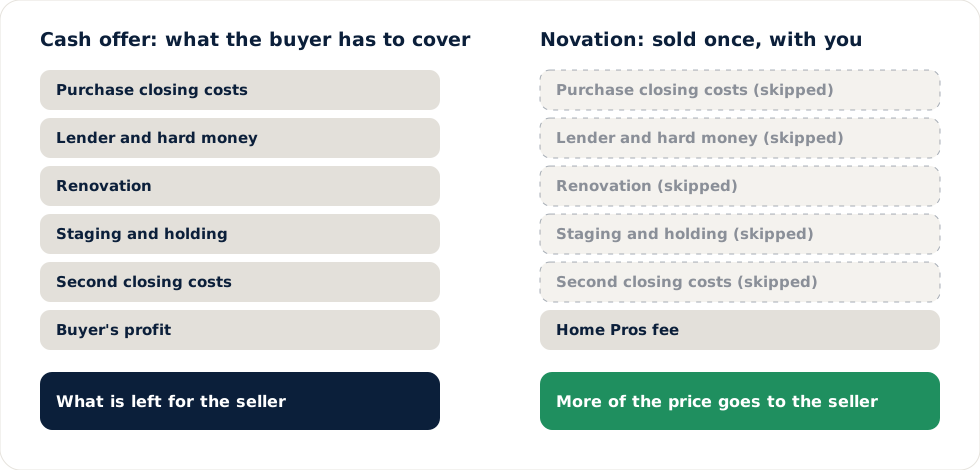
Three Alabama rules shape that statement. First, a licensee can't be "paying any profit, compensation, commission, or fee to, or dividing" one with "anyone other than a licensee or multiple listing service" (34-27-36(b)(11)). Your listing agent can't cut an unlicensed investor in on the commission, so don't ask. The investor's money comes from the contract position. Second, (b)(20) bars a licensee from "misrepresenting or failing to disclose to any lender, guaranteeing agency, or any other interested party, the true terms of a sale." If the retail buyer has a mortgage, the lender sees the investor line. Third, (b)(21) expects the licensee to tell the buyer or seller, when an offer is presented, which closing costs they'll pay and roughly how much.
Then there's the math that should keep you honest. A person who violates 8-42-2 "may be liable to the person to whom disclosure is required in an amount equal to three times the fee or amount received by the buyer." Here's an illustration, not a real deal: an $18,000 spread on a house in Center Point, earned without the written notices, is $54,000 of exposure. For skipping a one-page form.
When a partner brings a novation to Home Pros, the split is 60% of the net profit to the partner and 40% to Home Pros. The seller pays one $500 transaction coordination fee from proceeds at closing, and Home Pros covers the seller's closing costs. Our novation agreement guide shows where each number lands.
What did HB 586 try to change in 2026?
It tried to make wholesalers get a license. HB 586, introduced March 5, 2026 by Representative Wilcox, would have created an "Alabama Property Deception Prevention Act." Its own synopsis admits the gap in current law: a wholesaler can transfer an equitable interest for a fee "without being licensed by the Alabama Real Estate Commission."
The introduced text would have defined real estate wholesaling as "the practice of assigning or marketing the assignment of an equitable interest for profit," required a Commission license to do it, and given the Alabama Securities Commission concurrent power to investigate and discipline wholesalers. Securities regulators. On house contracts. The bill carried an October 1, 2026 effective date.
It didn't pass. LegiScan's history shows the House passed an amended substitute on March 19, a Senate committee reported it out on April 1, and it was carried over on the Senate floor on April 8. The session adjourned April 9, 2026. I read the introduced version only, so the substitute's wording may differ.
What that means for you: as of November 20, 2026, the 2023 disclosure law and the general license law are the whole picture. But a licensing bill that clears one chamber usually comes back. If you're building an Alabama novation business, build it as if a license requirement is coming, with a licensee already doing the marketing.
What should you never do on an Alabama novation?
Most of the trouble comes from running a novation like a quiet assignment.
- Don't market before the seller's written notice is signed. "Prior to commencing any marketing" means before the MLS entry, the photos and the sign.
- Don't keep the retail buyer in the dark about your contract. Section 8-42-2(a)(1) requires written disclosure of the nature of your interest to any potential purchaser.
- Don't paper the novation the same day you tell the seller. Three business days, minimum.
- Don't negotiate with retail buyers yourself if you're unlicensed. That's item (3) of 34-27-30.
- Don't hide the novation, the partner or the fee from the seller. Our scripts disclose all three, every time.
The penalties stack. A violation of 8-42-2 is a Class C misdemeanor, plus the treble damages above. A violation of the license chapter is a Class A misdemeanor under 34-27-11. And under 34-27-36(d), the Commission can issue a cease and desist order to an unlicensed person that becomes final 15 days after service unless a hearing is requested. After a hearing it can fine each violation in the licensee range of $100 to $5,000, add "any gain or economic benefit that was derived from the violation," and add its own costs.
Licensees have one more line to respect. Subdivision (b)(13) prohibits "inducing any party to a contract to breach the contract for the purpose of substituting a new contract where the substitution is motivated by the personal gain of the licensee." A real novation is agreed to by all three parties. It isn't a breach. But an agent who talks a seller into walking away from another buyer's contract so the house can be "novated" is describing (b)(13) out loud.
How does Home Pros handle an Alabama novation?
Alabama is one of our service states, and the process follows the same five steps here as anywhere. The seller and Home Pros agree on a net price. The seller pays no repairs and no commissions, and Home Pros covers closing costs. An Alabama licensee markets the house under a listing the seller signs. A retail buyer purchases. The seller is paid the agreed net at closing.
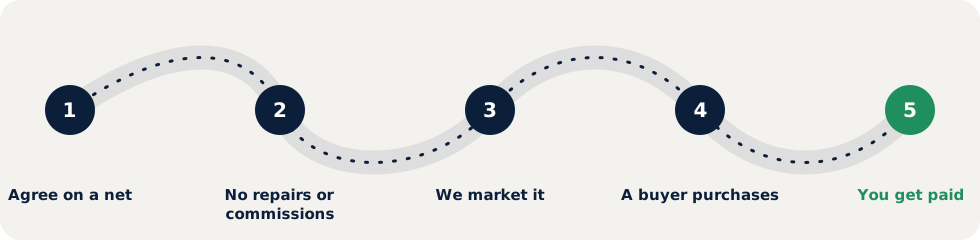
The Alabama additions are small and they're all paper: the written intent-to-market notice before step three, the written interest disclosure to the retail buyer during step four, and the three-business-day notice before the novation takes effect. Alabama records deeds with the county judge of probate, so that's where the one deed on a novation ends up, whether the house is in Jefferson County or Madison County.
We work with 300+ investor-friendly agents and have closed hundreds of deals. Partners can start at the partner section of our novation page or submit a deal directly. If the house is too rough to list, we'll look at a cash exit through our buyer network or the deal marketplace. Sellers can read the Alabama selling guide, the Birmingham page or the Huntsville page, and see how to verify Home Pros or any buyer. Comparing states? Read the Kentucky and Pennsylvania versions of this page. Need the seller conversation? Our novation pitch scripts disclose the structure in plain words. For the novation program, call Trevor Rice at (210) 672-1674.
Send the Alabama deal and we'll tell you which exit fits
Trevor Rice reviews submitted deals for a cash bid and for a novation listing. You'll get both numbers and the Alabama disclosure checklist in writing.
Get a cash offer List with Home Pros
Wholesaler with a deal under contract? See the Home Pros novation program or submit the deal.
Frequently Asked Questions
Is a novation legal in Alabama?
Yes. Ala. Code 8-42-2 names novation and allows a contract buyer on a single-family house to transfer the interest for a fee when three written disclosures are made: one to any potential purchaser and two to the seller. The real estate license law still controls who may list and negotiate.
Does Alabama's wholesaling law apply to novations?
Yes. Section 8-42-2(b) says the written disclosure is required whether the interest is transferred by assignment, novation, or other similar method. It applies only to single-family residential property.
Do I need an Alabama real estate license to do a novation?
The disclosure law doesn't require one, but Ala. Code 34-27-30 makes listing, negotiating a sale and procuring prospects for a fee licensed acts. The safest setup has an Alabama licensee do all marketing and negotiating while the investor stays a contract party.
What are the penalties for skipping the Alabama disclosures?
A violation of 8-42-2 is a Class C misdemeanor, and the violator may owe the person who should have received the disclosure three times the fee or amount received. Unlicensed brokerage is a separate Class A misdemeanor with Commission fines of $100 to $5,000 per violation plus the gain.
Is a novation a net listing in Alabama?
Not when it's built correctly. Section 34-27-36(b)(19) bars a broker from taking a listing where the excess over the owner's net is the broker's commission. In a novation the listing company earns a stated commission and the spread goes to the investor under a separate purchase contract.
Did Alabama pass a wholesaler license law in 2026?
No. HB 586 would have required wholesalers to be licensed by the Alabama Real Estate Commission starting October 1, 2026. The House passed it on March 19, 2026, and it was carried over in the Senate on April 8, the day before the session adjourned.
Sources
Sources were read on November 20, 2026.
- Ala. Code 8-42-1, legislative findings, and 8-42-2, assignment of equitable interest and disclosure requirements (Act 2023-201)
- Ala. Code 34-27-2, definitions and exemptions, and 34-27-30, license required
- Ala. Code 34-27-36, disciplinary action, 34-27-11, penalties, and 34-27-84, obligations of licensees
- HB 586 (2026 Regular Session), introduced text, Alabama Legislature, and its bill history on LegiScan
- Alabama Association of REALTORS, June 23, 2023, summary of the new law and its August 1, 2023 effective date

Trevor Rice is co-founder and CEO of Home Pros (Balint Holdings, LLC) and a licensed Texas real estate agent. He runs the Home Pros novation program. Reach him at (210) 672-1674 or trevor@selltohomepros.com. This article is general information, not legal or tax advice.