Key Takeaways
- Act 52 of 2024 (SB 1173), signed July 8, 2024 and effective 180 days later, added "wholesale transaction" to the Real Estate Licensing and Registration Act and made it broker activity "whether for the person or for another."
- The definition covers promoting an equitable interest with intent to "assign, sell or otherwise transfer" it for money without taking title. A novation investor fits most of those words.
- The owner exclusion in Section 304(1) now says it "shall not apply to a wholesale transaction," so holding the contract doesn't make you exempt.
- Section 610 gives the seller a non-waivable right to cancel for 30 days, or until conveyance, and up to closing if the four required statements are missing.
- The State Real Estate Commission's July 2026 regulatory agenda lists a proposed wholesaling rule for 49 Pa. Code Chapter 35 for fall 2026. When we checked Chapter 35 on November 18, 2026, it had no wholesale section yet.
Not legal advice. This is a plain-language reading of Pennsylvania's Real Estate Licensing and Registration Act (Act 9 of 1980, as amended by Act 52 of 2024), published by the Pennsylvania General Assembly and read on November 18, 2026. Have a Pennsylvania real estate attorney review your contract, disclosures and listing paperwork before you use them.
Is a novation legal in Pennsylvania?
Yes, when the right people hold the right licenses. Nothing in the act bans a seller from listing a house while an investor's contract sits on it. The word "novation" doesn't appear anywhere in the statute. What changed is who's allowed to be the investor.
Before 2025, Pennsylvania looked a lot like Kansas does today: an old broker definition and an argument about whether selling your own contract counted. Act 52 of 2024 ended that argument. Governor Josh Shapiro approved it on July 8, 2024, and Section 4 set the effective date at 180 days, so it's been live since early January 2025.
Our Pennsylvania wholesaling law guide walks through plain assignments, licensing hours and transfer tax. This page asks the narrower question partners keep sending us: if you never assign the contract and the house sells on the MLS instead, are you still inside the law? Mostly, yes. And that's the whole problem for an unlicensed investor.
Does a novation count as a wholesale transaction under Act 52?
Read the definition slowly, because every phrase matters. A "wholesale transaction" is "undertaking to promote the sale, exchange or purchase of an equitable interest or other interest in residential property with the intent to assign, sell or otherwise transfer the interest for a fee, commission or other valuable monetary consideration without having taken title as the owner of record of the interest."
Now walk a novation through it. You sign a purchase agreement, which gives you an equitable interest. The house is a single-family home, and "residential property" means 1 to 4 dwelling units in Pennsylvania. You never take title. At closing your contract is replaced by the seller's contract with the retail buyer, and you're paid the spread. Is that "otherwise transfer the interest" for money? We think a cautious reader has to assume so. The phrase is there precisely so the definition isn't limited to a formal assignment.
| Piece of the definition | Typical novation | Fits? |
|---|---|---|
| Equitable interest or other interest | Investor holds a signed purchase agreement | Yes |
| Residential property (1 to 4 units) | Single-family house or duplex | Yes |
| Undertaking to promote the sale | Investor arranges the MLS listing and buyer traffic | Likely |
| Intent to assign, sell or otherwise transfer | Contract replaced by seller's retail contract | Arguable, assume yes |
| For valuable monetary consideration | Investor earns the spread at closing | Yes |
| Without taking title as owner of record | Investor never goes on the deed | Yes |
The State Real Estate Commission's own summary, in the Governor's regulatory agenda published July 25, 2026, describes a wholesale deal as one where the buyer "assigns its rights under the contract to a third-party purchaser." That's an assignment. Some investors will read it as a hint that novations sit outside. We wouldn't. An agency summary isn't the statute, and the statute says "otherwise transfer." Even if a novation escaped the wholesale definition, the older broker definition still covers anyone who, for another and for a fee, "undertakes to promote the sale" of real estate.
Who has to be licensed on a Pennsylvania novation?
Act 52 rewrote the broker definition in Section 201 to add a second paragraph: "Any person who, whether for the person or for another, engages or attempts to engage in a wholesale transaction." The words "for the person" kill the old defense that you're only selling your own contract. Then Section 304(1), the owner exclusion, picked up one sentence: "This exclusion shall not apply to a wholesale transaction."
| Party | License needed? | Source |
|---|---|---|
| Seller | No. An owner selling their own house is excluded | RELRA 304(1) |
| Listing broker | Yes. Listing and negotiating for the seller is broker work | RELRA 201, 301 |
| Investor holding the contract | Plan on yes. Wholesale transactions are broker activity "for the person," and the owner exclusion doesn't apply | RELRA 201, 304(1) |
| Licensed salesperson as investor | Licensed, but paid only through the employing broker | RELRA 604(a)(12) |
That last row trips people up. The amended "salesperson" definition says a salesperson may "engage or attempt to engage in a wholesale transaction for or in behalf of such real estate broker." Section 604(a)(12) then bars a salesperson from accepting a commission or "any valuable consideration" from anyone except their broker. So a licensed salesperson running a novation has the spread paid to the brokerage, not to an LLC on the side. Ask your broker before you sign anything.
A licensee who is also the buyer has one more duty. Section 604(a)(13) bars failing to disclose in writing a licensee's "intention or true position" when they acquire or intend to acquire an interest in property listed with their office. On a novation, the license, the interest and the plan all go in writing, early.
Does the 30-day cancellation right apply to a novation?
If the deal is a wholesale transaction, yes, and it's the part of Act 52 that changes how you schedule a listing. New Section 610(a) gives the consumer the right to cancel "until midnight of the 30th day after the date when the consumer executed the agreement or contract, or until conveyance, whichever occurs first." The right "shall not be waivable." No addendum fixes that.
It gets stricter when the contract is missing the disclosures. A wholesale contract without the four statements in Section 610(e) "may be canceled at any time prior to conveyance." Picture a seller backing out on day 50, with the house under a retail contract and photos on the MLS. That's what a sloppy form buys you.
| Section 610(e) statement | What it tells the seller |
|---|---|
| (1) Wholesale notice | The licensee intends to assign, sell or otherwise transfer the interest for money without taking title |
| (2) Outside advice | The seller may get an appraisal from a certified appraiser, consult a licensee not tied to your broker, or see a lawyer, before or after signing |
| (3) Cancellation right | Cancel until midnight of day 30 or conveyance, by certified mail or another delivery method with a receipt |
| (4) Refund | All payments refunded within ten business days after notice |
Section 610(c) also says that after a cancellation, the broker or salesperson sends back every payment within ten business days along with an acknowledgment that the contract is void. Section 610(e) says the statements must appear "prominently" and in the manner the Commission sets by regulation. That regulation isn't final yet. The July 2026 agenda lists it as rulemaking #16A-5629, targeted for fall 2026 as a proposed rule, and Chapter 35 of the Commission's rules had no wholesale section when we checked on November 18. Put the four statements in bold near the top of the contract now, and check the Bulletin before each new form batch.
Practical upshot for scheduling: don't go live on the MLS in week one and then act surprised when the seller reconsiders. A 30-day window that you planned for is a feature. One you didn't plan for wrecks a buyer's financing timeline.
Does a limited authorization change anything in Pennsylvania?
No, not for licensing. Home Pros asks novation sellers to sign one extra document, a limited authorization that lets partner agents sign listing paperwork for the house. It saves time on a deal where the seller may live two states away. It doesn't turn an unlicensed investor into a licensee, and nothing in RELRA says a power of attorney or authorization lifts the broker definition for someone getting paid.
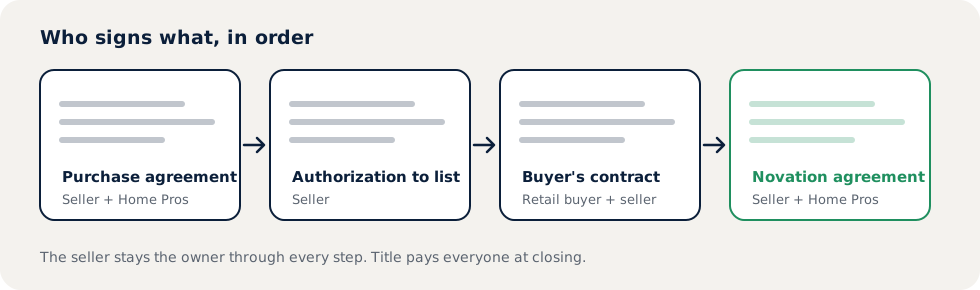
Two prohibited acts in Section 604(a) shape how it should read. Item (8) bars placing a sign on or advertising any property "without the written consent of the owner, or his authorized agent." Item (9) requires furnishing a copy of any listing, sale or other contract "to all signatories thereof at the time of execution." So the authorization names the licensed agent, states the price and terms the seller approved, and the seller gets a copy the day they sign. Keep it narrow. Have a Pennsylvania attorney draft it.
Watch item (11) too. It bars a licensee from inducing a party "to break such contract for the purpose of substitution in lieu thereof of a new contract, where such substitution is motivated by the personal gain of the licensee." A novation replaces one contract with another by design. Done openly, with the seller agreeing to the structure in writing from the start, that's a plan the seller chose. Pitched as a surprise switch after signing, it reads like the conduct item (11) describes.
How does the money move on a Pennsylvania novation?
One deed, seller to retail buyer. The seller agreed to a net price. The retail buyer pays more. Out of that come the loan payoff, transfer tax, title charges and the listing broker's fee, then the seller's net, and the remainder is the investor side of the deal, shown on its own line on the settlement statement. Nothing hidden, nothing renamed.
Transfer tax is worth a line in the seller's math. The Pennsylvania Department of Revenue charges 1 percent state realty transfer tax on the value transferred by deed, and county recorders usually collect a local transfer tax on top. Grantor and grantee are jointly and severally liable. Who pays which share is a contract term, so write it in plainly.
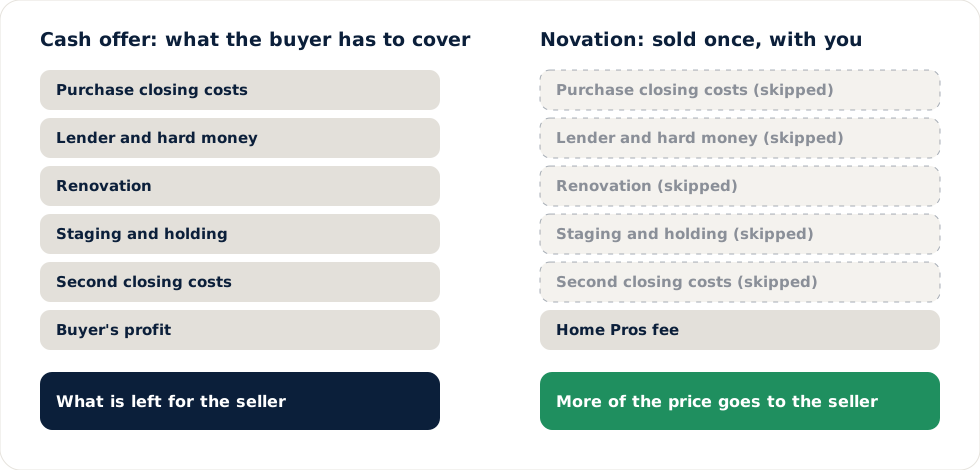
On licensing, follow the money backward. Section 604(a)(12.1) bars a broker from paying a commission or "any valuable consideration" to anyone other than its licensed employees or another broker for licensed acts. So no Pennsylvania listing broker should be cutting a check to an unlicensed investor, and you shouldn't ask. When a partner brings a novation to Home Pros, the split is 60% of the net profit to the partner and 40% to Home Pros, and the seller pays one $500 transaction coordination fee from proceeds at closing while Home Pros covers the seller's closing costs. In Pennsylvania, a partner should confirm with counsel that their own role and payment fit the license act before the deal is signed. Our novation agreement guide shows where each number sits.
What should you never do on a Pennsylvania novation?
Pennsylvania punishes the same shortcuts other states do, but its definition is wider, so there's less room to argue afterward.
- Don't run a Pennsylvania novation unlicensed and call it "not an assignment." The definition says "otherwise transfer," and the owner exclusion is closed to wholesale deals.
- Don't leave the four Section 610(e) statements out. Without them the seller can cancel any time before the deed records.
- Don't ask the seller to waive the 30-day right. The statute says it can't be waived.
- Don't hide the novation, the partner or the fee from the seller. Our scripts disclose all three, and Section 604(a)(1) makes any substantial misrepresentation grounds for discipline.
- Don't advertise the house without the owner's written consent. Section 604(a)(8).
Here's the exposure. Under RELRA Section 303, acting as a broker without a license is a summary offense the first time, with a fine up to $500, up to three months in jail, or both. A second offense is a third degree felony: a $2,000 to $5,000 fine, one to two years, or both. Section 305 lets the Commission add a civil penalty up to $1,000 against anyone practicing without a license, after a hearing. And Section 302 bars an unlicensed person from suing to collect pay for licensed work. If the seller won't sign at the closing table, you can't take your fee to court.
How does Home Pros run a novation in Pennsylvania?
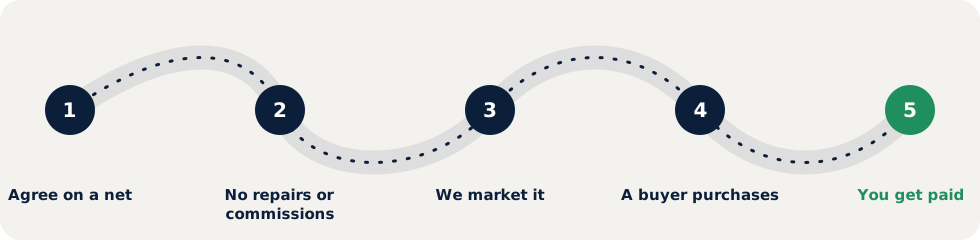
Pennsylvania is a Home Pros service state, and the five steps don't change. We agree on a net price with the seller. The seller pays no repairs and no commissions, and Home Pros covers closing costs. A Pennsylvania licensee markets the house under a written listing the seller signs, with the Section 610 statements in the contract when the deal is a wholesale transaction. A retail buyer purchases. The seller is paid the agreed net at closing.
We work with 300+ investor-friendly agents and have closed hundreds of deals. Partners can start at the partner section of our novation page or submit a deal directly. If the house is too rough to list, we'll price a cash exit through our buyer network or the deal marketplace. Sellers can read our Pennsylvania selling guide, run a number with the cash offer calculator, and see how to verify Home Pros or any buyer. Deal questions go to Trevor Rice at (210) 672-1674. Working Kansas too? Its rules are looser, and our Kansas novation guide shows the contrast. Oregon's are in our Oregon guide.
Send the Pennsylvania deal and we'll price both exits
Trevor Rice reviews submitted deals for a cash bid and for a novation listing. You'll get both numbers and the Pennsylvania paperwork list in writing.
Get a cash offer List with Home Pros
Wholesaler with a deal under contract? See the Home Pros novation program or submit the deal.
Frequently Asked Questions
Is a novation legal in Pennsylvania?
Yes, when licensees do the work. No Pennsylvania statute bans a novation, but Act 52 of 2024 made any wholesale transaction broker activity, and its definition covers transferring an equitable interest for money without taking title. An unlicensed investor should assume a novation falls inside it.
Do I need a Pennsylvania real estate license to do a novation?
Plan on it. Since January 2025, RELRA Section 201 makes anyone who engages in a wholesale transaction a broker, whether for themselves or for another, and Section 304(1) says the owner exclusion doesn't apply to wholesale deals. A licensed salesperson has to be paid through the employing broker.
Can a Pennsylvania seller cancel a novation contract?
If it's a wholesale transaction, yes. Section 610 gives the seller a non-waivable right to cancel until midnight of the 30th day after signing or until conveyance, whichever comes first. If the contract lacks the four required statements, the seller can cancel any time before conveyance.
Does a power of attorney or limited authorization let me list the house myself?
No. Nothing in RELRA lets an authorization lift the broker definition for someone who's getting paid. Home Pros uses a limited authorization only so a licensed partner agent can sign listing documents; the seller still signs the retail sale.
Has the Pennsylvania Real Estate Commission issued wholesaling rules?
Not yet. The Governor's regulatory agenda published July 25, 2026 lists wholesaling rulemaking #16A-5629 for 49 Pa. Code Chapter 35, targeted for fall 2026 as a proposed rule. Chapter 35 had no wholesale section when we checked on November 18, 2026.
What happens if I do a Pennsylvania novation without a license?
Under RELRA Section 303, a first offense is a summary offense with a fine up to $500, up to three months in jail, or both. A repeat is a third degree felony. The Commission can add a civil penalty up to $1,000, and Section 302 bars suing to collect your fee.
Sources
Sources were read on November 18, 2026.
- Act 52 of 2024 (SB 1173), Pennsylvania General Assembly: wholesale transaction and residential property definitions, amended broker and salesperson definitions, Section 304(1), new Section 610
- Real Estate Licensing and Registration Act, Act 9 of 1980: Sections 301, 302, 303, 305 and 604(a)
- Pennsylvania Bulletin, 56 Pa.B. 4485, Regulatory Agenda (July 25, 2026): State Real Estate Commission wholesaling rulemaking #16A-5629
- 49 Pa. Code Chapter 35, State Real Estate Commission rules
- Pennsylvania Department of Revenue, Realty Transfer Tax

Trevor Rice is co-founder and COO of Home Pros (Balint Holdings, LLC) and a licensed Texas real estate agent. He runs the Home Pros novation program. Reach him at (210) 672-1674 or trevor@selltohomepros.com. This article is general information, not legal or tax advice.