
Key Takeaways
- HB 62 (2023 Ky. Acts ch. 84), signed March 23, 2023 and effective June 29, 2023, added one line to the definition of real estate brokerage in KRS 324.010: it "includes advertising for sale an equitable interest in a contract for the purchase of real property."
- The same act made that advertising unlawful for anyone who isn't a licensed broker or sales associate (KRS 324.020(1)(b)).
- A clean novation lists the house through a licensee and never markets the investor's contract, so the HB 62 line isn't the main risk. The older "for others for a fee" broker definition is.
- Kentucky brokers can't split fees with or compensate unlicensed people (KRS 324.020(4)), and a licensed investor must disclose their license status in writing on the offer (KRS 324.160(4)(e)).
- Unlicensed brokerage is a Class A misdemeanor the first time and a Class D felony after that, and each transaction counts as its own offense (KRS 324.990).
Not legal advice. This is a plain-language reading of KRS Chapter 324 as published by the Kentucky Legislative Research Commission and read on November 19, 2026. Have a Kentucky real estate attorney review your contract, disclosures and listing paperwork before you use them.
Is a novation legal in Kentucky?
Yes, as long as the house is marketed by someone holding a Kentucky license. Chapter 324 never mentions novations. It doesn't ban a seller from listing a home while an investor's purchase contract is in place, and it doesn't ban an investor from being paid the difference at closing. What it controls is who may do brokerage, and that's where the planning goes.
Kentucky moved earlier than a lot of states. Pennsylvania waited until 2025 to write a full wholesale definition. Kansas still hasn't touched its act. Kentucky's legislature passed HB 62 in the 2023 session, the Governor signed it March 23, and it took effect June 29, 2023, the date shown on the current text of KRS 324.010.
It's a short bill. Two sentences, really. That's good news for novations, because the new language aims at one specific move: putting your contract up for sale. A novation doesn't do that. Still, short doesn't mean harmless, and the rest of the chapter didn't go anywhere. The Home Pros novation hub covers the structure itself; this page is only about Kentucky's license law.
What did HB 62 change for Kentucky wholesalers?
It added paragraph (b) to the brokerage definition. Real estate brokerage now "includes advertising for sale an equitable interest in a contract for the purchase of real property between a property owner and a prospective purchaser." Then it added the matching ban to KRS 324.020(1): it's unlawful for an unlicensed person to "advertise for sale an equitable interest in a contract."
Notice what's missing. There's no "assign," no "transfer," no "intent to profit." The trigger is advertising the contract. Post "Off-market 3/2 in Shively, assignment fee $18,000" to a buyers list and you've done what the statute names. Close on a plain assignment to a buyer you already knew, with no marketing, and the HB 62 line arguably doesn't reach you. Kentucky's rule is narrower than Pennsylvania's on that point.
| Move | What gets marketed | HB 62 line triggered? |
|---|---|---|
| Blast your contract to a cash buyers list | Your equitable interest | Yes, unless licensed |
| Post "assignment available" on social media | Your equitable interest | Yes, unless licensed |
| Quiet assignment to one buyer you already know | Nothing advertised | Arguably no, but see 324.010(1)(a) |
| Novation listed on the MLS by a Kentucky licensee | The house, with the owner's consent | No, the licensee does the advertising |
| Novation where the unlicensed investor runs the ads | The house, for the investor's spread | Risky under 324.010(1)(a) and 324.020(2) |
So HB 62 pushes Kentucky novations in a healthy direction. Let the licensee market the property. Don't market your paper.
Who has to be licensed on a Kentucky novation?
Start with the older paragraph (a), which HB 62 left alone. Brokerage means "selling or offering for sale," "negotiating the purchase, sale, or exchange of real estate," or "referring or offering to refer for the purpose of securing prospects," for "others for a fee, compensation, or other valuable consideration." It also covers "a single" act. One deal is enough.
Here's the uncomfortable bit. On a novation the seller still owns the house, and the investor arranges its sale to a stranger and gets paid from the proceeds. That looks a lot like selling real estate for another for a fee. Your purchase contract is your argument that you're a buyer, not an agent. It's a real argument. It isn't one you want to make to the Commission.
| Party | License needed? | Source |
|---|---|---|
| Seller | No. An owner acting on their own property is excepted | KRS 324.030(1) |
| Listing agent | Yes. Listing and negotiating for the seller is brokerage | KRS 324.010(1)(a), 324.020(2) |
| Investor holding the contract | Safest answer is yes, or stay hands-off and let the licensee market and negotiate | KRS 324.010(1), 324.020(1)(b) |
| Licensed sales associate as investor | Licensed, but paid only through the principal broker | KRS 324.160(4)(f) |
If you're a licensed sales associate, that last row matters more than anything else on this page. KRS 324.160(4)(f) bars accepting "valuable consideration" for licensed acts from anyone except your principal broker under your compensation agreement. Your novation spread should run through the brokerage. Talk to your principal broker before you sign the seller.
Does a power of attorney or limited authorization help in Kentucky?
Not for licensing. KRS 324.030 does list an exception for "any person acting as attorney in fact under a duly executed power of attorney from the owner authorizing the final consummation by performance of any contract for the sale" of real estate. Read the words. It covers finishing a sale that already exists, like signing the deed at closing. It says nothing about marketing the house, finding the buyer or negotiating the price, which is the part of a novation that looks like brokerage.
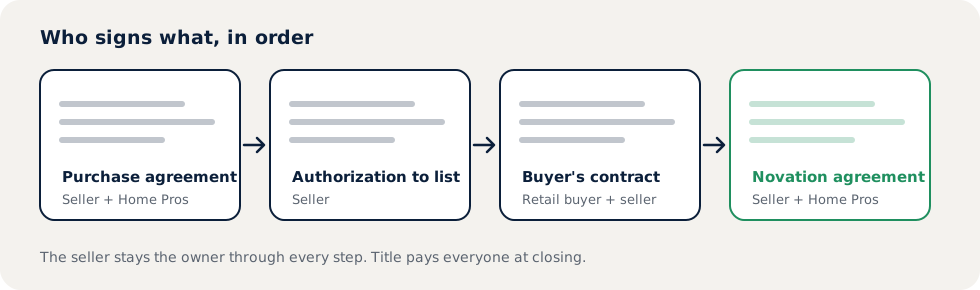
Home Pros asks novation sellers to sign one extra document, a limited authorization that lets partner agents sign listing paperwork for the house. It's a convenience for a seller who lives out of town or works nights. It isn't a license substitute, and we don't describe it as one. In Kentucky it should name the licensed agent, spell out the list price and terms the seller approved, and leave the retail contract and the deed for the seller to sign. A Kentucky attorney should draft it. Don't lean on the 324.030(2) exception to cover anything more.
What disclosures does a Kentucky novation need?
Two sets, and both are easy to miss when the deal started as a cash offer.
The first is the property form. KRS 324.360 applies to single-family sales "if any person licensed under this chapter receives compensation." A novation pays a listing agent, so it applies. The seller completes and signs the seller's disclosure of conditions form when they sign the listing agreement, covering things like whether the basement and roof leak, water and sewer source, and system condition. The listing agent delivers it to a buyer within 72 hours of receiving a signed written offer. On a straight cash purchase the seller may never have seen that form. Budget a conversation for it.
The second is about you. KRS 324.160(4)(e) says a licensee who buys property listed with their own broker, or who becomes a party to a purchase contract, must disclose "his or her status as a licensee" in writing on the offer or contract, and must disclose any interest in the property in writing before selling it. Paragraph (m) separately punishes acting "in the dual capacity of licensee and undisclosed principal." Licensed investors: put it in the contract, in plain words, on page one.
| Disclosure | Who gives it | When | Source |
|---|---|---|---|
| Seller's disclosure of conditions form | Seller signs, listing agent delivers | At listing; to buyer within 72 hours of a signed offer | KRS 324.360(4) |
| Licensee status of the investor | Licensed investor | In writing on the offer or sales contract | KRS 324.160(4)(e)1, 2 |
| Investor's interest in the property | Licensed investor | In writing before selling or being paid | KRS 324.160(4)(e)3 |
| The novation, the partner and the fee | Everyone on the Home Pros side | Before the seller signs anything | Our scripts; KRS 324.160(4)(b) bars substantial misrepresentation |
How does the money move on a Kentucky novation?
One deed, from the seller to the retail buyer. The seller agreed to a net number up front. The buyer pays more. From the gross come the loan payoff, title charges, the listing broker's fee and the seller's agreed net, and the remainder is the investor side, shown on its own line on the settlement statement. Nothing renamed as a "marketing fee." Nothing tucked into a seller credit.
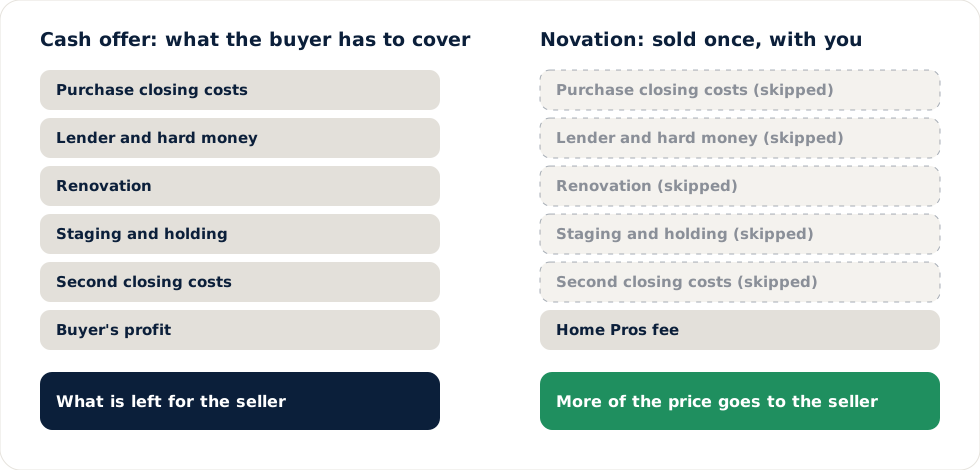
Now follow the money backward through the license law. KRS 324.020(4) says "no broker shall split fees with or compensate any person who is not licensed," with narrow exceptions for out-of-state brokers and auctioneers. KRS 324.160(4)(i) adds a sanction for "paying valuable consideration to any person for services performed in violation of this chapter." So a Kentucky listing broker shouldn't be cutting a referral check to an unlicensed investor, and you shouldn't ask for one. Your money comes from your contract position on the settlement statement, or it comes through a brokerage.
When a partner brings a novation to Home Pros, the split is 60% of the net profit to the partner and 40% to Home Pros. The seller pays one $500 transaction coordination fee from proceeds at closing, and Home Pros covers the seller's closing costs. In Kentucky, a partner should have counsel confirm that their own role and pay fit Chapter 324 before the seller signs. Our novation agreement guide shows where each number lands.
What should you never do on a Kentucky novation?
Most Kentucky trouble starts with a wholesaler treating a novation like an assignment with extra steps.
- Don't market your contract. Posting the deal to a buyers list or social media is the exact act KRS 324.020(1)(b) names. Let the licensee market the house.
- Don't run the showings and price talks yourself if you're unlicensed. Negotiating the sale for the owner is paragraph (a) brokerage.
- Don't ask the listing broker to pay you. KRS 324.020(4) bars it.
- Don't skip the disclosure form because "it's a cash deal." Once a licensee is paid, KRS 324.360 applies.
- Don't hide the novation, the partner or the fee from the seller. Our scripts disclose all three, every time.
The penalties are real. Under KRS 324.990, brokerage without a license is a Class A misdemeanor for a first offense and a Class D felony after that. A Circuit Court can add a fine of $100 to $1,000, up to six months in jail, or both, and then add "the amount of any real estate brokerage commission paid or received" to the fine. "Each transaction shall be regarded as a separate offense." The Commission can also go to Circuit Court for an injunction under KRS 324.020(6). Licensees face their own list in KRS 324.160(1): fines up to $1,000, suspension, revocation or probation.
We haven't found a Kentucky Real Estate Commission regulation written specifically for wholesaling or novations. If you're unsure how a step of your deal reads under Chapter 324, ask the Commission or a Kentucky real estate attorney before you sign the seller.
How does Home Pros handle a Kentucky novation?
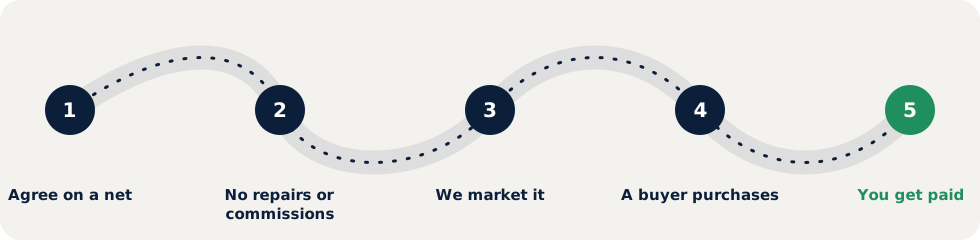
Kentucky isn't on our core service-state list yet, so send the deal first and Trevor will tell you straight whether we can take it. We do buy in Louisville, and our Louisville selling guide covers Jefferson County for sellers. When we take a Kentucky novation, it follows the same five steps as everywhere else. The seller and Home Pros agree on a net price. The seller pays no repairs and no commissions, and Home Pros covers closing costs. A Kentucky licensee markets the house under a listing the seller signs, with the disclosure form attached. A retail buyer purchases. The seller is paid the agreed net at closing.
We work with 300+ investor-friendly agents and have closed hundreds of deals. Partners can start at the partner section of our novation page or submit a deal directly. If the house is too rough to list, we'll look at a cash exit through our buyer network or the deal marketplace. Sellers can run a number with the cash offer calculator and see how to verify Home Pros or any buyer. Need the seller conversation? Our novation pitch scripts disclose everything up front. Deal questions go to Trevor Rice at (210) 672-1674. Working other states too? Pennsylvania's Act 52 goes much further than HB 62, and Kansas hasn't passed a wholesaling law at all.
Send the Kentucky deal and we'll tell you which exit fits
Trevor Rice reviews submitted deals for a cash bid and for a novation listing. If we can take it, you'll get both numbers and the Kentucky paperwork list in writing.
Get a cash offer List with Home Pros
Wholesaler with a deal under contract? See the Home Pros novation program or submit the deal.
Frequently Asked Questions
Is a novation legal in Kentucky?
Yes, when a Kentucky licensee lists and markets the house. No Kentucky statute bans a novation. HB 62 of 2023 made advertising an equitable interest in a purchase contract licensed activity, so the investor shouldn't market the contract, and the older broker definition still covers selling real estate for others for a fee.
Do I need a Kentucky real estate license to do a novation?
Not if you stay a hands-off contract buyer and a licensee does the marketing and negotiating, though that's a judgment call to make with an attorney. A licensed sales associate doing a novation must be paid through the principal broker and disclose license status in writing on the contract.
What did Kentucky HB 62 change?
Effective June 29, 2023, it added advertising for sale an equitable interest in a contract for the purchase of real property to the definition of real estate brokerage in KRS 324.010, and made that advertising unlawful for unlicensed people under KRS 324.020(1)(b).
Does a power of attorney let me list the house myself?
No. The KRS 324.030(2) exception covers an attorney in fact finishing an existing sale contract, not marketing a house or finding a buyer. Home Pros uses a limited authorization only so a licensed partner agent can sign listing documents.
Does the seller's disclosure form apply to a novation?
Yes. KRS 324.360 applies to single-family sales when a licensee is paid, which happens when an agent lists the house. The seller signs the form with the listing agreement, and the agent delivers it to the buyer within 72 hours of a signed offer.
What happens if I broker a Kentucky deal without a license?
Under KRS 324.990 it's a Class A misdemeanor the first time and a Class D felony after that. A court can add a fine of $100 to $1,000 plus any commission received, and each transaction is a separate offense.
Sources
Sources were read on November 19, 2026.
- 2023 Ky. Acts ch. 84 (HB 62), Kentucky General Assembly: amendments to KRS 324.010 and 324.020, signed March 23, 2023
- KRS 324.010, definitions, effective June 29, 2023
- KRS 324.020, activities unlawful without a license, fee splitting, injunctive relief
- KRS 324.030, exceptions, and KRS 324.160, sanctions
- KRS 324.360, seller's disclosure of conditions, and KRS 324.990, penalties

Trevor Rice is co-founder and COO of Home Pros (Balint Holdings, LLC) and a licensed Texas real estate agent. He runs the Home Pros novation program. Reach him at (210) 672-1674 or trevor@selltohomepros.com. This article is general information, not legal or tax advice.