Key Takeaways
- Arkansas has no wholesaling statute. SB 553 of 2023, which would have created an "Arkansas Real Estate Wholesale Consumer Protection Act," died in Senate committee on May 1, 2023.
- Ark. Code 17-42-104(c) says no one qualifies for any exemption if they take an equitable interest on behalf of someone who wants a non-ownership interest, or if they "strategically circumvent" licensing.
- One unlicensed broker act for pay is a violation (17-42-301(c)). It can bring a civil penalty up to $5,000 plus repayment of what you earned (17-42-109), and the chapter makes a violation a Class D felony (17-42-105(d)).
- The power-of-attorney exemption needs a recorded power and no expectation of a fee, direct or indirect (17-42-104(a)(2)). A paid investor doesn't fit it.
- The Arkansas Real Estate Commission's December 2025 newsletter told agents to confirm they're working with the actual owner or the owner's legal representative before listing.
Not legal advice. This is a plain-language reading of the Arkansas Real Estate License Law (Ark. Code 17-42-101 et seq.) as compiled by the Arkansas Real Estate Commission in April 2026, plus the commission's December 2025 newsletter and the Arkansas Legislature's record for SB 553 of 2023, all read on November 17, 2026. Have an Arkansas real estate attorney review your contract, addendum and listing paperwork before you use them.
Is a novation legal in Arkansas?
Nothing in Arkansas law says no. We read the definitions, exemptions, penalty and licensing sections of the Real Estate License Law, and neither "novation" nor "wholesaler" appears. A seller can list with a licensed Arkansas firm while an investor's purchase contract sits alongside. That's the whole structure: the seller stays on title, a licensee markets the house, a retail buyer signs with the seller, and the investor's contract is replaced at closing.
Here's the catch. Arkansas wrote the strictest anti-workaround sentence we've seen in a license act, and it sits in the exemptions section where wholesalers usually look for cover. We'll get to it in the next section.
The Legislature also looked at a wholesaling statute and passed on it. SB 553, filed March 30, 2023, would have barred any exemption for someone who "publicly markets for sale an equitable interest" in a residential purchase contract, and it would have required written wholesale disclosures before a binding agreement. The bill record shows it "Died in Senate Committee at Sine Die adjournment" on May 1, 2023. So there's no registration and no disclosure form to file. There's also no safe harbor.
What does 17-42-104(c) mean for a wholesaler holding a contract?
It means the exemptions most investors rely on can vanish. Subsection (a)(1) exempts owners, and people "attempting to acquire for his or her own use" an interest in real estate. A buyer who plans to live in or keep the house fits. Then subsection (c) says a person "shall not under any circumstance qualify for an exemption" if they:
- "Obtains an equitable interest in real estate with knowledge that the interest was obtained on behalf of a person or entity that intends to gain an interest in the real estate other than that of ownership"; or
- "Strategically circumvents the requirement for licensure thereby eliminating remedies available to consumers through the commission."
Read those next to the broker definition. Under 17-42-103(10), a principal broker is anyone "acting for another for a fee, commission, or other consideration" who lists, offers, negotiates, procures prospects, or "assigns or offers to buy, sell, or assign" options on real estate. Subdivision (13) defines real estate as "an interest in real property," so a contract interest is in play.
Our read, and it's only a read: an investor who never meant to own the house and makes money by steering a sale to someone else is standing close to both prongs of (c). The "own use" exemption fits a buyer who closes. It doesn't fit a spread. That's why the Arkansas version of a novation has to keep every broker act with a licensee and keep the investor in a principal's lane, ready to close on its own contract. Your attorney decides how close is too close.
Who has to be licensed on an Arkansas novation?
Three parties touch the deal before closing. Only one of them is plainly safe without a license.
| Party | License needed? | Source |
|---|---|---|
| Seller | No. An owner of a freehold interest is exempt for acts on their own property | 17-42-104(a)(1)(A) |
| Listing agent and firm | Yes. Listing, offering and negotiating for the seller are broker acts, and a firm acts only through a principal broker | 17-42-103(10), 17-42-301(e)(2) |
| Investor holding the contract | Not if they stay out of every broker act; but (c) can strip the exemptions a non-owner leans on | 17-42-104(a)(1)(C), 17-42-104(c) |
One act is enough to trip the wire. 17-42-301(b) says anyone who, for another and expecting consideration, "offers, attempts, or agrees to perform any single act" in the broker definition "shall be deemed a broker," and (c) makes "a single act" by an unlicensed person a violation. Posting the seller's house on a buyers list for a fee could be that act.
A licensed investor has a different job. 17-42-108 requires a licensee to "clearly disclose to all parties" which party they represent, and 17-42-311(a)(8) bars acting for more than one party without everyone's knowledge. Put your license and your contract interest in writing to the seller on day one.
Does a limited authorization or power of attorney help in Arkansas?
It helps with paperwork. It doesn't help with the license law. Home Pros asks novation sellers to sign one extra document, a limited authorization that lets partner agents sign listing paperwork for the house. The seller still owns the house and still signs the retail sale.
Arkansas's power-of-attorney exemption is narrow on two counts. 17-42-104(a)(2) covers an attorney in fact "under a duly executed and recorded power of attorney," and only if they don't "receive or have an expectation of receiving a fee, commission, or other consideration, directly or indirectly." Recorded, and unpaid. An investor expecting a spread fails the second test even if the first is met.
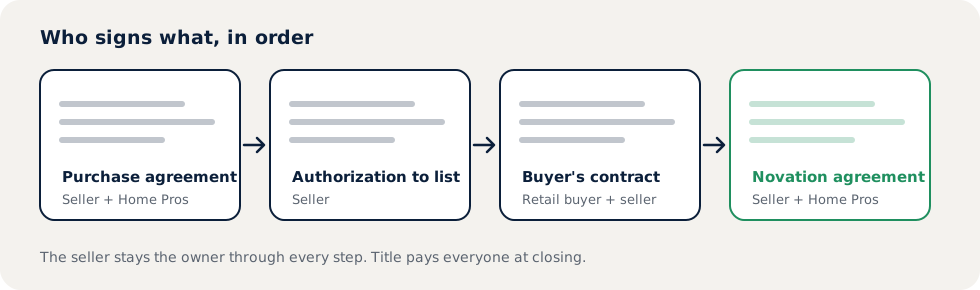
Our advice for Arkansas: have the seller sign the listing agreement in person with the licensed agent, even if an authorization exists for later documents. Keep the authorization narrow, have it name the licensed agent rather than the investor, and spell out the exact price and terms the seller approved. It costs the agent a 20 minute appointment and removes the one question the commission now tells agents to ask.
What is the Arkansas Real Estate Commission telling agents?
To slow down. The commission's December 2025 newsletter ran a two-page piece by Commissioner Tracey Rittelmeyer on wholesaling, and the executive director's column said wholesaling and fraudulent sellers "continue to lead the list" of concerns. Executive Director Melissa Goff was quoted directly: "Unlicensed individuals continue to prey upon Arkansas residents and property owners as wholesaling activities increase."
The practical part is aimed at licensees, which is who you'll need on a novation:
- Wholesalers "will seek out new or inexperienced licensees," and a principal broker may not hear about it until a complaint is filed.
- An agent "should make sure they are working with the actual owner of the property or their legal representative."
- A buyer's agent who thinks a wholesaler is listing a house should contact their principal broker or the listing firm's principal broker.
- Agents who list for an unlicensed wholesaler "may face serious disciplinary sanctions including fines, suspension, and even license revocation."
Expect pushback, and don't take it personally. An Arkansas agent who reads that newsletter will want the seller on the phone, the seller's signature on the listing, and the principal broker told up front. Give them all three before they ask. A novation that can't survive that conversation shouldn't be listed.
How does the investor get paid without a commission split?
From the contract, never from the commission. Arkansas closes this door from three sides. 17-42-311(a)(12) bars a licensee from "paying a commission or valuable consideration to any person for acts or services performed in violation of this chapter." Subsection (a)(8) bars a licensee from taking consideration from anyone but their own principal broker. And 17-42-107 says nobody can sue in an Arkansas court for compensation for broker acts unless they held the right license when they did the work.
That last one matters more than people think. If your deal rests on a "marketing fee" or "finder's fee" from the seller or the agent, you may not be able to collect it if someone balks.
The novation moves money a different way. The seller agreed to a net price. The retail buyer pays more. After the loan payoff, title and closing costs and the listing firm's fee, the seller gets their net, and the investor's share comes out of what's left as its own line on the settlement statement. Everyone at the table can read it.
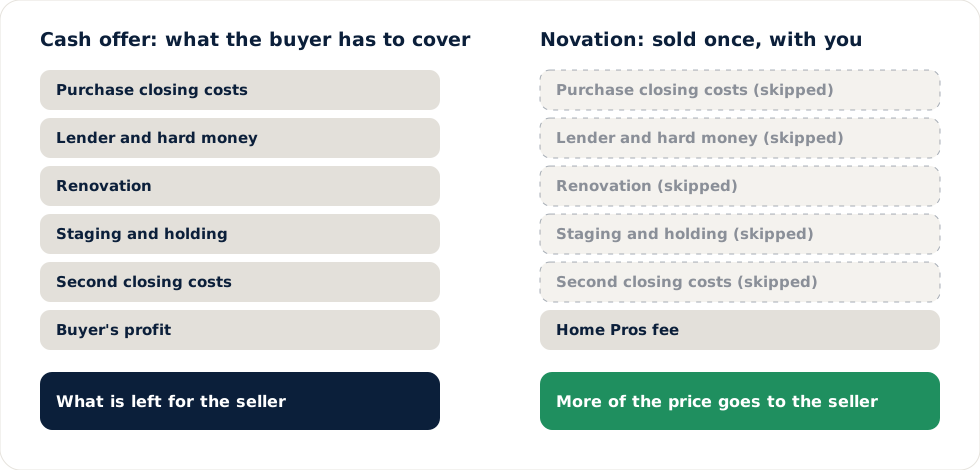
When a partner brings a novation to Home Pros, the partner keeps 60% of the net profit and Home Pros keeps 40%. The seller pays one $500 transaction coordination fee from proceeds at closing, and Home Pros covers the seller's closing costs. It's all in writing before the listing starts. Our novation agreement guide shows where each number sits in the contract.
How does Arkansas compare with Kansas and Oregon?
We've now read three states' license acts for novation, and Arkansas has the heaviest penalty of the three, without a wholesaling statute.
| Question | Arkansas | Kansas | Oregon |
|---|---|---|---|
| Wholesaling statute? | No. SB 553 died in committee, May 1, 2023 | No. SB 382 died on the House calendar, May 23, 2022 | Yes. Registration or license since July 1, 2025 |
| Anti-workaround clause | 17-42-104(c): no exemption for equitable interests taken on another's behalf | None in the exemptions | Arranging a broker listing counts as "marketing" (ORS 696.650) |
| Power of attorney exemption | Recorded power and no fee, direct or indirect | No commission or other compensation, direct or indirect | Not covered in our Oregon guide |
| Top penalty | Class D felony; civil penalty up to $5,000 plus repayment | Misdemeanor; fines up to $10,000 on repeat offenses | Class A misdemeanor; civil penalties up to $5,000 plus profit |
Full detail sits in our Kansas novation guide and our Oregon novation guide. If you run deals in more than one of these states, don't reuse one state's paperwork in another.
What should you never do on an Arkansas novation?
Most Arkansas trouble comes from treating "no wholesaling law" as "no rules." It's the opposite here.
- Don't market the seller's house yourself. Ads, buyers-list blasts and showings for pay are broker acts under 17-42-103(10), and one is enough under 17-42-301(c).
- Don't negotiate the retail offer. That belongs to the licensee and the seller.
- Don't hide the novation, the partner or the fee from the seller. Our scripts disclose all three. Hiding them is also the fastest way into the "strategically circumvents" language in 17-42-104(c)(2).
- Don't ask the agent for a referral cut. 17-42-311(a)(12) makes paying you a disciplinary problem for them.
- Don't use a power of attorney to do paid broker work. 17-42-104(a)(2) only covers the unpaid.
The penalties are real. Under 17-42-109 the commission can impose a civil penalty up to $5,000, assess costs, and require you to give back "any compensation, fees, or other remuneration collected." Under 17-42-105, a violation of the chapter is a Class D felony, and subsection (b) lets "any licensee residing in the county where the violation occurs" start criminal proceedings by affidavit without posting a bond. In plain terms, the agent you annoyed can file.
How does Home Pros handle an Arkansas novation?
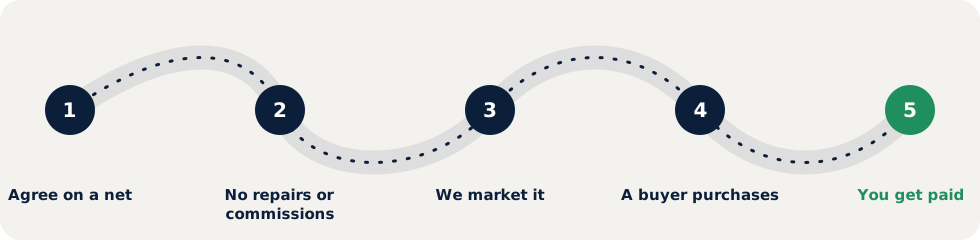
Arkansas isn't on our core service-state list yet, so send the deal first and Trevor will tell you straight whether we can take it. When we do, it follows the same five steps as everywhere else. The seller and Home Pros agree on a net price. The seller pays no repairs and no commissions, and Home Pros covers closing costs. An Arkansas licensee markets the house under a listing the seller signs. A retail buyer purchases. The seller is paid the agreed net at closing.
We work with 300+ investor-friendly agents and have closed hundreds of deals. Partners can start at the partner section of our novation page or submit a deal directly, and the novations hub collects every guide in this series. Before you call a seller, read how to pitch a novation; the disclosure lines in those scripts matter more in Arkansas than most places. Sellers can read our Little Rock selling page, check a number with the cash offer calculator, and see how to verify Home Pros or any buyer. Deal questions go to Trevor Rice at (210) 672-1674.
Send the Arkansas deal and we'll tell you if it fits
Trevor Rice reviews submitted deals for a cash bid and for a novation listing. If we can take it, you'll get both numbers in writing.
Get a cash offer List with Home Pros
Wholesaler with a deal under contract? See the Home Pros novation program or submit the deal.
Frequently Asked Questions
Is a novation legal in Arkansas?
No Arkansas statute bans or names a novation, and Arkansas has no wholesaling law. The Real Estate License Law still applies, so an Arkansas licensee has to list, market and negotiate the house, and Ark. Code 17-42-104(c) can strip the license exemptions from an investor who takes an equitable interest on someone else's behalf.
Do I need an Arkansas real estate license to do a novation?
Not if an Arkansas licensee handles every broker act: listing, advertising the house, procuring buyers and negotiating. Under 17-42-301(b) and (c), one of those acts done for another person for consideration makes you a broker, and one unlicensed act is a violation.
Does a power of attorney from the seller let me list the house myself?
No. Ark. Code 17-42-104(a)(2) covers an attorney in fact only under a recorded power of attorney and only if they don't receive or expect a fee, commission or other consideration, directly or indirectly. An investor earning a spread doesn't fit.
Can the Arkansas listing agent pay me a referral fee?
No, unless you're licensed. Ark. Code 17-42-311(a)(12) bars a licensee from paying consideration to anyone for acts performed in violation of the license law. The investor's share comes from the gap between the seller's net and the sale price, shown on the settlement statement.
Did Arkansas pass a wholesaling law?
Not as of November 17, 2026. SB 553 of 2023 would have created an Arkansas Real Estate Wholesale Consumer Protection Act with written disclosures. It was filed March 30, 2023 and died in Senate committee at sine die adjournment on May 1, 2023.
What happens if I violate the Arkansas license law?
The Arkansas Real Estate Commission can impose a civil penalty up to $5,000, assess costs and order you to repay what you collected (17-42-109). Under 17-42-105, a violation of the chapter is a Class D felony, and a licensee in the county can start criminal proceedings by affidavit.
Sources
Sources were read on November 17, 2026.
- Arkansas Real Estate License Law, April 2026 compilation, Arkansas Real Estate Commission: Ark. Code 17-42-103, 17-42-104, 17-42-105, 17-42-107, 17-42-108, 17-42-109, 17-42-301 and 17-42-311
- Ark. Code 17-42-103 and 17-42-104 (2025 code text, cross-checked against the commission's compilation)
- Arkansas Real Estate Commission newsletter, December 2025: "The Dangers of Wholesale Real Estate Practices in Arkansas"
- Arkansas State Legislature, SB 553 (2023 Regular Session): bill text and status history

Trevor Rice is co-founder and COO of Home Pros (Balint Holdings, LLC) and a licensed Texas real estate agent. He runs the Home Pros novation program. Reach him at (210) 672-1674 or trevor@selltohomepros.com. This article is general information, not legal or tax advice.