
Key Takeaways
- RSMo 407.3600 took effect August 28, 2026 (S.B. 973, merged with H.B. 2636). Its definition of "wholesaler" covers a buyer who "assigns or novates the contract" on a home with one to four dwelling units.
- The wholesaler must hand the record owner a separate boldface disclosure, 12-point or larger, at least 14 calendar days before entering the contract. Both sign and date it.
- Miss it and the owner can cancel any time before the close of escrow, and the earnest money goes to the owner within 30 days.
- Section 407.3600 has no license exemption. Listing, negotiating and procuring prospects "for another" and for pay are broker acts under RSMo 339.010.
- A Missouri licensee can't pay any part of a commission to an unlicensed person for help selling real estate (RSMo 339.150.2).
Not legal advice. This is a plain-language reading of RSMo 407.3600 and Chapter 339 as published by the Missouri Revisor of Statutes and read on November 21, 2026. Have a Missouri real estate attorney review your contract, disclosure form and listing paperwork before you use them.
Is a novation legal in Missouri?
Yes. Until this summer you'd have had to reason your way there from general contract law. That changed on August 28, 2026. RSMo 407.3600 now defines a "wholesaler" as a person or entity that, for a fee or with the expectation of one, "enters into a purchase contract for residential real property" as the grantee "and assigns or novates the contract to another person or entity."
Assigns or novates. The legislature put both exits in the same sentence and treated them the same way. Nothing in the section bans either one. What it does is attach a condition: a signed disclosure, delivered two weeks before any contract exists.
So the fair reading is that a novation on a Missouri house is lawful, and that a novation you planned from the start makes you a wholesaler under this section. The statute sits in Chapter 407, the Merchandising Practices Act chapter, which means it binds anyone who fits the definition. Licensed or not. The Home Pros novation hub explains how the structure works for sellers and partners; this page sticks to what Missouri's statutes say. Home Pros (Balint Holdings, LLC) read every section cited below on the Revisor's own site.
What does RSMo 407.3600 require before a Missouri novation?
One document, and a wait. The Missouri Senate's bill page for S.B. 973 lists the act as signed by the Governor with an effective date of August 28, 2026.
| Requirement | What the statute says | Source |
|---|---|---|
| Covered property | Real property improved by a building "that has one to four dwelling units" | 407.3600.1(1) |
| Who is covered | A contract buyer who "assigns or novates the contract," for a fee or the expectation of one | 407.3600.1(2)(a) |
| Who is carved out | Transfers to a relative within the third degree, or to a parent, affiliate or subsidiary under common control | 407.3600.1(2)(b) |
| Timing | "Not less than fourteen calendar days before entering into a contract" | 407.3600.2 |
| Form | Separate from the purchase contract, boldface, at least 12-point type, statutory wording | 407.3600.2 |
| Signatures | No binding contract until the wholesaler and the record owner both sign and date it | 407.3600.3 |
| Waiver | None. A clause that waives the section in an agreement signed after August 28, 2026 is "null and void" | 407.3600.5 |
The wording of the form isn't yours to write. Subsection 2 gives it to you, and one line of it reads oddly on a novation: the wholesaler "may assign the wholesaler's interest in the purchase contract to a third party without the owner's consent before closing." A novation can't happen without the owner's signature. That's the whole point of one.
Don't edit the statutory text to fix that. Use it word for word, then hand the seller a second page in plain English that says what you'll really do: list the house with a licensed Missouri agent, bring a retail buyer, and ask the seller to sign a novation agreement. My view is that the second page matters more to the seller than the first. The first one is what keeps your contract enforceable.
How does the 14-day wait change a novation timeline?
It moves your start line back two weeks. Elsewhere, a novation usually begins the day the seller signs your purchase agreement. In Missouri that signature can't come until day 14, counted in calendar days from the date the disclosure is delivered and signed.
| When | What can happen on a novation |
|---|---|
| Day 0 | Disclosure delivered; seller and investor sign and date it. Give the plain-English novation page with it |
| Days 1 to 13 | No purchase contract. Line up the Missouri listing broker, order title work, build the net sheet, let the seller call a lawyer |
| Day 14 or later | Purchase agreement signed at the agreed net. Listing paperwork follows |
| Marketing period | Licensed agent lists, shows and negotiates |
| Retail buyer found | Seller, investor and retail buyer sign the novation agreement |
| Closing | One deed, seller to retail buyer. Seller is paid the agreed net |
That gap changes which sellers a novation fits. Someone with a trustee's sale three weeks out doesn't have 14 days to spend before a contract even exists, plus a marketing period after it. Be honest about that at the first meeting. A buyer who is purchasing the house to own it, with no plan to assign or novate, isn't inside the definition.
What about the days in between? Use them. A novation lives or dies on the list price, and you can't know that number from the driveway. Pull comps, get the agent's opinion in writing, and show the seller both figures before day 14. Don't put a sign in the yard early, though. RSMo 339.100.2(14) makes it a disciplinary ground for a licensee to advertise a property "without the written consent of the owner or his or her duly authorized agent."
Who needs a Missouri license on a novation?
Section 407.3600 is a disclosure rule. It never mentions Chapter 339 and it doesn't hand out a license exemption. So signing the form doesn't answer the second question: who on this deal is doing a broker's work?
RSMo 339.010.1 defines a real estate broker as anyone who, "for another, and for a compensation or valuable consideration," does any of ten things. Item (3) is negotiating a sale. Item (4) is to list or offer to list. Item (7) is one investors skip past: "assists or directs in the procuring of prospects, calculated to result in the sale" of real estate. Item (5) reaches a person who "buys, sells, offers to buy or sell or otherwise deals in options on real estate."
On a novation the seller still owns the house while it's shown to strangers. If the unlicensed investor is the one answering buyer calls and haggling over price, that looks a lot like items (3) and (7) done for another. The owner exemption in 339.010.9(1) covers a person who "as owner, lessor, or lessee" acts "with reference to property owned or leased by them." A buyer under contract isn't the owner yet, and the statute doesn't say an equitable interest counts.
| Party | License needed? | Source |
|---|---|---|
| Seller | No. An owner acting on property they own is exempt | 339.010.9(1) |
| Listing agent and broker | Yes. Listing and negotiating for another, for pay, are broker acts | 339.010.1(3), (4); 339.020 |
| Investor holding the contract | Safest to stay hands-off: the licensee markets, shows and negotiates | 339.010.1(3), (7) |
| Licensed attorney-at-law | Exempt from the chapter | 339.010.9(2) |
I looked for a published Missouri Real Estate Commission statement on wholesaling or novations and didn't find one, so I won't guess at the Commission's position. If a step in your deal sits near that list of ten, ask the Commission or a Missouri attorney before you take it. Our Missouri wholesaling law guide covers the same statute for plain assignments.
Can a Missouri agent share the commission with an unlicensed investor?
No, and Missouri says it three different ways.
First, RSMo 339.150.2: "No real estate licensee shall pay any part of a fee, commission or other compensation received by the licensee to any person for any service rendered by such person to the licensee in buying, selling, exchanging, leasing, renting or negotiating a loan upon any real estate," unless that person is licensed. Second, 339.100.2(7) lets the Commission discipline a licensee for "paying a commission or valuable consideration to any person for acts or services performed in violation of" the license law. Third, 339.160 shuts the courthouse door: nobody can sue for compensation for selling real estate "without alleging and proving" they were licensed when the claim arose.
Put those together. If your plan is for the listing agent to kick back half the commission as your pay, the agent risks a license and you can't collect if the agent changes their mind. Terrible structure. Don't build it.
The investor's money on a novation has to come from somewhere else, which is the contract position: the gap between the seller's agreed net and what the retail buyer pays, set out in the purchase agreement and the novation agreement. The listing brokerage earns a commission stated in the listing agreement. Keep those as separate lines with separate paper behind each.
One more line for licensed investors. Section 339.100.2(6) bars "accepting a commission or valuable consideration for services from more than one party in a real estate transaction without the knowledge of all parties to the transaction." If you hold a Missouri license and you're also the contract holder, everyone at the table needs to know both facts in writing.
Does a limited authorization change anything in Missouri?
It changes who can sign the listing paperwork. It doesn't change who needs a license.
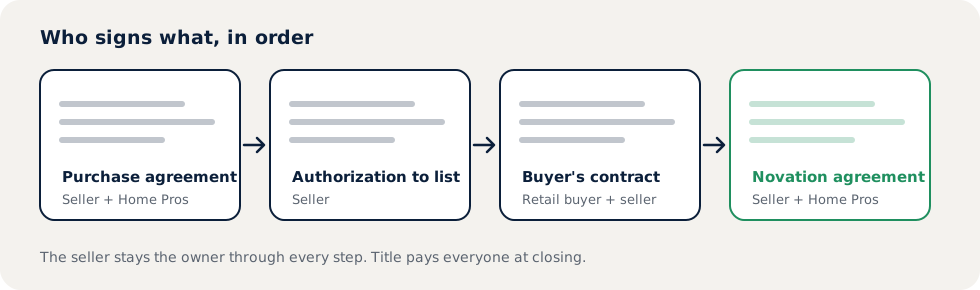
Home Pros asks novation sellers to sign one extra document, a limited authorization that lets partner agents sign listing documents for the house. It's handy for a seller who lives in another state or can't get to a signing on short notice. It isn't a license, and it doesn't rewrite a word of 339.010.
Missouri's discipline list does recognize the idea of an authorized signer. The advertising rule in 339.100.2(14) accepts the written consent of "the owner or his or her duly authorized agent." Fine. But the agent's duties still run to the seller. Under RSMo 339.730, a seller's agent must seek "a price and terms which are acceptable to the client" and present "all written offers to and from the client in a timely manner," and 339.100.2(17) makes it a violation to fail to "timely inform seller of all written offers unless otherwise instructed in writing by the seller."
So the authorization should be narrow. Name the licensed agent and brokerage, state the list price the seller approved, and leave the deed and the novation agreement for the seller's own hand. Every offer still goes to the seller. An authorization that lets someone else decide which offers the owner sees is how a decent deal turns into a complaint file.
How does the money move on a Missouri novation?
One deed, seller to retail buyer. The purchase price pays off the loan, the title charges, the listing brokerage's commission and the seller's agreed net. What remains is the investor side, on its own line of the settlement statement.
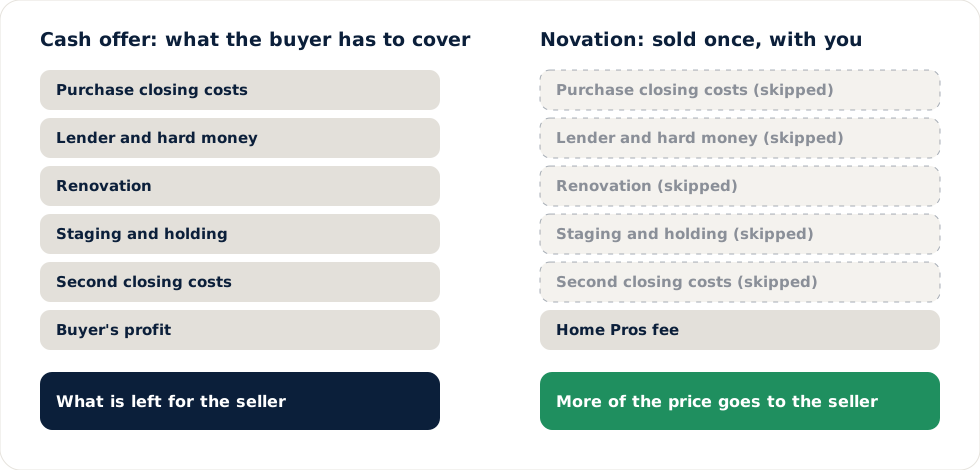
Two Missouri rules shape that statement. Section 339.100.2(4) bars a licensee from representing to "any lender, guaranteeing agency, or any other interested party" a price "in excess of the true and actual sale price" or "terms differing from those actually agreed upon." If the retail buyer has a mortgage, the lender sees the investor line. And 339.100.2(8) bars a licensee from "guaranteeing" future profits from a resale, so nobody on the listing side should be promising you or the seller a number the market hasn't produced yet.
Now the risk math. Here's an illustration, not a real deal: you put $2,500 of earnest money on a bungalow in Florissant and skip the disclosure. Under 407.3600.4 the owner "may cancel the contract at any time prior to the close of escrow without penalty," and the closing agent must send that $2,500 to the owner within thirty days. Picture that cancellation arriving the morning of closing, after eight weeks of marketing. That's a lot to lose over a form.
When a partner brings a novation to Home Pros, the split is 60% of the net profit to the partner and 40% to Home Pros. The seller pays one $500 transaction coordination fee from proceeds at closing, and Home Pros covers the seller's closing costs. Our novation agreement guide shows where each number lands.
What should you never do on a Missouri novation?
Most of the trouble comes from treating Missouri like it's still 2025.
- Don't sign the purchase agreement at the first visit. Fourteen calendar days from the signed disclosure, minimum.
- Don't fold the disclosure into your contract. The statute wants it "separate from the purchase contract or agreement," in boldface.
- Don't ask the seller to waive it. Subsection 5 voids the waiver.
- Don't negotiate with retail buyers yourself if you're unlicensed. That's item (3) of 339.010.1.
- Don't take your pay as a slice of the agent's commission. See 339.150.2.
- Don't hide the novation, the partner or the fee from the seller. Our scripts disclose all three, every time.
The penalties come from two directions. On the disclosure side, any violation of 407.3600 is "an unlawful practice under the Missouri merchandising practices act." The owner can bring a private action, and the Attorney General can sue for "damages, injunctive relief, attorney fees" and other relief.
On the license side, RSMo 339.170 makes a knowing violation a class B misdemeanor, and 558.002 caps the fine for that class at $1,000. The bigger number is civil. Under 339.200 the Commission can file a complaint against an unlicensed person, and 339.205 allows a civil penalty of up to $2,500 per offense, with each day of a continued violation counted separately up to $25,000. Section 339.180 adds a court injunction on top. A cheap misdemeanor fine shouldn't make anyone relax. The injunction is what ends a business.
How does Home Pros handle a Missouri novation?
Missouri is one of our service states, and the five steps are the same here as anywhere. The seller and Home Pros agree on a net price. The seller pays no repairs and no commissions, and Home Pros covers closing costs. A Missouri licensee markets the house under a listing the seller approves. A retail buyer purchases. The seller is paid the agreed net at closing.
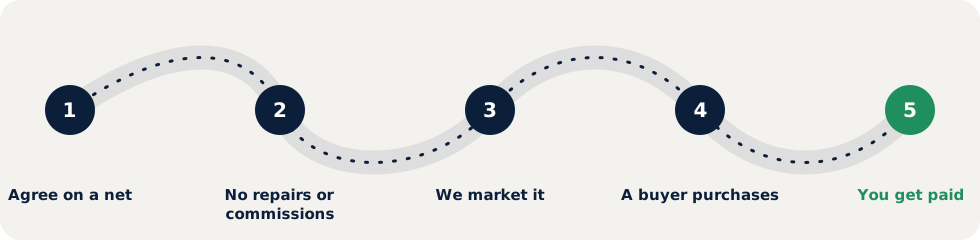
The Missouri difference is the front end. The 407.3600 disclosure and our plain-English novation page go to the seller on day 0, and nobody signs a purchase agreement before day 14. We'd rather lose a deal to that wait than close one the seller can cancel at the table.
We work with 300+ investor-friendly agents and have closed hundreds of deals. Partners can start at the partner section of our novation page or submit a deal directly. If the house is too rough to list, we'll look at a cash exit through our buyer network or the deal marketplace. Sellers can read the Missouri selling guide, the Kansas City page or the St. Louis page, and see how to verify Home Pros or any buyer. Working both sides of State Line Road? The Kansas version of this page reads very differently, and so does Arkansas. Need the seller conversation? Our novation pitch scripts disclose the structure in plain words. For the novation program, call Trevor Rice at (210) 672-1674.
Send the Missouri deal and we'll tell you which exit fits
Trevor Rice reviews submitted deals for a cash bid and for a novation listing. You'll get both numbers and the Missouri disclosure timeline in writing.
Get a cash offer List with Home Pros
Wholesaler with a deal under contract? See the Home Pros novation program or submit the deal.
Frequently Asked Questions
Is a novation legal in Missouri?
Yes. RSMo 407.3600, effective August 28, 2026, names novation in its definition of a wholesaler and allows it when the record owner receives a signed boldface disclosure at least 14 calendar days before the contract. The real estate license law in Chapter 339 still controls who may list and negotiate.
Does Missouri's wholesaler disclosure law apply to novations?
Yes. The definition covers a person who enters a purchase contract as the grantee and "assigns or novates the contract to another person or entity" for a fee or with the expectation of one. It applies to residential property with one to four dwelling units.
Do I need a Missouri real estate license to do a novation?
Section 407.3600 doesn't require one, but RSMo 339.010 makes listing, negotiating a sale and procuring prospects for another, for pay, broker acts. The safest setup has a Missouri licensee do all marketing and negotiating while the investor stays a contract party.
What happens if I skip the 14-day disclosure in Missouri?
The owner may cancel the contract any time before the close of escrow without penalty, and the closing agent must pay your earnest money to the owner within 30 days. The violation is also an unlawful practice under the Merchandising Practices Act, with a private action and Attorney General enforcement.
Can a Missouri agent pay an unlicensed investor part of the commission?
No. RSMo 339.150.2 bars a licensee from paying any part of a fee or commission to an unlicensed person for services in selling real estate. The investor's proceeds on a novation come from the purchase contract and the novation agreement.
What is the penalty for unlicensed brokerage in Missouri?
A knowing violation is a class B misdemeanor under RSMo 339.170, with a fine of up to $1,000 under 558.002. The Commission can also seek a civil penalty of up to $2,500 per offense, capped at $25,000 for a continued violation, and a court injunction under 339.180.
Sources
Sources were read on November 21, 2026.
- RSMo 407.3600, wholesaler disclosure statement (L. 2026 H.B. 2636 merged with S.B. 973), and the Missouri Senate's S.B. 973 bill page
- RSMo 339.010, definitions and exemptions, and 339.020, license required
- RSMo 339.100, grounds for discipline, 339.150, no fees to unlicensed persons, and 339.160, no action for compensation unless licensed
- RSMo 339.170, penalty, 339.180, injunction, 339.200 and 339.205, complaints and civil penalties against unlicensed persons, and 558.002, fines
- RSMo 339.730, duties of a licensee representing a seller

Trevor Rice is co-founder and CEO of Home Pros (Balint Holdings, LLC) and a licensed Texas real estate agent. He runs the Home Pros novation program. Reach him at (210) 672-1674 or trevor@selltohomepros.com. This article is general information, not legal or tax advice.