Key Takeaways
- North Carolina has no wholesaling statute. G.S. 93A-2 as published by the General Assembly doesn't use the word, and HB 797's last action is a May 1, 2025 referral to the Senate Rules Committee.
- A broker is anyone who, for pay, lists, sells, or "negotiates the purchase or sale or exchange of real estate" for others. Doing it without a license is a Class 1 misdemeanor under G.S. 93A-8.
- The Commission's 2023-2024 Update Course says a wholesaler's broker "may not advertise the property" because the wholesaler has no written agreement with the owner. On a novation, the owner signs that agreement with the listing firm.
- Rule 58A .0105(a)(2) bars a sign or ad "without the written consent of the owner or the owner's authorized agent." Rule 58A .0104(a) requires the owner's listing agreement in writing, signed at formation, with an end date.
- G.S. 84-2.1 makes preparing deeds and passing on title the practice of law. Line up a North Carolina closing attorney who'll accept a novation file before the seller signs.
Not legal advice. This is a plain-language reading of G.S. 93A-1, 93A-2, 93A-6, 93A-8, 84-2.1, 75-1.1 and 75-16 as published by the North Carolina General Assembly, the HB 797 bill page, Commission Rules 21 NCAC 58A .0104 and .0105 as published by the Office of Administrative Hearings, and the Commission's 2023-2024 General Update Course, all read on November 24, 2026. Have a North Carolina real estate attorney review your contract, disclosures and listing paperwork before you use them.
Is a novation legal in North Carolina?
Yes. Nothing in the General Statutes stops a seller, a first buyer and a retail buyer from agreeing to replace one buyer with another. North Carolina came close to writing a wholesaling law and didn't. House Bill 797, Residential Property Wholesaling Protection, passed the House 103 to 0 on April 30, 2025. The Senate referred it to Rules and Operations the next day. As of today the bill page shows nothing after that.
So you're working under the 1957 license law. G.S. 93A-1 makes it unlawful to act as a broker, "or directly or indirectly to engage or assume to engage in the business of real estate broker or to advertise or hold himself or herself" out as one, without a Commission license. The contract swap isn't the regulated part. Marketing someone else's house to the public is. Home Pros (Balint Holdings, LLC) read the chapter, the two Commission rules that matter here, and what the Commission teaches licensees about wholesalers. Our North Carolina wholesaling law guide covers assignments and the HB 797 text. This page covers the novation.
| North Carolina source | What it says | On a novation |
|---|---|---|
| G.S. 93A-2(a) | A broker, for pay, lists, sells or "negotiates the purchase or sale or exchange of real estate" for others | Marketing the house to retail buyers is broker work. A licensee does it |
| G.S. 93A-2(c)(2) | Exempts an attorney-in-fact authorized for "the final consummation of performance" of a sale contract | Covers signing at the finish line, not running the sale |
| Rule 58A .0104(a) | Owner listing agreements in writing, signed at formation, definite term, license number | The seller signs with the listing firm directly |
| Rule 58A .0105(a)(2) | No sign or ad without "the written consent of the owner" | Your purchase contract isn't that consent |
| G.S. 84-2.1 | Preparing deeds and passing on title is practicing law | A North Carolina attorney handles the closing documents |
Who needs a North Carolina license on a novation?
Start with the definition. Under G.S. 93A-2(a), a broker is any person or entity "who for a compensation or valuable consideration or promise thereof lists or offers to list, sells or offers to sell, buys or offers to buy," or "negotiates the purchase or sale or exchange of real estate," and the sentence closes on two words: "for others."
Those two words carry the whole analysis. On an assignment you can at least argue you're selling your own contract. On a novation the seller deeds straight to the retail buyer, so whoever finds that buyer and negotiates the price is selling the seller's house. If they're paid for it, that's the definition.
The owner exemption in 93A-2(c)(1) won't stretch to cover it. It applies to an entity acting "with reference to property owned or leased by them," in the regular course of managing and investing in that property. Your LLC doesn't own the house. Even where the exemption does apply, the person relying on it has to tell every party in writing that they aren't licensed, which exemption they're using, and the owner's legal name and address.
| Party | License needed? | Source |
|---|---|---|
| Seller | No. An owner selling its own house isn't acting "for others" | 93A-2(a) |
| Listing broker and firm | Yes. Listing and negotiating a sale for others, for pay | 93A-1; 93A-2(a) |
| Unlicensed investor holding the contract | Unsettled for the contract itself. Advertising and negotiating the house sale for a fee is broker work | 93A-1; 93A-2(a) |
| Investor's LLC | Owner exemption covers property the LLC owns or leases, with a written disclosure | 93A-2(c)(1) |
| Licensed investor holding the contract | Licensed, but every Commission rule on disclosure and dual roles applies | 93A-6(a)(1), (4) |
The penalty is criminal. G.S. 93A-8 says anyone violating 93A-1 "shall upon conviction thereof be deemed guilty of a Class 1 misdemeanor." The Commission doesn't have to wait for a prosecutor, either. Under 93A-6(a) it can investigate "any other person or entity who shall assume to act in such capacity," and under 93A-6(c) it can go to superior court for an injunction against any person, licensed or not.
What has the Real Estate Commission said about wholesalers?
More than most commissions. Its 2023-2024 General Update Course, which every active North Carolina broker had to take, spends a section on wholesaling. It isn't a statute or a rule. It's the Commission telling its own licensees how it reads the rules, and that's worth more than any forum post.
Three points from it matter on a novation. First, assignability depends on the contract. The course notes that Paragraph 15 of Standard Form 2-T, the statewide offer to purchase, requires written permission from all parties to assign, so a wholesaler on that form "may not, without the seller's written permission, assign their equitable rights."
Second, the advertising line. Citing Rule 58A .0104, the course says the wholesaler "does not have a written agreement with the owner of the property to provide brokerage services; therefore, the real estate broker of the wholesaler may not advertise the property." The wholesaler holds "equitable interest and not legal title," so the broker "may not market/advertise the property as if their principal, the wholesaler, is selling the property."
That's the sentence a North Carolina novation is built around. A novation fixes the problem the Commission describes by putting the owner and the listing firm in a direct, written agreement. If your setup has an agent advertising the house under an agreement with you instead of the seller, it's the exact pattern the course warns about.
Third, disclosure. A listing agent who learns the buyer is a wholesaler "must disclose to the seller" because it's "a material fact" under 93A-6(a)(1). Our view: the seller should hear about the novation, the partner and the fee from you, on day one, before any agent has to tell them.
Does a power of attorney exempt you in North Carolina?
Not in the way some investors hope. G.S. 93A-2(c)(2) exempts "any person acting as an attorney-in-fact under a duly executed power of attorney from the owner authorizing the final consummation of performance of any contract for the sale, lease or exchange of real estate."
Read the middle of that sentence again. The power covers the "final consummation of performance" of a contract. It describes someone signing to finish a sale that already exists. Finding the buyer, setting the price and negotiating the terms all happen before there's a contract to consummate. Georgia's version of this exemption is broadly worded. North Carolina's is narrow on its face, and we wouldn't build a business on it.
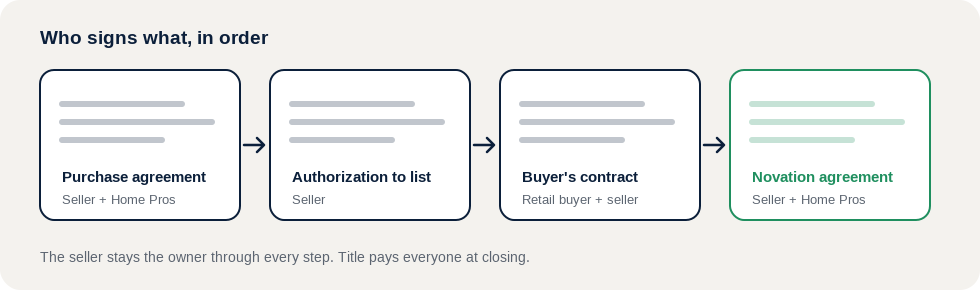
Home Pros asks novation sellers to sign one extra document, a limited authorization to sign listing documents, so a partner agent can list the house. In North Carolina we treat it as what it is: the owner's written authority for the listing paperwork that Rules 58A .0104 and .0105 require. It isn't a license exemption, and it doesn't change what 93A-2 says. The person listing, advertising and negotiating holds a North Carolina license.
How does the listing have to be papered?
By the Commission's rules, and the details matter. Rule 58A .0104(a) says every agreement between a broker and an owner "shall be in writing and signed by the parties at the time of its formation." It has to run "for a definite period of time," include the broker's license number, and end without notice when that period expires. "Until it sells" doesn't qualify.
Rule 58A .0105(a)(2) adds: a broker "shall not display a 'for sale' or 'for rent' sign on any real estate or otherwise advertise any real estate without the written consent of the owner or the owner's authorized agent." Rule .0105(b) bans blind ads, so every ad has to show it's from a broker or firm. A Facebook post with just your cell number won't pass.
Here's an illustration, not a real deal. A seller in Durham agrees to net $240,000, and your purchase agreement says $240,000. The listing agreement the seller signs with the North Carolina firm shows a list price, say $289,900, the firm's fee, a start date and an end date. The novation agreement then says how the gap between the retail contract price and the seller's net gets paid. The seller sees all three numbers before anything goes on the MLS. Set that list price from sold comps, not hope. Compr, our sister company, has a free tool that pulls sold comps and returns an ARV and a max offer for wholesale deals.
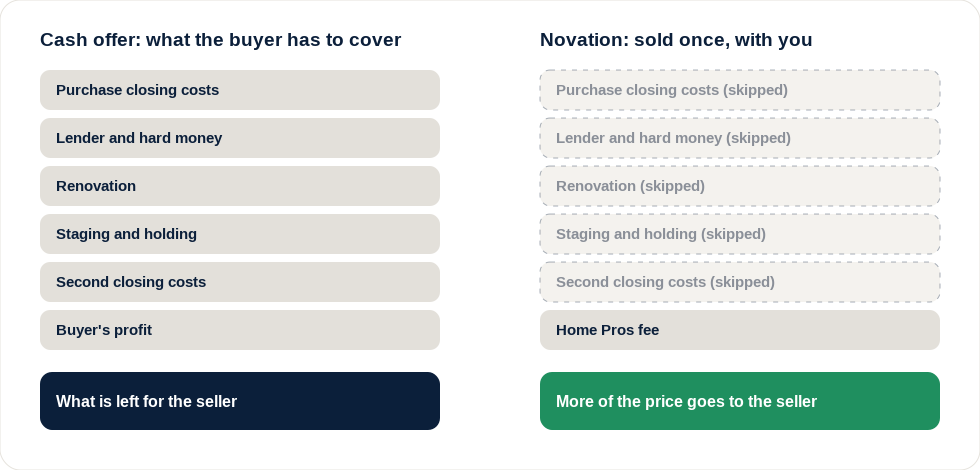
Two rules on the money. G.S. 93A-6(a)(9) lets the Commission discipline a licensee for "paying a commission or valuable consideration to any person for acts or services performed in violation of this Chapter," so your agent can't split the commission with you. And 93A-6(a)(4) covers "acting for more than one party in a transaction without the knowledge of all parties." If you hold a license and you're also the buyer on the seller's contract, put that in writing to everyone.
Who closes a North Carolina novation?
A North Carolina attorney prepares the deed. G.S. 84-2.1(a) defines practicing law to include "the preparation or aiding in the preparation of deeds, mortgages" and "abstracting or passing upon titles." Subsection (b)(2) goes further: nothing in it lets anyone not licensed to practice law "prepare for any third person any contract or deed conveying any interest in real property" located in North Carolina. A licensee who does legal work can be disciplined under 93A-6(a)(11).
In practice that means the closing attorney reads your purchase agreement, the listing agreement, the retail contract, the novation agreement and the settlement statement. Some attorneys won't close a novation. Call before your seller signs, send the documents, and ask. Finding out a week before closing is how a deal dies.
The settlement statement is also where the seller sees the retail price, the agreed net and your share on one page. Under 93A-6(a)(14), a broker has to make sure the client gets "a detailed and accurate closing statement." If the seller learns the size of your spread from that page for the first time, you wrote the contract wrong.
What should you never do on a North Carolina novation?
Most of the trouble we see starts with one of these.
- Don't advertise the house yourself if you're unlicensed. G.S. 93A-1 covers anyone who would "advertise or hold himself or herself" out as a broker.
- Don't let an agent list under an agreement with you. The Commission's course says a wholesaler's broker "may not advertise the property." The owner signs with the firm.
- Don't assign a Form 2-T without written permission. Paragraph 15 requires it from all parties.
- Don't lean on a power of attorney. 93A-2(c)(2) covers "final consummation," not marketing.
- Don't take a cut of the commission. 93A-6(a)(9) puts the agent's license at risk for paying you.
- Don't hide the novation, the partner or the fee from the seller. Our scripts disclose all three, every time.
There's a civil exposure on top of the license law. G.S. 75-1.1 declares "unfair or deceptive acts or practices in or affecting commerce" unlawful, and G.S. 75-16 gives an injured party judgment for "treble the amount fixed by the verdict." A seller who says they were misled about who was buying, or what the house was worth, will plead both. HB 797 would have made any violation of its rules an automatic unfair practice. It didn't pass, but a seller's lawyer doesn't need it to.
How does Home Pros handle a North Carolina novation?
North Carolina is one of our service states, and the five steps don't change at the state line. The seller and Home Pros agree on a net price. The seller pays no repairs and no commissions, and Home Pros covers closing costs. The house gets marketed. A retail buyer purchases. The seller is paid the agreed net at closing, less one $500 transaction coordination fee from proceeds.
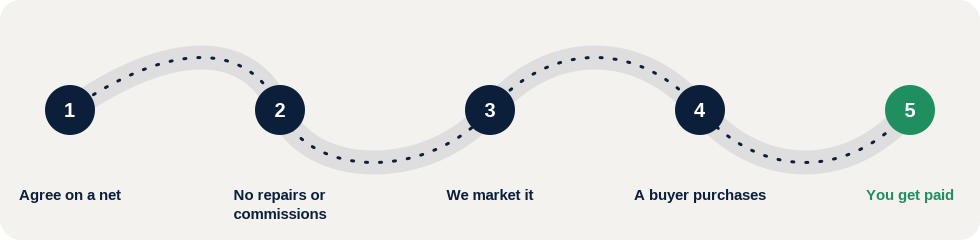
What changes here is the paperwork order. A partner firm with a North Carolina license signs the listing agreement with the seller, with a definite term and its license number on it. The seller gets the novation, the partner and the fee explained before signing anything. A closing attorney who'll take a novation file gets the documents early. We work with 300+ investor-friendly agents and have closed hundreds of deals. When a partner brings us a novation, the partner keeps 60% of the net profit and Home Pros keeps 40%.
Sometimes cash is the right exit instead. A retail buyer's lender or inspection can push a closing back, and a seller facing a foreclosure sale may not have that time. North Carolina's upset bid process also keeps a foreclosure sale open for bids for ten days, which changes the timeline you're working against. We'll tell you which exit we'd pick. I'm licensed in Texas and hold no North Carolina license, so treat this page as an operator's reading and have North Carolina counsel check your documents.
Partners can start at the partner section of our novation page or submit a deal directly. Too rough to list? We'll look at a cash exit through our buyer network or the deal marketplace. Sellers can read the North Carolina selling guide or the pages for Charlotte and Raleigh. Investors working the closing side should read how to evaluate a deal in an attorney-closing state. Next door, Tennessee wrote a wholesaling statute and Georgia didn't. The novation pitch scripts cover the seller conversation. For the novation program, call Trevor Rice at (210) 672-1674.
Send the North Carolina deal and we'll tell you which exit fits
Trevor Rice reviews submitted deals for a cash bid and for a novation listing. You'll get both numbers in writing, and we'll tell you how we'd paper the North Carolina listing.
Get a cash offer List with Home Pros
Wholesaler with a deal under contract? See the Home Pros novation program or submit the deal.
Frequently Asked Questions
Is a novation legal in North Carolina?
Yes. No North Carolina statute prohibits it, and the state has no wholesaling law. The license law in G.S. 93A controls who may advertise and negotiate the sale for pay, and Real Estate Commission rules control how the listing is written.
Did North Carolina pass House Bill 797?
No. HB 797 passed the House 103 to 0 on April 30, 2025, and the Senate referred it to its Rules Committee on May 1, 2025. The bill page showed no later action when we checked on November 24, 2026.
Do I need a North Carolina real estate license to do a novation?
Not to sign a purchase contract. But G.S. 93A-2(a) treats listing, selling or negotiating a sale for others, for pay, as broker work, and 93A-1 covers advertising it. The cautious setup has a North Carolina licensee list, advertise and negotiate under an agreement signed by the owner.
Can my agent list a house I only have under contract?
Not under an agreement with you. The Commission's 2023-2024 Update Course says a wholesaler's broker may not advertise the property because the wholesaler has no written agreement with the owner. Rule 58A .0105 requires the owner's written consent to advertise.
Does a North Carolina novation need a closing attorney?
Practically, yes. G.S. 84-2.1 makes preparing deeds and passing on title the practice of law, and bars nonlawyers from preparing a deed conveying North Carolina property for someone else. Confirm your closing attorney will take a novation before the seller signs.
What is the penalty for unlicensed brokerage in North Carolina?
It's a Class 1 misdemeanor under G.S. 93A-8. The Commission can also investigate anyone acting as a broker and ask a superior court for an injunction under 93A-6(c). A seller can sue under G.S. 75-1.1, where damages are trebled under 75-16.
Sources
Sources were read on November 24, 2026. Statute pages are the General Assembly's online text. Check current wording there before you rely on a section.
- G.S. 93A-1 (license required), 93A-2 (definitions and exceptions), 93A-6 (disciplinary action) and 93A-8 (penalty), North Carolina General Assembly
- G.S. 84-2.1 (practice of law defined), 75-1.1 (unfair and deceptive practices) and 75-16 (treble damages)
- House Bill 797 (2025-2026 Session), Residential Property Wholesaling Protection, bill history
- North Carolina Real Estate Commission, 21 NCAC 58A .0104, Agency Agreements and Disclosure, and 21 NCAC 58A .0105, Advertising, Office of Administrative Hearings
- North Carolina Real Estate Commission, 2023-2024 General Update Course, Section 3 (wholesaling questions and answers)

Trevor Rice is a co-founder of Home Pros (Balint Holdings, LLC) and a licensed Texas real estate agent. He runs the Home Pros novation program. Reach him at (210) 672-1674 or trevor@selltohomepros.com. This article is general information, not legal or tax advice.