Key Takeaways
- Public Chapter 72 (S.B. 909) added Tenn. Code Ann. 66-4-401 to 66-4-403. Governor Lee approved it March 25, 2025, and it took effect that day. Its definition of wholesaling turns on a buyer who "assigns" an equitable interest "for a higher price." The word novation isn't in it.
- The act's seller disclosure is your intent to market, in bold, large font, inside the contract. It costs nothing to give on a novation, and we'd give it every time.
- Tennessee's broker definition reaches anyone who, for pay, "solicits, negotiates" a listing or sale for another, or "advertises or holds out" as doing so. A single act is enough (62-13-103).
- The license act exempts an attorney-in-fact under a "duly executed and recorded power of attorney." In 1998 the Court of Appeals refused to let that exemption work as "a loophole" for people who do the work for a living.
- Tennessee Real Estate Commission Rule 1260-02-.07 bars a "net price" listing. Your seller's agreed net belongs in the purchase agreement. The listing needs a list price and a stated commission.
Not legal advice. This is a plain-language reading of Public Chapter 72 as published by the Tennessee Secretary of State, the Real Estate Commission's rules and spring 2025 newsletter, two Attorney General opinions and one Court of Appeals decision, all read on November 23, 2026. Tennessee's official code is hosted by LexisNexis and wouldn't open for us, so license act sections other than the broker definition were read on a public 2024 copy, linked in Sources. Have a Tennessee real estate attorney review your contract, disclosures and listing paperwork before you use them.
Is a novation legal in Tennessee?
Yes. We found nothing in the Tennessee Code that stops a seller, a first buyer and a second buyer from agreeing to swap one buyer for another. The legislature took up wholesaling in 2025 and chose to regulate it with disclosures. Public Chapter 72 says a buyer under contract "may engage in wholesaling the real property" once two written disclosures are made. Its text never mentions novation.
The Tennessee Real Estate Commission read the act the same way in its spring 2025 newsletter: "wholesaling is permitted if the buyer discloses in writing their equitable interest to a potential assignee and notifies the seller of their intention of wholesaling the property." That's the only published Commission statement on wholesaling we found. It doesn't address novation either.
So the transaction itself is lawful. Who gets to sell the house to the public is a different question, and the Tennessee Real Estate Broker License Act of 1973 (Title 62, Chapter 13) answers it. If you only have five minutes, skip to the power of attorney section. That's where Tennessee differs most from its neighbors. The Home Pros novation hub covers how the structure works for sellers and partners. Home Pros (Balint Holdings, LLC) read every source cited here, and where one wouldn't open, we say so.
Does Public Chapter 72 apply to a novation?
On its words, maybe not. Act as if it does.
Section 66-4-402 says a buyer "engages in the act of wholesaling the real property when the buyer, after entering into the contract with the seller, assigns the buyer's equitable interest in the real property to a subsequent purchaser for a higher price than the buyer paid." A novation doesn't assign anything. The seller signs a new contract with the retail buyer and releases you from the first one. We found no Tennessee court decision saying whether that counts as wholesaling.
| What the act says | Section | On a novation |
|---|---|---|
| Trigger: the buyer "assigns the buyer's equitable interest" for a higher price | 66-4-402 | No assignment happens. The seller contracts directly with the retail buyer. Untested in court |
| Tell the seller "the buyer's intent to market its equitable interest prior to execution of the contract" | 66-4-403(a)(1)(B) | Give it. You do intend to market |
| Tell the seller the effective date of any assignment "at least three (3) business days prior," if the contract allows assignment | 66-4-403(a)(1)(B) | There's no assignment date. Give the seller the planned listing date in writing |
| Tell a subsequent purchaser or assignee "the nature of the buyer's equitable interest" | 66-4-403(a)(1)(A) | The retail buyer's contract is with the seller. Disclose your contract position anyway |
| Format: "bold, large font print, and included in the written agreement" | 66-4-403(a)(2) | Put it in the purchase agreement itself |
| Deadline to sue: within "two (2) years after the execution of a contract" | 66-4-403(b) | Keep signed copies at least that long |
The act names no penalty and gives the seller no cancellation right. Ohio's statute hands the seller both. What Tennessee leaves is a two-year window for a seller to bring a claim under other law. In my view, "it was a novation, so I owed no disclosure" is an argument you'd only make after a deal has already gone wrong. The disclosure is two bold sentences. Write them.
One date to get right: the General Assembly's bill history for SB 909 shows the governor signed it March 25, 2025, with the same effective date. April 8 is when the Secretary of State assigned the chapter number. Contracts signed on or after March 25 are covered. Our Tennessee wholesaling law guide walks through the three business day notice for straight assignments.
Who needs a Tennessee license on a novation?
Public Chapter 72 sits in Title 66, the property title. It licenses nobody and doesn't amend the license act. The license rules are in Title 62.
Attorney General Opinion 14-27 quotes the definition. A broker is any person who, for a fee or "with the intent or expectation of receiving" one from another, "solicits, negotiates or attempts to solicit or negotiate the listing, sale, purchase, exchange, lease or option to buy" real estate, "or who advertises or holds out as engaged in any of the foregoing" (Tenn. Code Ann. 62-13-102(4)(A)). Section 62-13-103 adds that anyone who performs "any single act" from that list for another, expecting to be paid, is deemed a broker. Section 62-13-301 makes it unlawful to act as one, or "to advertise or claim to be engaging in" the business, without a license.
The exemption investors reach for is 62-13-104(a)(1)(A): the chapter doesn't apply to "an owner of real estate with respect to property owned or leased by such person." On a novation the seller holds the deed until the retail closing. You hold a contract. The act's definition of "real estate" does include "any other interest or estate in land," and wholesalers argue an equitable interest fits. We couldn't find a Commission position on that argument. I wouldn't bet a misdemeanor on it.
| Party | License needed? | Source |
|---|---|---|
| Seller | No. An owner dealing with property the owner holds is exempt | 62-13-104(a)(1)(A) |
| Listing agent and firm | Yes. Listing and negotiating a sale for another, for pay | 62-13-102(4)(A); 62-13-301 |
| Unlicensed investor holding the contract | Unsettled for marketing your own contract. Advertising and negotiating the sale of the house itself is broker work | 62-13-102(4)(A); 62-13-103 |
| Investor's LLC | No corporate exemption. The Attorney General reads it as limited to corporations, and it covers only real estate the corporation owns | 62-13-104(a)(1)(F); AG Op. 14-27 |
| Licensed investor holding the contract | Licensed, but must identify as a licensee and disclose the personal interest | Rule 1260-02-.11; 62-13-403(7)(A) |
The LLC row surprises people. Plenty of wholesalers sign contracts in an LLC's name and assume a company exemption follows. The 2014 opinion says otherwise: "A limited liability company is not a corporation."
Does a recorded power of attorney exempt you in Tennessee?
On paper, Tennessee looks friendlier than Ohio here. Section 62-13-104(a)(1)(B) says the license act doesn't apply to "an attorney-in-fact under a duly executed and recorded power of attorney from the owner or lessor." Ohio's broker definition says the reverse. The tempting plan writes itself: get a power of attorney from the seller, record it with the county register of deeds, list the house yourself.
A Gatlinburg cabin company already tried it. In Tennessee Real Estate Commission v. Hamilton (Tenn. Ct. App., May 29, 1998), LeConte Chalet Rentals gave up its firm license, had its cabin and chalet owners sign powers of attorney, and kept renting. Each form paid LeConte "forty percent (40%) of the gross receipts." The Commission won an injunction in Davidson County Chancery Court, and the Court of Appeals affirmed without hedging: "It seems abundantly clear that the legislature did not intend for the attorney-in-fact exemption to be a loophole around the unequivocal requirements of the Licensing Act."
The court's test asks how you do the work. Someone who does the listed acts "as a vocation or for compensation" is a broker. Someone acting "ministerially as an agent for the owners" is an attorney-in-fact. LeConte's work under those forms was "the mainstay of their livelihood," so the exemption didn't apply. Hamilton was a rental case under an older section number, and the exemption's words are unchanged in the copy we read. A wholesaler who collects powers of attorney from sellers and earns a spread on each sale looks a lot like LeConte.
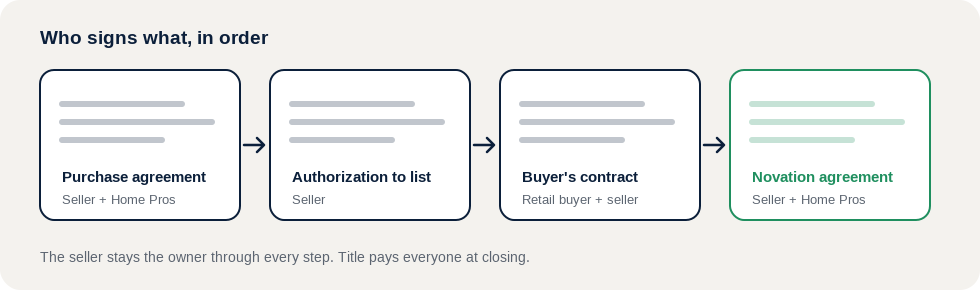
Home Pros asks novation sellers to sign one extra document, a limited authorization to sign listing documents, so partner agents can list the house. We don't treat it as a license exemption in Tennessee, and it doesn't change what 62-13-104 says. The listing runs through a partner agent who holds a Tennessee license.
Can a Tennessee agent take a net listing on a novation?
No. It's the rule most likely to collide with how a novation gets written up. Commission Rule 1260-02-.07 is one sentence: "No broker or affiliate broker shall accept or enter a listing based on a 'net price' (i.e., a price excluding the customary commission and expenses associated with the sale)."
Step one of any novation is agreeing on a net. That's fine in a purchase agreement, because you're a buyer naming a price. It's a problem when the same deal is typed into a listing agreement as "seller receives this amount, brokerage keeps the rest."
Here's an illustration, not a real deal. A seller in Donelson agrees to net $240,000, and your purchase agreement says $240,000. The listing agreement the Tennessee agent signs states a list price, say $289,900, and a commission written as a percentage or a flat fee. The novation agreement then says what happens to the gap between the retail contract price and the seller's net. The net shows up in the purchase agreement and the novation agreement. It stays out of the listing. That list price should come from sold comps, and Compr, our sister company, has a free tool that pulls sold comps and returns an ARV and a max offer for wholesale deals.
Two more listing rules matter. The Commission can discipline a licensee for using a listing form "that fails to specify a definite termination date" (62-13-312(b)(9)), so an authorization that runs "until it sells" won't do. And Rule 1260-02-.08 says a licensee "promptly shall tender every written offer to purchase." Every offer goes to the seller, including the ones below your number. I think that's the right rule. The seller still owns the house.
Can a Tennessee broker pay an unlicensed investor?
No. Section 62-13-302(a) reads: "It is unlawful for any licensed broker to employ or compensate any person who is not a licensed broker or a licensed affiliate broker for performing any of the acts regulated by this chapter." An affiliate broker can't route money around the firm either. Under 62-13-312(b)(11) an affiliate may accept a commission only from "the licensed real estate broker with whom the licensee is affiliated," and (b)(17) makes "any undisclosed commission, rebate, compensation or profit" grounds for discipline.
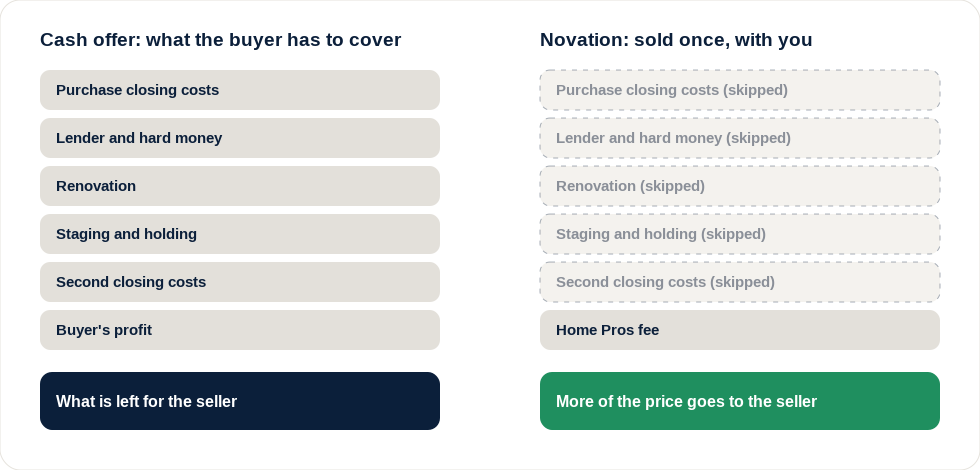
Your money comes from your contract position. That's the gap between the seller's agreed net and the retail price, written into the purchase agreement and the novation agreement and shown on the settlement statement. A title company can cut the checks. Attorney General Opinion 21-01 says "the principal broker may contractually delegate to a third party, such as a title company, the duty and authority to disburse the commission." The opinion is about who writes the check. Section 62-13-302 still decides who can receive one.
Hold a Tennessee license yourself? Two more rules apply. Rule 1260-02-.11(2) says "All licensees shall identify themselves as a licensee when buying or selling property for themselves." And 62-13-403(7)(A) bars self-dealing "without prior disclosure of the interest and the timely written consent of all parties to the transaction." The retail buyer is a party. Tell them.
What should you never do on a Tennessee novation?
Tennessee's criminal penalty is small. The civil one can be three times your fee.
- Don't sign a seller without the bold intent-to-market language in the contract. Section 66-4-403(a)(2) wants it "included in the written agreement."
- Don't advertise the house yourself if you're unlicensed. "Advertises or holds out" is in the broker definition.
- Don't build your business on recorded powers of attorney. Hamilton closed that door in 1998.
- Don't let the listing be written as a net listing. Rule 1260-02-.07 bars it.
- Don't take a cut of the commission. Section 62-13-302(a) makes the payment unlawful for the broker.
- Don't hide the novation, the partner or the fee from the seller. Our scripts disclose all three, every time.
Under 62-13-110(a)(1), acting as a broker without a license is a Class B misdemeanor, which 40-35-111(e)(2) caps at six months and a $500 fine. Subsection (b) costs more. A person who took "any money" as "a fee, commission, compensation or profit" through unlicensed brokerage is liable for a penalty of "no less than the amount of the sum of money so received and no more than three (3) times the sum so received," recoverable "by any person aggrieved." On a $30,000 spread that's $30,000 to $90,000, and the person suing can be your seller.
The Commission has its own tool. Rule 1260-02-.32(2) lets it assess a civil penalty of up to $1,000 per violation against an unlicensed person who needed a broker license, and "each day of a continued violation may constitute a separate violation." Thirty days of a yard sign could be counted as thirty violations.
How does Home Pros handle a Tennessee novation?
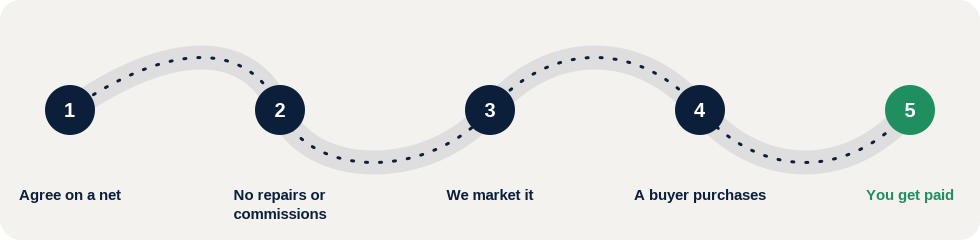
Tennessee is one of our service states, and the five steps are the ones we use everywhere. The seller and Home Pros agree on a net price. The seller pays no repairs and no commissions, and Home Pros covers closing costs. The house gets marketed. A retail buyer purchases. The seller is paid the agreed net at closing, less one $500 transaction coordination fee from proceeds.
What changes in Tennessee is the paperwork. The bold intent-to-market language goes into the purchase agreement before the seller signs it. The listing runs through a partner agent with a Tennessee license, at a stated list price and commission. We work with 300+ investor-friendly agents and have closed hundreds of deals. When a partner brings us a novation, the partner keeps 60% of the net profit and Home Pros keeps 40%.
A novation isn't always the right exit. A retail buyer's lender or inspection can push the closing back or end the deal, so a seller who has to close fast is better off with cash. We'll tell you which one we see. I'm licensed in Texas and hold no Tennessee license, so treat this page as an operator's reading and have Tennessee counsel check your documents.
Partners can start at the partner section of our novation page or submit a deal directly. Too rough to list? We'll look at a cash exit through our buyer network or the deal marketplace. Sellers can read the Tennessee selling guide or the pages for Nashville and Memphis, run the cash offer calculator, and see how to verify Home Pros. Working across the state line? Kentucky, Alabama and Missouri each follow a different statute. The novation pitch scripts cover the seller conversation. For the novation program, call Trevor Rice at (210) 672-1674.
Send the Tennessee deal and we'll tell you which exit fits
Trevor Rice reviews submitted deals for a cash bid and for a novation listing. You'll get both numbers and the Tennessee disclosure language in writing.
Get a cash offer List with Home Pros
Wholesaler with a deal under contract? See the Home Pros novation program or submit the deal.
Frequently Asked Questions
Is a novation legal in Tennessee?
Yes. No Tennessee statute prohibits it. Public Chapter 72 (Tenn. Code Ann. 66-4-401 to 66-4-403) permits wholesaling by assignment with written disclosures and doesn't mention novation. The Real Estate Broker License Act controls who may list, advertise and negotiate the sale.
Does Tennessee's wholesaling law mention novation?
No. Section 66-4-402 defines wholesaling as a buyer who assigns an equitable interest to a subsequent purchaser for a higher price. We found no court decision saying whether a novation counts, so the cautious practice is to give the bold written disclosures anyway.
Do I need a Tennessee real estate license to do a novation?
You don't need one to sign a purchase contract. But 62-13-102(4)(A) treats soliciting, negotiating or advertising a sale for another, for pay, as broker work, and 62-13-103 says a single act is enough. The cautious setup has a Tennessee licensee do the listing, advertising and negotiating.
Can I list a seller's house under a power of attorney without a Tennessee license?
Tennessee exempts an attorney-in-fact under a duly executed and recorded power of attorney. In Tennessee Real Estate Commission v. Hamilton (1998), though, the Court of Appeals held the exemption doesn't cover people who do broker acts as a vocation or for compensation.
Can a Tennessee agent take a net listing?
No. Commission Rule 1260-02-.07 bars a broker or affiliate broker from accepting a listing based on a net price. The seller's agreed net goes in the purchase agreement and the novation agreement. The listing states a list price and a commission.
What is the penalty for unlicensed brokerage in Tennessee?
It's a Class B misdemeanor under 62-13-110, punishable by up to six months and a $500 fine under 40-35-111. A person aggrieved can also recover one to three times the money the unlicensed person received, and the Commission can assess up to $1,000 per violation.
Sources
Sources were read on November 23, 2026. The Commission's Laws page links the official code on LexisNexis. Check current wording there before you rely on a section.
- Public Chapter 72 (S.B. 909, 114th General Assembly), Tenn. Code Ann. 66-4-401 to 66-4-403, and the bill history
- Tennessee Real Estate Commission, spring 2025 newsletter, Legal Update
- Rules of the Tennessee Real Estate Commission, Chapter 1260-02, Rules of Conduct (revised September 2025): rules .07, .08, .11 and .32
- Tennessee Attorney General, Opinion 14-27 (March 6, 2014), broker definition and the corporate exemption, and Opinion 21-01, disbursement of commissions
- Tennessee Real Estate Commission v. Hamilton, No. 01A01-9707-CH-00320 (Tenn. Ct. App. May 29, 1998)
- Tenn. Code Ann. 62-13-102, 62-13-103, 62-13-104, 62-13-110, 62-13-301, 62-13-302, 62-13-312, 62-13-403 and 40-35-111, read on LawServer's 2024 copy

Trevor Rice is a co-founder of Home Pros (Balint Holdings, LLC) and a licensed Texas real estate agent. He runs the Home Pros novation program. Reach him at (210) 672-1674 or trevor@selltohomepros.com. This article is general information, not legal or tax advice.