
Key Takeaways
- Georgia has no wholesaling statute. The words "wholesaling" and "equitable interest" don't appear in the broker license chapter, O.C.G.A. 43-40, as published in the 2025 Georgia Code.
- A Georgia broker is anyone who, "for another" and for pay, negotiates or "assists in procuring prospects" for a sale, or advertises that work. One paid act without a license is a violation (43-40-30).
- Commission Rule 520-1-.06(1)(c) prohibits "net brokerage engagements." The seller's agreed net goes in your purchase agreement. The listing needs a gross price and a stated broker fee.
- Rule 520-1-.09(3) says a licensee can't advertise a house without "the written permission of the owner." The owner is your seller, so get that permission in writing and in plain words.
- In 2003 the Supreme Court of Georgia approved UPL Advisory Opinion 2003-2: only "a duly-licensed Georgia attorney" can close a real estate transaction. Your closing attorney will read the novation agreement, and some decline novations outright.
Not legal advice. This is a plain-language reading of O.C.G.A. 43-40-1, 43-40-25, 43-40-29 and 43-40-30 as published in the 2025 Georgia Code, Georgia Real Estate Commission Rules 520-1-.06 and 520-1-.09 as current through November 6, 2026, and the Supreme Court of Georgia's 2003 opinion on closings, all read on November 24, 2026. Section 43-40-31 was read on a public copy of the official code. Have a Georgia real estate attorney review your contract, disclosures and listing paperwork before you use them.
Is a novation legal in Georgia?
Yes. Nothing in the Georgia Code stops a seller, a first buyer and a retail buyer from agreeing to swap one buyer for another. Two neighbors, Tennessee and Alabama, have written wholesaling statutes. Georgia hasn't. We read the broker license chapter as Justia publishes the 2025 code, and neither "wholesaling" nor "equitable interest" appears in it. We also looked for a published Georgia Real Estate Commission statement on wholesaling or novation and didn't find one. If the Commission puts one out, it'll matter more than anything on this page.
So the contract swap is fine. Selling the house to the public is the part Georgia regulates, through three sources: the license chapter (O.C.G.A. 43-40), the Commission's rules in Chapter 520-1, and the Supreme Court's rule that closings belong to lawyers. Home Pros (Balint Holdings, LLC) read each one. Our Georgia wholesaling law guide covers straight assignments, and the novation hub explains the structure for sellers and partners. This page covers what changes when you list the house instead of selling the paper.
| Georgia source | What it says | On a novation |
|---|---|---|
| O.C.G.A. 43-40-1(2) | A broker acts "for another" and for pay, including "assists in procuring prospects" and advertising | Marketing the house to retail buyers is broker work. A licensee does it |
| O.C.G.A. 43-40-29(a)(2) | Exempts "an attorney in fact under a duly executed power of attorney to convey real estate" | Untested as a business model. Don't build on it |
| Rule 520-1-.06(1)(c) | Brokers can't accept "net brokerage engagements" | The seller's net stays out of the listing |
| Rule 520-1-.09(3) | No advertising without "the written permission of the owner" | The seller signs that permission, not you |
| UPL Advisory Opinion 2003-2 | Only a Georgia attorney may close or facilitate executing the deed | Pick a closing attorney who closes novations before you sign |
Who needs a Georgia license on a novation?
Georgia's definition is broad. Under 43-40-1(2), a broker is any person who, "for another, and who, for a fee, commission, or any other valuable consideration or with the intent or expectation of receiving the same from another," does one of ten things. Paragraph (A) covers anyone who "negotiates or attempts to negotiate, or assists in procuring prospects for the listing, sale, purchase" of real estate. Paragraph (J) adds anyone who "advertises or holds himself or herself out as engaged in any of the foregoing."
Section 43-40-30(a) sets the bar low. A person who performs "any single act" in that definition, expecting to be paid, "shall be deemed a licensee," and "the commission of a single such act" without a license is a violation, so a single paid yard sign on a house you don't own can be enough.
Wholesalers point to the owner and purchaser exemption in 43-40-29(a)(1). It covers a "prospective purchaser" acting on property "to be acquired" by that purchaser, but only where the acts are done "in the regular course of, or as incident to, the management of such property and the investment therein." On a novation you don't plan to acquire anything. The seller deeds the house straight to the retail buyer. I'd have a hard time calling that investment in property you'll manage.
HB 399 amended that exemption effective July 1, 2025, adding an owner's family members (as Commission rules define them) and officers of a limited liability company. That helps an investor's LLC on houses the LLC owns. It doesn't reach a house the LLC only has under contract with someone else's name on the deed.
| Party | License needed? | Source |
|---|---|---|
| Seller | No. An owner acting on property the owner holds is exempt | 43-40-29(a)(1) |
| Listing agent and firm | Yes. Procuring buyers and negotiating a sale for another, for pay | 43-40-1(2)(A); 43-40-30 |
| Unlicensed investor holding the contract | Unsettled for the contract itself. Advertising and negotiating the house sale for a fee is broker work | 43-40-1(2)(A), (J); 43-40-30(a) |
| Investor's LLC officer | Exempt only for property the LLC owns, after HB 399 | 43-40-29(a)(1) |
| Licensed investor holding the contract | Licensed, but must disclose the license and the interest in writing | Rule 520-1-.06(4)(a); 520-1-.09(8); 43-40-25(b)(9) |
There's a money reason to care, too. The annotations to 43-40-1 cite the 11th Circuit's holding in Amend v. 485 Properties (2005) that a brokerage fee agreement with an unlicensed broker is "void and unenforceable." If your fee looks like a commission and the seller balks at closing, you may have nothing to sue on.
Does a power of attorney exempt you in Georgia?
Read literally, Georgia's version is looser than most. Section 43-40-29(a)(2) exempts "an attorney in fact under a duly executed power of attorney to convey real estate from the owner or lessor." Tennessee's matching exemption requires a recorded power. Georgia's text doesn't say recorded, and it doesn't say anything about doing this for a living.
That silence is the risk. Tennessee's Court of Appeals held in 1998 that its attorney-in-fact exemption wasn't "a loophole" for people doing broker work as a business. We didn't find a Georgia decision either way in what we read. A Georgia court looking at an investor who collects powers of attorney from dozens of sellers and earns a spread on each sale would start from 43-40-30's "any single act" language and the 1979 Berchenko decision, quoted in the 43-40-1 annotations, that the legislature meant to require a license "before procuring real property purchasers in return for compensation." I wouldn't want to be the test case.
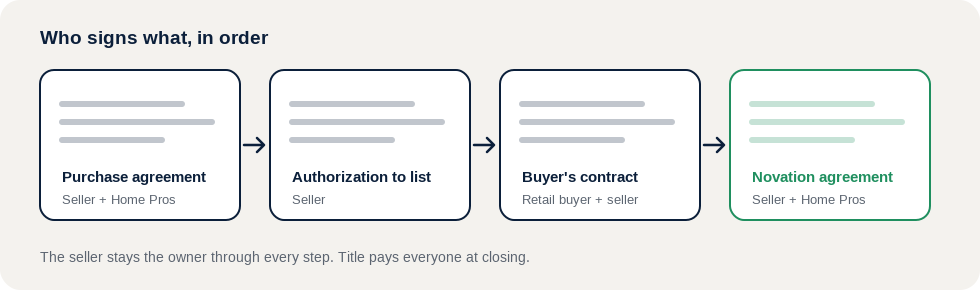
Home Pros asks novation sellers to sign one extra document, a limited authorization to sign listing documents, so a partner agent can list the house. In Georgia we treat it as what it is: written permission from the owner, the thing Rule 520-1-.09(3) asks a licensee to hold before advertising. We don't treat it as a license exemption, and it doesn't change what 43-40-29 says. The person listing, advertising and negotiating is a Georgia licensee.
Can a Georgia agent take a net listing on a novation?
No, and this is where Georgia novations most often get written wrong. Rule 520-1-.06(1)(c) reads: "The Commission prohibits the acceptance by brokers of net brokerage engagements and hereby makes it obligatory upon the broker, when securing the brokerage engagement, to add the broker's fee thereby notifying the client of the gross price of the property and the broker's services."
Every novation starts with a net. That's fine in a purchase agreement, where you're a buyer naming a price. It's a rule violation when the same number gets typed into a brokerage engagement as "seller gets this, the brokerage keeps the rest."
Here's an illustration, not a real deal. A seller in East Point agrees to net $215,000, and your purchase agreement says $215,000. The listing agreement the Georgia agent signs shows a gross list price, say $264,900, and the broker's fee as a percentage or a flat number. The novation agreement then says how the gap between the retail contract price and the seller's net gets paid out. The net lives in your contract and the novation agreement, and it stays off the listing. Pull that list price from sold comps, not hope. Compr, our sister company, has a free tool that pulls sold comps and returns an ARV and a max offer for wholesale deals.
Two more Georgia listing rules. Section 43-40-25(b)(18) makes it an unfair practice to fail "to include a fixed date of expiration in any written listing agreement" and to leave the seller a copy, and Rule 520-1-.06(1)(a) says the same about exclusive agreements. An authorization that runs "until it sells" won't pass. And under 43-40-25(b)(19), the licensee has to deliver a completed copy of every purchase offer to the seller. Lowball offers included, and I think that's right, because the seller still owns the house.
Who can advertise the house in Georgia?
A licensee, with the owner's written permission. Rule 520-1-.09(3): "A licensee shall not advertise any real estate for sale, rent, lease, or exchange unless the licensee has first secured the written permission of the owner, the owner's authorized agent, or the owner of a leasehold estate."
On a novation the owner is the seller, not you. A clause buried in your purchase agreement giving you "the right to market" doesn't hand the agent the owner's permission. Have the seller sign it directly, name the brokerage, and say plainly that the house will be listed for sale to the public.
If you hold a Georgia license yourself, the rules get stricter. Rule 520-1-.09(8) requires your ads to carry a legend such as "seller, buyer, landlord, tenant ... holds a real estate license" or your Georgia license number. Rule 520-1-.06(4)(a) says no licensee may buy an interest in property the licensee or the licensee's firm has been asked to list "unless the licensee shall clearly disclose the licensee's position as a buyer to the seller" and "insert a clause to this effect in the contract." Section 43-40-25(b)(9) separately bans acting "in the dual capacity of agent and undisclosed principal." Spell out your contract position to the retail buyer too.
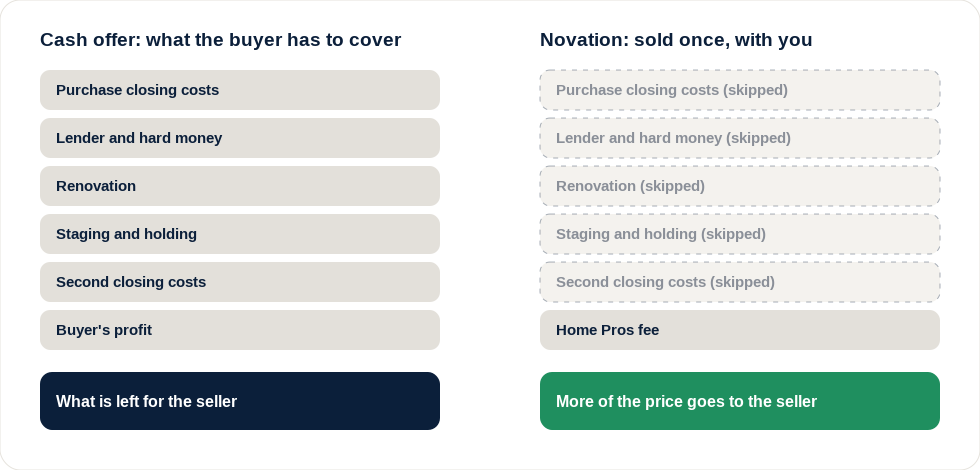
And the money: 43-40-25(b)(17) makes it an unfair practice for a licensee to pay "a commission or compensation" to anyone "for performing the services of a real estate licensee" who isn't licensed. Your agent can't kick part of the commission to you. Your share comes from your contract position, written into the novation agreement and shown on the settlement statement.
Who closes a Georgia novation?
A Georgia lawyer. On November 10, 2003, the Supreme Court of Georgia approved UPL Advisory Opinion 2003-2, 588 S.E.2d 741. The court wrote that "it is the unauthorized practice of law for someone other than a duly-licensed Georgia attorney to close a real estate transaction or to prepare or facilitate the execution of such deed(s) for the benefit of a seller, borrower, or lender." A title company can't run the closing table alone.
That shapes a novation more than investors expect. The closing attorney sees the purchase agreement, the novation agreement, the retail contract and the settlement statement, and has to be comfortable with all of them. At least one Georgia closing firm, Georgia Title, posts that it doesn't close novations, assignments or double closings at all. Call the closing attorney before your seller signs, send the documents, and ask directly. Finding out at the clear-to-close stage is how a deal slips by weeks.
One more Georgia wrinkle. The settlement statement is where the seller sees the retail price, the agreed net and your share. Write your contract so the seller already knows all three before that day. A seller who finds out at the table how big your spread is will ask the closing attorney questions, and the closing attorney doesn't work for you.
What should you never do on a Georgia novation?
Most Georgia novation trouble starts with one of these.
- Don't advertise the house yourself if you're unlicensed. "Advertises or holds himself or herself out" is in the broker definition.
- Don't let the listing be written as a net listing. Rule 520-1-.06(1)(c) prohibits it.
- Don't list without the owner's written permission. Rule 520-1-.09(3) puts that on the agent, and your deal dies with the listing.
- Don't build the business on powers of attorney. The exemption's text is loose, and its limits are untested here.
- Don't take a cut of the commission. Section 43-40-25(b)(17) makes paying an unlicensed person an unfair practice for the licensee.
- Don't hide the novation, the partner or the fee from the seller. Our scripts disclose all three, every time.
For an unlicensed person, the Commission can issue a cease and desist order under 43-40-30(c). It becomes final in ten days unless you ask for a hearing. Breaking it lets the Commission "impose a fine not to exceed $1,000.00 for each transaction constituting a violation of such order," and "each day that a person practices in violation of this chapter shall constitute a separate violation." Section 43-40-31 makes unlicensed practice a misdemeanor.
A licensee faces 43-40-25(a): suspension, revocation, and fines up to $1,000 per violation, capped at $5,000 in one disciplinary proceeding. And there's Amend: an unlicensed fee agreement that a court won't enforce.
How does Home Pros handle a Georgia novation?
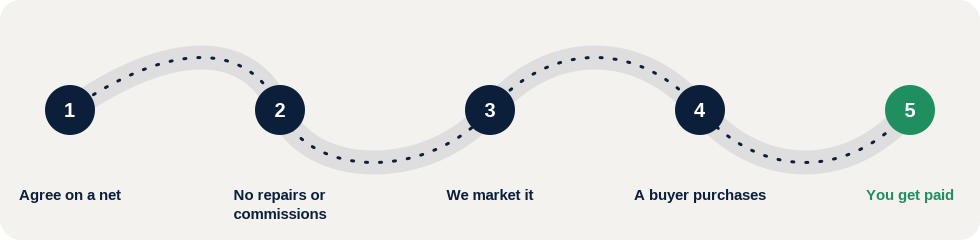
Georgia is one of our service states, and the five steps are the ones we use everywhere. The seller and Home Pros agree on a net price. The seller pays no repairs and no commissions, and Home Pros covers closing costs. The house gets marketed. A retail buyer purchases. The seller is paid the agreed net at closing, less one $500 transaction coordination fee from proceeds.
What changes in Georgia is who touches the file. A partner agent with a Georgia license lists the house at a gross price with a stated fee. The seller signs the written permission to advertise. A Georgia closing attorney who closes novations gets the documents early. We work with 300+ investor-friendly agents and have closed hundreds of deals. When a partner brings us a novation, the partner keeps 60% of the net profit and Home Pros keeps 40%.
Sometimes cash is the better exit. A retail buyer's lender or inspection can push the closing back or end the deal, and a seller with a foreclosure sale on the calendar may not have that time. We'll say which one we'd pick. I'm licensed in Texas and hold no Georgia license, so treat this page as an operator's reading and have Georgia counsel check your documents.
Partners can start at the partner section of our novation page or submit a deal directly. Too rough to list? We'll look at a cash exit through our buyer network or the deal marketplace. Sellers can read the Georgia selling guide or the pages for Atlanta and Savannah, and investors working a pre-foreclosure should read our Georgia foreclosure guide. Working across the state line? Tennessee and Alabama each follow a different statute. The novation pitch scripts cover the seller conversation. For the novation program, call Trevor Rice at (210) 672-1674.
Send the Georgia deal and we'll tell you which exit fits
Trevor Rice reviews submitted deals for a cash bid and for a novation listing. You'll get both numbers in writing, and we'll tell you how we'd paper the Georgia listing.
Get a cash offer List with Home Pros
Wholesaler with a deal under contract? See the Home Pros novation program or submit the deal.
Frequently Asked Questions
Is a novation legal in Georgia?
Yes. No Georgia statute prohibits it, and Georgia has no wholesaling act. The broker license chapter, O.C.G.A. 43-40, controls who may advertise and negotiate the sale for pay, and Real Estate Commission rules control how the listing is written.
Does Georgia have a wholesaling law?
No. The words wholesaling and equitable interest don't appear in O.C.G.A. 43-40 as published in the 2025 Georgia Code, and we found no published Commission statement on wholesaling or novation as of November 24, 2026.
Do I need a Georgia real estate license to do a novation?
Not to sign a purchase contract. But 43-40-1(2) treats assisting in procuring prospects, negotiating or advertising a sale for another, for pay, as broker work, and 43-40-30 says a single act is a violation. The cautious setup has a Georgia licensee do the listing, advertising and negotiating.
Can a Georgia agent take a net listing?
No. Commission Rule 520-1-.06(1)(c) prohibits net brokerage engagements and requires the broker to add the fee so the client sees the gross price. The seller's agreed net goes in the purchase agreement and the novation agreement.
Does a Georgia novation need a closing attorney?
Yes. In 2003 the Supreme Court of Georgia approved UPL Advisory Opinion 2003-2, holding that only a duly licensed Georgia attorney may close a real estate transaction or facilitate executing the deed. Confirm your closing attorney handles novations before the seller signs.
What is the penalty for unlicensed brokerage in Georgia?
It's a misdemeanor under 43-40-31. The Real Estate Commission can also issue a cease and desist order, and violating it allows a fine of up to $1,000 per transaction, with each day counted as a separate violation. A fee agreement with an unlicensed broker is also unenforceable.
Sources
Sources were read on November 24, 2026. Georgia's official code is published by LexisNexis for the General Assembly. Check current wording there before you rely on a section.
- O.C.G.A. 43-40-1 (definitions and annotations), 43-40-25 (sanctions and unfair trade practices), 43-40-29 (exceptions, as amended by HB 399, effective July 1, 2025) and 43-40-30 (acting without a license), 2025 Georgia Code on Justia
- O.C.G.A. 43-40-31 (penalty), read on the Public.Resource.Org copy of the official code
- Georgia Real Estate Commission, Rule 520-1-.06, Brokerage Relationships, and Rule 520-1-.09, Advertising, current through rules filed November 6, 2026
- Supreme Court of Georgia, In re UPL Advisory Opinion 2003-2, 588 S.E.2d 741 (Ga. Nov. 10, 2003)
- Georgia Title, Wholesaling, Double Closings, Assignments and Creative Finance, a closing firm's published intake policy

Trevor Rice is a co-founder of Home Pros (Balint Holdings, LLC) and a licensed Texas real estate agent. He runs the Home Pros novation program. Reach him at (210) 672-1674 or trevor@selltohomepros.com. This article is general information, not legal or tax advice.