Key Takeaways
- Section 40-57-30(44), added by Act 204 on May 21, 2024, defines wholesaling as holding a purchase contract, "then marketing the property for sale to a different buyer prior to taking legal ownership."
- The Real Estate Commission updated its advisory opinion on October 14, 2026: "The use of a novation does not remove a transaction from the statutory definition of wholesaling."
- The Commission counts the MLS, social media, Facebook groups, private email groups and "verbal communication" as marketing.
- Section 40-57-350 bars brokerage firms and their subagents from "engaging in, representing others in, or assisting others in the practice of wholesaling," so a partner agent can't fix it.
- Section 40-57-725 lets the department cite unlicensed individuals: up to $500, then $1,000, then $10,000. Unlicensed practice is also a misdemeanor under Section 40-1-200.
Not legal advice. This is a plain-language reading of S.C. Code Sections 40-57-20, 40-57-30, 40-57-135, 40-57-240, 40-57-350, 40-57-710, 40-57-720, 40-57-725, 40-1-200, 40-1-210 and 39-5-140 as published by the South Carolina Legislature, the H.4754 bill page, the Real Estate Commission's advisory opinion on wholesaling (dated November 14, 2024, updated October 14, 2026) and its June 2024 summary of Act 204, and the Supreme Court's opinion in Boone v. Quicken Loans, all read on November 25, 2026. Have a South Carolina real estate attorney review any structure before you use it.
Is a novation legal in South Carolina?
As a contract, yes. As a way to resell a house you hold under contract, no, and the regulator has said so in writing. Most state guides in our novation guide hub land on yes, as long as a licensee does the marketing. South Carolina doesn't work that way.
The reason is Act 204. H.4754 passed the House 111 to 0 on March 5, 2024 and the Senate 43 to 0 on May 9, and the governor signed it on May 21, 2024. It put a definition into Section 40-57-30(44): wholesaling "means having a contractual interest in purchasing residential real estate from a property owner, then marketing the property for sale to a different buyer prior to taking legal ownership of the property."
Read that against a standard novation. You sign a purchase contract with the owner. The house gets marketed. A retail buyer takes your place. That's three for three. Home Pros (Balint Holdings, LLC) read the chapter, the bill history and everything the Real Estate Commission has published on the subject. Our South Carolina wholesaling law guide covers Act 204 and assignments. This page covers what the Commission added about novations last month.
| South Carolina source | What it says | On a novation |
|---|---|---|
| Section 40-57-30(44) | Wholesaling is holding a purchase contract, "then marketing the property for sale to a different buyer" before taking title | Describes the usual novation step by step |
| Commission advisory opinion, updated October 14, 2026 | "The use of a novation does not remove a transaction from the statutory definition of wholesaling" | Swapping the instrument doesn't change the answer |
| Section 40-57-350(A) and (L)(5) | Firms and subagents can't engage in, represent others in, or assist wholesaling | A partner agent who lists the house is exposed |
| Section 40-57-135(E)(1) | A licensee needs a written listing agreement "between the property owner and the real estate brokerage firm" | The owner hires the firm. You can't hire it for them |
| Section 40-57-725 | Citations of up to $500, $1,000 and $10,000, including against unlicensed individuals | The Commission can cite you without a license to pull |
What did the Real Estate Commission say on October 14, 2026?
It answered the novation question by name. The Commission first published its advisory opinion on wholesaling on November 14, 2024. The opening paragraph says the revised act "includes a prohibition on the practice known as 'wholesaling.'" On October 14, 2026 it added a section because, in its words, "questions have arisen regarding the use of novation in residential real estate transactions and whether a novation may be used to avoid South Carolina's restrictions on wholesaling."
The update is five paragraphs long, and the last one states the conclusion: "a novation is not a means of avoiding South Carolina's wholesaling requirements. Where the statutory elements of wholesaling are present, substituting a new buyer through a novation does not alter the character of the underlying activity."
The 2024 opinion had already listed those elements. There are four: a contractual interest in buying residential real estate from an owner, marketing or advertising the property before taking ownership, expecting compensation, and "using a legal instrument, such as an assignment, to transfer the interest to a third party for the compensation." A common argument is that a novation isn't an assignment, so the fourth element is missing. The Commission's reply is that the name on the paper doesn't decide it. It "will look to the substance of the transaction and the activities of the parties, rather than the name or form of the contractual mechanism used to substitute the ultimate buyer."
An advisory opinion isn't a statute, and a court could read Section 40-57-30(44) differently. We wouldn't bet a deal on that. The Commission is the body that investigates complaints and writes the citations, and it has now told you how it'll read your file.
What counts as marketing the property?
Nearly everything. The opinion says the Commission "has repeatedly held that marketing and advertising include MLS, social media, print media, Facebook groups, private email groups, verbal communication, etc." Marketing is "broadly construed to include any effort to make the offering of the property known to others."
Verbal communication is on that list. So is a private email group, and a buyers list is one. If you're under contract and you call three investors to say you've got a brick ranch in West Ashley, the Commission would call that marketing.
Section 40-57-135(E)(1) does allow one kind of ad: one that "markets a contractual position" and "does not imply, suggest, or purport to sell, advertise, or market the underlying real property." The Commission calls complying with that "practically impossible," because "there is no market for purchasing random contracts for unknown items." It lists nine things that would likely cross the line when an unlicensed person includes them. The list covers a photo, the address or tax map number, the bedroom count or square footage, the year built, the condition, rental history, and even the neighborhood or subdivision.
The October update carries the same test over to novations. It reaches an original buyer who "uses identifying information concerning the property" to "solicit or locate another buyer and thereafter uses a novation to substitute that buyer into the transaction." Price is on that list too.
The only example of compliance the Commission offers is passive. A person holding a contract "is approached about contracts they hold on properties in a particular area, without making any effort to market or advertise the property for sale." You can't build a business on waiting for the phone to ring, and we think that's the point.
Can a licensed agent list a house you have under contract?
This is where South Carolina differs most from its neighbors. In North Carolina and Georgia, bringing in a licensed firm is the fix. Here the statute closes that door. Section 40-57-350(A) says a brokerage firm and its subagents "are prohibited from engaging in, representing others in, or assisting others in the practice of wholesaling." Subsection (L)(5) repeats the sentence for customers, so the firm can't get around it by declining to represent anyone.
The Commission's June 2024 summary of Act 204 puts it in one line: "Licensees are prohibited from wholesaling because of duties owed to clients." If you hold a purchase contract and an agent puts that house on the MLS to find your replacement buyer, the agent is the one assisting.
The listing rules point the same way. Under Section 40-57-135(E)(1), a licensee can't advertise or market a house owned by someone else "without first obtaining a written listing agreement between the property owner and the real estate brokerage firm with whom the licensee is associated." Subsection (I)(2) requires that agreement to carry "the signatures of all parties," "specific dates for the beginning and ending of the relationship," and the list price.
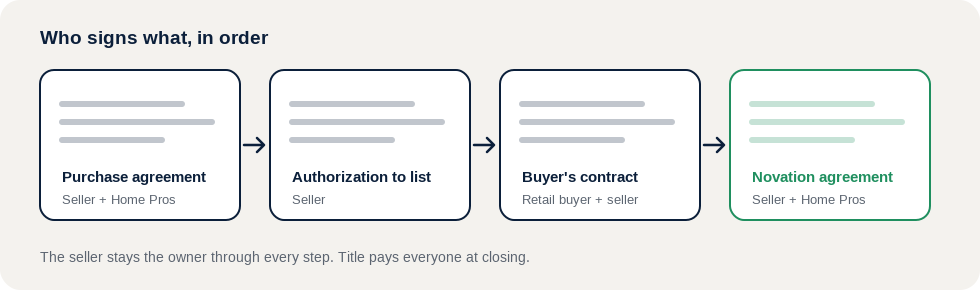
In other states Home Pros asks novation sellers to sign a limited authorization to sign listing documents, so a partner agent can list the house. It is what its name says. It isn't a license exemption, and it can't change what Sections 40-57-30(44) and 40-57-350 say. Whether a signature under that authorization would even count as the owner's signature on a South Carolina listing agreement is a question for the firm's broker-in-charge and a South Carolina attorney.
Money is the last problem. Section 40-57-710(A)(12) lets the Commission discipline a licensee who "pays a commission or compensation to an unlicensed individual for activities requiring a license." It adds that a licensee "may not pay or offer to pay a referral fee or finder's fee to an unlicensed individual who is not a party in the real estate sales or rental transaction." Once the retail buyer takes your seat, you'd have to explain why you're still a party.
What are the penalties in South Carolina?
There are four layers, and Act 204 added the fastest one. Section 40-57-725 is new. It lets the department "issue administrative citations and cease and desist orders in person or by certified mail" and assess penalties "against any individual or entity, including unlicensed individuals." You get ten days to appeal. After that the citation is a final order, and you have thirty days from receipt to pay.
| Source | Who it reaches | Exposure |
|---|---|---|
| Section 40-57-725(C) | Anyone, licensed or not | Up to $500 for a first violation, $1,000 for a second within five years, $10,000 for a third or later |
| Section 40-57-720(E)(2) | Licensees | Fine of up to $10,000 per violation, plus license discipline and costs |
| Section 40-1-200 | Anyone practicing without a license | Misdemeanor: up to one year in jail or a fine of up to $50,000 |
| Section 40-1-210 | Anyone violating the article or a board order | Injunction in the Administrative Law Court and up to $10,000 per violation |
| Section 39-5-140 | Anyone sued by a seller for an unfair or deceptive practice | Actual damages, tripled if willful or knowing, plus attorney's fees |
The criminal piece comes from Title 40, Chapter 1, which Section 40-57-5 applies to real estate. Section 40-57-20 makes it unlawful "to advertise or provide services" as a broker or associate "without an active, valid license," and the wholesaling definition says marketing someone else's real estate for expected pay "falls under the definition of 'broker' and requires licensure."
The citation schedule looks small. Don't read it that way. Each deal can be its own violation, the third one in five years is $10,000, and the Commission's maximum fine for licensees doubled from $5,000 under the same act. Your agent has far more to lose than you do, which is why the good ones will turn this down.
What can an investor still do with a South Carolina deal?
Less than in any state we've covered, and we'd rather tell you that than sell you a workaround. Here's what the text leaves open.
- Buy it and own it. Section 40-57-240(1) exempts an unlicensed owner selling an interest that "is identical to the owner's legal interest." Close first, then sell. That takes real funds, two sets of closing costs, and an attorney who'll run both closings.
- Assign without marketing. The Commission's own examples of assignments that aren't wholesaling are a spouse, your own entity, or "another person" where "there is no marketing, advertising, or expectation of compensation." That's a narrow lane, and an assignment fee is compensation.
- Step aside. If the house would bring more on the open market than you can pay, the owner can hire a South Carolina brokerage and list it. You don't get paid for that. Sometimes it's still the right call for the seller.
- Bring in a buyer who closes. A direct cash buyer who takes title in its own name isn't marketing anyone else's house.
Before you tie up funds on a buy-and-close, check the resale number against sold comps, not list prices. Compr, our sister company, built a free tool for wholesale deals that pulls the comps and returns an ARV and a max offer.
One thing we haven't found is a published Commission answer on a deal where the investor cancels its purchase contract before any marketing starts and the owner then lists with a firm directly. The first element, a contractual interest, would be gone. Whether the investor could be paid anything after that is another matter, given Section 40-57-710(A)(12). Ask a South Carolina attorney, or ask the Commission. The opinion invites both.
Who closes a South Carolina deal, and will they take a novation?
A South Carolina lawyer, and the lawyer may say no. In Boone v. Quicken Loans, filed July 19, 2017, the Supreme Court restated the steps of a residential purchase that "must be performed or supervised by a South Carolina-licensed attorney." They are preparing deeds and loan instruments, examining title, overseeing the closing, and directing how documents are recorded. The court added a fifth in 2006: disbursing the funds.
So an attorney sees every document in the file. On a novation that means your purchase contract, the listing agreement, the retail contract, the novation agreement and the settlement statement, side by side. A closing attorney who has read the October update knows what that stack looks like.
Some firms have already drawn the line. The Cloud Law Firm closes investor deals in both Carolinas, and its creative closings page says assignment contracts and novations "are available only for North Carolina properties." The firm "does not handle assignment contracts or novations for properties located in South Carolina." Call your closing attorney before the seller signs anything. If the answer is no, you want it on day one and not a week before closing. More on working with closing attorneys is in our guide to evaluating a deal in an attorney-closing state.
How does Home Pros handle a South Carolina deal?
South Carolina is one of our service states. We buy houses there for cash, as-is, and we take title. Our written offers go out within 24 hours, and we can close in as little as 7 days.
The novation program is a different product. It works the same way in each state where we run it: the seller and Home Pros agree on a net price, the house is marketed while we're under contract, a retail buyer purchases, and the seller is paid the agreed net less one $500 transaction coordination fee. Partners who bring us a novation keep 60% of the net profit and Home Pros keeps 40%.
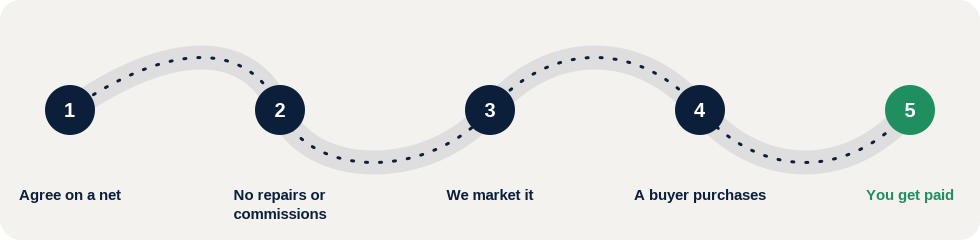
Look at step three. Marketing a house while holding a contract to buy it is the fact pattern in the Commission's update. I'm licensed in Texas and hold no South Carolina license, so treat this as an operator's reading. We can't square our standard novation with that text, and we won't tell a partner to try it on the strength of a blog post, ours included. A South Carolina attorney would have to clear the structure in writing first.
That leaves cash. If you've got a South Carolina house under contract and no clean way out, submit the deal and we'll tell you whether we can buy it. Our buyer network and the deal marketplace are for buyers who close in their own names. Partners working other states can start at the partner section of our novation page, and the program page lays out the five steps.
If you're a homeowner who landed here, the South Carolina selling guide and the pages for Charleston and Columbia are written for you. The cash offer calculator shows how we get to a number, and Is Home Pros legit? covers who we are. If a sale date is already set, read how long foreclosure takes in South Carolina first. For the novation program in other states, call Trevor Rice at (210) 672-1674.
Send the South Carolina deal and get a straight answer
Trevor Rice reviews submitted deals. For South Carolina you'll get a written cash bid when we can buy it, and a plain no when we can't.
Get a cash offer List with Home Pros
Wholesaler with a deal under contract? Submit the deal or see how the novation program works in other states.
Frequently Asked Questions
Is a novation legal in South Carolina?
A novation contract isn't unlawful by itself. But on October 14, 2026 the South Carolina Real Estate Commission said a novation is not a means of avoiding the state's wholesaling requirements. If you hold a purchase contract, market the house before taking title and expect to be paid, the Commission treats it as wholesaling.
Does South Carolina law mention novation by name?
The statute doesn't. Section 40-57-30(44) defines wholesaling without naming any instrument. The Real Estate Commission's advisory opinion does: its October 14, 2026 update says the use of a novation does not remove a transaction from the statutory definition of wholesaling.
Can an agent list a South Carolina house I have under contract?
Not without risking the license. Section 40-57-350 bars a brokerage firm and its subagents from engaging in, representing others in, or assisting others in wholesaling. Section 40-57-135(E)(1) also requires a written listing agreement between the property owner and the firm.
Is assigning a contract still allowed in South Carolina?
Only in a narrow lane. The Commission says an assignment isn't automatically wholesaling, and gives a spouse or your own entity as examples. An assignment that involves marketing the property with an expectation of compensation is wholesaling, and the Commission counts verbal communication and private email groups as marketing.
What is the penalty for wholesaling in South Carolina?
Section 40-57-725 allows citations against unlicensed individuals of up to $500 for a first violation, $1,000 for a second within five years and $10,000 for a third. Unlicensed practice is a misdemeanor under Section 40-1-200, with up to one year in jail or a fine of up to $50,000.
Does a South Carolina closing need an attorney?
Yes. In Boone v. Quicken Loans (2017), the Supreme Court restated that preparing deeds, examining title, overseeing the closing, directing recording and disbursing funds must be performed or supervised by a South Carolina-licensed attorney. Ask the attorney about your structure before the seller signs.
Sources
Sources were read on November 25, 2026. Statute pages are the Legislature's online Code of Laws. Check current wording there before you rely on a section.
- S.C. Code Title 40, Chapter 57: Sections 40-57-5, 40-57-20 (license required), 40-57-30 (definitions, including "broker" and "wholesaling"), 40-57-135 (advertising and listing agreements), 40-57-240 (exemptions), 40-57-350 (duties of brokerage firms), 40-57-710, 40-57-720 and 40-57-725 (discipline and penalties)
- S.C. Code Title 40, Chapter 1: Sections 40-1-200 (unlawful practice) and 40-1-210 (civil proceedings), and Title 39, Chapter 5: Sections 39-5-20 and 39-5-140 (Unfair Trade Practices Act)
- South Carolina General Assembly, H.4754 (Act 204 of 2024), bill history and votes
- South Carolina Real Estate Commission, Advisory Opinion on Exceptions to Wholesaling, November 14, 2024, updated October 14, 2026, and 2024 Changes to the Real Estate Practice Act, June 2024
- Supreme Court of South Carolina, Boone v. Quicken Loans, Inc., Opinion No. 27727, filed July 19, 2017
- The Cloud Law Firm, LLC, Investor and Creative Closings (a law firm's service page, cited for what that firm will close)

Trevor Rice is a co-founder of Home Pros (Balint Holdings, LLC) and a licensed Texas real estate agent. He runs the Home Pros novation program. Reach him at (210) 672-1674 or trevor@selltohomepros.com. This article is general information, not legal or tax advice.