
Key Takeaways
- House Enrolled Act 1068 (P.L.47-2024) added IC 32-21-16.5. It covers agreements entered into or renewed after June 30, 2024.
- An unlicensed investor soliciting a single-family homeowner must include "This solicitation is not from a licensed real estate professional." plus their legal name and the legal name of the expected buyer, if that's someone else.
- Investors who plan to take title, record the deed and keep the house as a home or investment are outside the chapter. A novation investor never takes title, so that exemption doesn't fit.
- If the disclosure is missing or wrong, the homeowner can cancel in writing within two days with no liability, and the Attorney General can treat it as a deceptive act.
- Listing or negotiating a sale "for consideration" without a license is a Class A infraction under IC 25-34.1-6-2, the court adds the fee you earned to the fine, and you can't sue to collect a fee for unlicensed work.
Not legal advice. This is a plain-language reading of the Indiana Code as published by the Indiana General Assembly and read on November 19, 2026. Have an Indiana real estate attorney review your contract, solicitation copy and listing paperwork before you use them.
Is a novation legal in Indiana?
Yes, as long as a licensed broker is the one listing and marketing the house. The Indiana Code doesn't use the word novation. Nothing in it stops a homeowner from listing while an investor's purchase agreement is in place, and nothing stops the investor from being paid at closing. Indiana regulates two other things: how you approach the homeowner, and who may sell or list real estate for pay.
That split matters. Kentucky and Pennsylvania rewrote their broker definitions to pull wholesaling inside the license act. Indiana didn't. In 2024 it passed House Enrolled Act 1068, now IC 32-21-16.5, which sits in the property title, not the license title. It's a marketing disclosure law. It tells unlicensed investors what to say on the postcard, the text and the phone call, and it gives homeowners a way out when you don't say it.
So an Indiana novation has two separate tests to pass. The first is your first contact with the seller. The second is everything after the contract is signed, when the house goes up for sale. The Home Pros novation hub explains the structure itself. This page sticks to Indiana law.
What does Indiana's 2024 solicitor law require?
One sentence, word for word: "This solicitation is not from a licensed real estate professional." Section 4 says an unlicensed real estate solicitor "may not solicit the sale or purchase of a residential, single-family home" without it. Written pitches need it "legible and in plain sight." Spoken pitches need it said "clearly and audibly," at the same volume and clarity as the rest of the call.
Then comes the part most Indiana wholesalers get wrong. The disclosure "must include the legal name of the unlicensed real estate solicitor and the legal name of the person that is expected to purchase" the home, if that's someone other than you. Your LLC's legal name, not "We Buy Indy Houses." And if your plan is to have a partner or another company take the deal, their legal name goes in too.
Section 2 defines solicitation broadly, from postcards to Facebook posts.
| Channel | Covered by IC 32-21-16.5-2? | How the disclosure has to appear |
|---|---|---|
| Postcards and letters | Yes, "post card or other mailer" | Legible, in plain sight |
| Bandit and yard signs | Yes, "yard sign" | Legible, in plain sight |
| Cold calls and voicemails | Yes, "telephone call" | Spoken clearly and audibly |
| SMS and email | Yes, "text message" and "electronic mail" | Legible, in plain sight |
| Your website and social posts | Yes, "website" and "social media" | Legible, in plain sight |
| Radio, TV, billboards, print ads | Yes, all listed | Written or spoken to match the medium |
Section 5 adds a check before signing: you must tell the homeowner "whether any information provided in the disclosure" has changed. If your buyer's name changed between the postcard and the kitchen table, say so before the pen comes out. On a novation that's a real issue, because the house will end up with a retail buyer nobody has met yet. The statute doesn't say how to name a buyer you haven't found. Our view: say in writing that the house will be listed and sold to a retail buyer, and get your attorney's read on the rest.
Does the investor exemption cover a novation?
Probably not, and this is the Indiana detail other guides skip. Section 3 carves several groups out of "unlicensed real estate solicitor": home builders, 501(c)(3) nonprofits, government, people already exempt under IC 25-34.1-3-2(b), and a person who "offers to purchase a home, or purchases a home, with the intent to" both "take title to the home and record the deed" and "use the home as a personal residence or as an investment."
Read the word "and." A flipper who closes, records the deed and renovates is out of the chapter. A buy-and-hold landlord is out. A novation investor never takes title. One deed goes from the seller straight to the retail buyer. Neither half of that exemption describes the deal.
| Investor | Takes title and records? | Disclosure required? |
|---|---|---|
| Flipper closing with a hard money loan | Yes | No, if the intent is real when they offer |
| Landlord buying a rental | Yes | No |
| Wholesaler planning an assignment | No | Yes |
| Investor planning a novation | No, one deed seller to retail buyer | Yes |
| Licensed Indiana broker | Either | No, the chapter only covers unlicensed people |
Intent is measured when you make the offer. If you mail a list hoping to flip and later decide a house is a better novation, you've changed plans after the solicitation went out. Put the sentence on everything. It costs one line of ink.
The penalty for skipping it isn't a fine schedule. It's leverage. Under section 6, if the disclosure doesn't meet section 4, the homeowner "may nullify the agreement" by written rescission within two days and "is not liable" for doing it. A violation is also "a deceptive act that may be enforced by the attorney general under IC 24-5-0.5-11." A contract a seller can walk away from isn't much of a contract.
Who has to be licensed on an Indiana novation?
The license rule is old and wide. IC 25-34.1-3-2(a) says no person shall, "for consideration, sell, buy, trade, exchange, option, lease, rent, manage, list, or appraise real estate or negotiate or offer to perform any of those acts" in Indiana without a license. Notice "list" and "negotiate." Those are the two jobs a novation needs done.
One quirk cuts the other way. IC 25-34.1-1-2 defines real estate as "any right, title, or interest in real property," and subsection (b)(8) of 3-2 exempts "acts performed by a person in relation to real estate owned by that person." Some Indiana wholesalers argue their contract is an interest they own, so marketing it's exempt. It's an argument. We haven't seen the Indiana Real Estate Commission publish a position on it, and a novation weakens it anyway, because what gets marketed is the seller's house, not your contract.
| Party | License needed? | Source |
|---|---|---|
| Seller | No. Acts on your own property are exempt | IC 25-34.1-3-2(b)(8) |
| Listing broker | Yes. Listing and negotiating for pay is licensed work | IC 25-34.1-3-2(a) |
| Unlicensed investor holding the contract | Stay hands-off: the broker lists, shows and negotiates | IC 25-34.1-3-2(a), 32-21-16.5 |
| Licensed Indiana broker as investor | Licensed, and outside the solicitor chapter, but acts under a managing broker | IC 25-34.1-1-2, 32-21-16.5-3 |
That last row deserves a second look. Indiana's broker definition includes "acting in association with and under the auspices of a managing broker and broker company." If you hold an Indiana license and do novations on the side, talk to your managing broker before you sign a seller.
Does a power of attorney or limited authorization help in Indiana?
No. Indiana's exemption list in IC 25-34.1-3-2(b) is longer than most, with thirteen items, and none of them is an attorney in fact. The closest one, (b)(3), covers "a receiver, executor, administrator, commissioner, trustee, or guardian" acting on property they represent "pursuant to court order or a will." A power of attorney signed at a kitchen table isn't either of those.
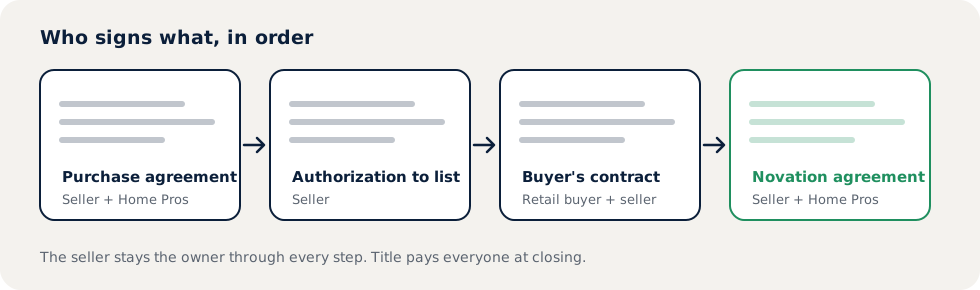
Home Pros asks novation sellers to sign one extra document, a limited authorization that lets partner agents sign listing paperwork for the house. It helps a seller who's moved to Fort Wayne for work or can't take calls on a shift. It doesn't make anyone exempt from a license, and we don't pitch it that way. In Indiana it should name the licensed broker, state the list price and terms the seller approved, and leave the retail purchase agreement and the deed for the seller's own signature.
What disclosures does an Indiana novation need?
Three, at three different moments.
The first is the solicitor sentence and legal names, on every pitch, before any contract. The second is the change check from section 5, right before the seller signs. The third is the property form. IC 32-21-5-10(a) says an owner "must complete and sign a disclosure form and submit the form to a prospective buyer before an offer for the sale of the residential real estate is accepted." The Commission adopted the form by rule in 876 IAC 9-1-1.
On a cash purchase, an investor often never sees that form. On a novation the seller is selling to a stranger on the open market, and the listing broker will want it filled out before the first showing. Plan for the conversation. Sellers of a rough house in Gary or a dated ranch in Muncie may have a lot to write down.
| Disclosure | Who gives it | When | Source |
|---|---|---|---|
| "Not from a licensed real estate professional" plus legal names | Unlicensed investor | Every solicitation | IC 32-21-16.5-4 |
| Whether any disclosed information changed | Unlicensed investor | Before the written agreement | IC 32-21-16.5-5 |
| Seller's residential disclosure form | Seller signs, broker delivers | Before the buyer's offer is accepted | IC 32-21-5-10 |
| The novation, the partner and the fee | Everyone on the Home Pros side | Before the seller signs anything | Our scripts |
How does the money move on an Indiana novation?
One deed, seller to retail buyer. The seller agreed to a net number at the start. The buyer pays more. Out of the gross come the payoff, title charges, the listing broker's fee and the seller's agreed net. What's left is the investor side, on its own labeled line of the settlement statement. Don't rename it. Don't bury it in a credit.
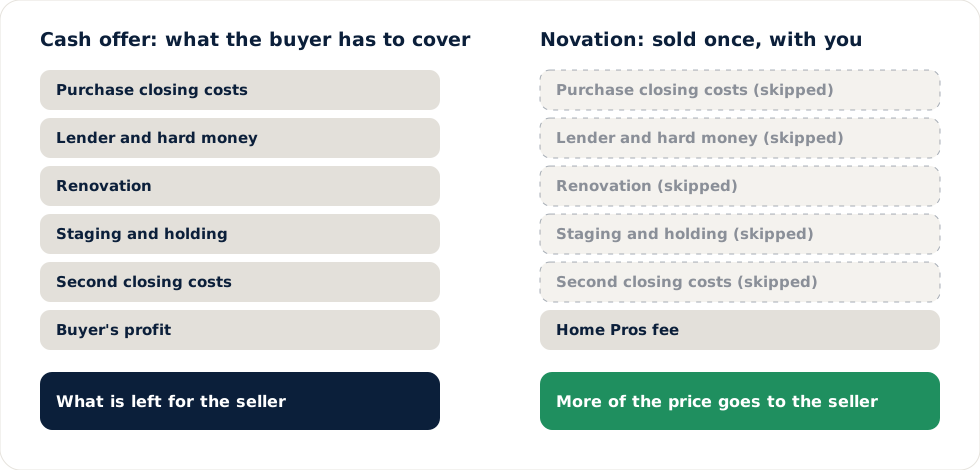
Indiana adds a twist that should change how you draft. IC 25-34.1-6-2(b) says that in "all actions for the collection of a fee or other compensation for performing acts regulated by this article," the person suing must prove they weren't violating the license law when the claim arose. Picture a seller who backs out after your broker lines up a buyer. If your spread looks like pay for listing or negotiating, collecting it in court gets harder. Your money should flow from your contract position as a purchaser, in writing, not from "services."
When a partner brings a novation to Home Pros, the split is 60% of the net profit to the partner and 40% to Home Pros. The seller pays one $500 transaction coordination fee from proceeds at closing, and Home Pros covers the seller's closing costs. Our novation agreement guide shows where each number lands on the statement.
What should you never do on an Indiana novation?
Most Indiana problems come from treating the 2024 law as a mailer rule and forgetting the license act behind it.
- Don't leave the sentence off a text or voicemail. Section 2 lists both. A seller who cancels within two days owes you nothing.
- Don't use a trade name in the disclosure. The statute asks for legal names.
- Don't claim the flipper exemption on a deal you never planned to close. It requires intent to take title and record the deed.
- Don't list, show or negotiate the house yourself if you're unlicensed. That's "list" and "negotiate" under IC 25-34.1-3-2(a).
- Don't hide the novation, the partner or the fee from the seller. Our scripts disclose all three, every time.
The license penalty is lighter than Kentucky's but stings in a different place. Under IC 25-34.1-6-2(a), anyone who "performs the acts of a broker without a broker license" commits a Class A infraction. "Upon conviction," the court "shall add to any fine imposed the amount of any fee or other compensation earned," and "each transaction constitutes a separate offense." So the fee you made on the deal goes back out the door, deal by deal.
We haven't found an Indiana Real Estate Commission rule or bulletin written about wholesaling or novations. If a step of your deal reads close to the line, ask the Professional Licensing Agency or an Indiana real estate attorney before you sign the seller.
How does Home Pros handle an Indiana novation?
Indiana isn't on our core service-state list yet, so send the deal first and Trevor will tell you straight whether we can take it. For sellers in Marion County, our Indianapolis selling guide covers local timelines. When we take an Indiana novation, it follows the same five steps as everywhere else. The seller and Home Pros agree on a net price. The seller pays no repairs and no commissions, and Home Pros covers closing costs. An Indiana broker markets the house under a listing the seller signs, with the disclosure form done. A retail buyer purchases. The seller is paid the agreed net at closing.

We work with 300+ investor-friendly agents and have closed hundreds of deals. Partners can start at the partner section of our novation page or submit a deal directly. If the house is too rough to list, we'll look at a cash exit through our buyer network or the deal marketplace. Sellers can run a number with the cash offer calculator and see how to verify Home Pros or any buyer. Need the seller conversation? Our novation pitch scripts disclose everything up front. Deal questions go to Trevor Rice at (210) 672-1674. Working next door? Kentucky's HB 62 targets advertising your contract, and Pennsylvania's Act 52 goes further still.
Send the Indiana deal and we'll tell you which exit fits
Trevor Rice reviews submitted deals for a cash bid and for a novation listing. If we can take it, you'll get both numbers and the Indiana paperwork list in writing.
Get a cash offer List with Home Pros
Wholesaler with a deal under contract? See the Home Pros novation program or submit the deal.
Frequently Asked Questions
Is a novation legal in Indiana?
Yes, when a licensed Indiana broker lists and markets the house. No Indiana statute bans a novation. Unlicensed investors must follow the 2024 solicitor disclosure law in IC 32-21-16.5, and the license act still requires a license to list or negotiate a sale for pay.
What does an Indiana wholesaler have to say in marketing?
Every solicitation to a single-family homeowner must include: "This solicitation is not from a licensed real estate professional." It must also give the legal name of the solicitor and of the expected buyer if that's someone else. It applies to mail, signs, calls, texts, email, websites and social media.
Does the Indiana disclosure law apply to a novation investor?
Very likely. The chapter exempts a buyer who intends to take title, record the deed and use the home as a residence or investment. A novation investor never takes title, so that exemption doesn't describe the deal. Use the disclosure on every pitch.
Can an Indiana homeowner cancel a contract with a wholesaler?
Yes, if the solicitation disclosure didn't meet IC 32-21-16.5-4. The homeowner can nullify the agreement with a written rescission within two days and isn't liable for doing it. A violation is also a deceptive act the Attorney General can enforce.
Does a power of attorney let me list the house myself?
No. None of the thirteen exemptions in IC 25-34.1-3-2(b) covers an attorney in fact. Home Pros uses a limited authorization only so a licensed partner agent can sign listing documents for the seller.
What happens if I broker an Indiana deal without a license?
Under IC 25-34.1-6-2 it's a Class A infraction. The court adds any fee you earned to the fine, each transaction is a separate offense, and you must prove you weren't violating the license law to sue for a fee.
Sources
Sources were read on November 19, 2026.
- IC 32-21 (2026), Indiana General Assembly: chapter 16.5, unlicensed real estate solicitors (added by P.L.47-2024, HEA 1068), and IC 32-21-5-10, seller disclosure form
- IC 25-34.1-3-2, transactions without a license and exemptions
- IC 25-34.1-1-2, definitions of real estate and broker
- IC 25-34.1-6-2, penalties and the fee collection bar
- 876 IAC 9-1-1, residential real estate sales disclosure form rule

Trevor Rice is co-founder and CEO of Home Pros (Balint Holdings, LLC) and a licensed Texas real estate agent. He runs the Home Pros novation program. Reach him at (210) 672-1674 or trevor@selltohomepros.com. This article is general information, not legal or tax advice.