
Key Takeaways
- R.C. 5301.95 took effect March 2, 2026 (S.B. 155, 136th General Assembly). Its "wholesaler" definition covers a contract buyer who "assigns or novates that contract" on a home with one to four dwelling units.
- There's no waiting period. The disclosure has to be separate, boldface, 12-point or larger, and signed and dated by the wholesaler and the record owner before the contract binds.
- Skip it and the owner can cancel any time before the close of escrow, with the earnest money paid to the owner within 30 days. It's also a Consumer Sales Practices Act violation.
- Ohio's broker definition reaches acts done "for another, whether pursuant to a power of attorney or otherwise." A signing authority doesn't turn an unlicensed investor into the owner.
- An Ohio broker can't pay a commission to an unlicensed person for broker acts (R.C. 4735.20), and an unlicensed person can't sue to collect one (R.C. 4735.21).
Not legal advice. This is a plain-language reading of R.C. 5301.95 and Chapter 4735 as published on codes.ohio.gov and read on November 21, 2026. Have an Ohio real estate attorney review your contract, disclosure form and listing paperwork before you use them.
Is a novation legal in Ohio?
Yes. Ohio's legislature settled it in writing. R.C. 5301.95 defines a "wholesaler" as a person or entity that, for a fee or the expectation of one, "enters into a purchase contract for residential real property" and then "assigns or novates that contract to another person or entity."
You don't have to argue your way to novation being allowed. The statute assumes people do it and tells them what paperwork comes first. It passed the Senate 33-0 and the House 93-0, according to the Legislative Service Commission's final analysis of S.B. 155, and the Senate concurred on November 5, 2025.
That same analysis has one sentence every Ohio investor should tape to the monitor. Wholesalers, it says, "are prohibited from engaging in any activity that would require a real estate professionals license without such a license, such as marketing a property to the general public." On a novation, marketing to the public is the whole job. So the legal answer comes in two parts: the novation is lawful, and someone with an Ohio license has to do the selling. The Home Pros novation hub covers how the structure works for sellers and partners. Home Pros (Balint Holdings, LLC) read each section cited here on the state's own code site.
What does R.C. 5301.95 require before an Ohio novation?
One signed page, delivered before the deal binds. Here's the checklist, straight from the section.
| Requirement | What the statute says | Source |
|---|---|---|
| Covered property | Real property improved by a structure "that has one to four dwelling units" | 5301.95(A)(1) |
| Who is covered | A contract buyer, or a contract seller without legal title, who "assigns or novates" for a fee or the expectation of one | 5301.95(A)(2)(a) |
| Carve-outs | An individual novating to a blood relative; a transfer to a parent, affiliate or subsidiary under common control | 5301.95(A)(2)(b) |
| Timing | "Before entering into a binding contract." No set number of days | 5301.95(B)(1) |
| Form | Separate from the purchase contract, boldface, not less than 12-point, in substantially the statutory wording | 5301.95(B)(1) |
| Signatures | No binding contract until the wholesaler and the record owner both sign and date it | 5301.95(B)(2) |
| Waiver | None. A clause that waives the duty or the remedy is "void ab initio and unenforceable" | 5301.95(C)(2) |
Compare that with our neighbors. Missouri makes you wait 14 days after the disclosure. Ohio doesn't. You can hand over the form, get both signatures and sign the purchase agreement at the same kitchen table, as long as the disclosure comes first and sits on its own page.
The statutory wording has a line that reads strangely on a novation: "The wholesaler may assign the wholesaler's interest in the purchase contract to a third party without the owner's consent before closing." A novation can't happen without the owner. That's what makes it a novation. Don't rewrite the form to fix it. Use it as the statute gives it, then add a second page in plain English that says what you'll really do: list with a licensed Ohio agent, bring a retail buyer, and ask the seller to sign a novation agreement when that buyer shows up.
Which side of an Ohio deal owes the disclosure?
Ohio's definition is wider than most. It catches two kinds of wholesaler, and only one of them has to hand over the form.
Type one is the familiar investor: you sign "as the grantee," meaning you're the buyer, and then assign or novate. Type two is a contract seller who signs "as the grantor" and, "without holding legal title," assigns or novates. Think of someone who controls a house through an option or a contract with the real owner and then contracts to sell it onward. The LSC analysis says it plainly: a wholesaler may act as grantee or grantor, "however, the act's notice requirements apply only to wholesalers acting in place of the purchaser."
| Your position on the deal | A "wholesaler" under 5301.95? | Owes the boldface disclosure? |
|---|---|---|
| Buyer under contract who novates to a retail buyer | Yes, (A)(2)(a)(i) | Yes, before the contract binds |
| Seller-side party without legal title who novates onward | Yes, (A)(2)(a)(ii) | Not under (B); other law still applies |
| Buyer who closes, takes title and resells later | No assignment or novation of the contract | No |
| Individual novating to a blood relative | No, (A)(2)(b)(i) | No |
The usual Home Pros novation puts us, or our partner, in row one. So we give the form every time. My view is that a type-two wholesaler should hand it over too, even though (B) doesn't require it. A disclosure you weren't strictly required to give has never lost anyone a deal in front of a judge.
Who needs an Ohio license on a novation?
Section 5301.95 is a disclosure rule. Signing the form doesn't license anybody. The license question lives in Chapter 4735, and Ohio drew it broadly.
R.C. 4735.01(A) says a real estate broker includes anyone who, "for another," and for a fee or the expectation of one, does any of a list of acts. Item (1) is selling or negotiating a sale. Item (3) is listing. Item (4) is dealing "in options on real estate." Item (6) is advertising or holding yourself out as being in the business. Item (7) is the one investors miss: "directs or assists in the procuring of prospects." Then R.C. 4735.02(A) says nobody may act as a broker "or advertise or assume to act as such" without a license.
What about the owner exemption? R.C. 4735.01(I)(1)(a) exempts a person dealing with real estate "owned by such person" or "acquired on its own account." But division (I)(2) limits that exempt person to acts that fit "the legal interest in the real estate held by that person." On a novation the seller keeps title until the retail closing. The investor holds a contract. Whether a contract right is enough "legal interest" to show and sell a house you don't own is a question I couldn't answer from the code, so I won't pretend to. Ask an Ohio attorney.
| Party | License needed? | Source |
|---|---|---|
| Seller | No. An owner dealing with property it owns is exempt | 4735.01(I)(1)(a) |
| Listing agent and brokerage | Yes. Listing and negotiating for another, for pay, are broker acts | 4735.01(A)(1), (3); 4735.02 |
| Unlicensed investor holding the contract | Stay out of marketing, showing and negotiating; the licensee does them | 4735.01(A)(6), (7); LSC analysis |
| Licensed investor holding the contract | Licensed, but must disclose the principal role and comply with 5301.95 | 4735.18(A)(15), (40) |
The Ohio Division of Real Estate and Professional Licensing enforces Chapter 4735. I didn't find a Division bulletin specific to novations, so the LSC sentence above is the clearest official word on marketing. Our Ohio wholesaling law guide covers the same statute for straight assignments.
Does a power of attorney or limited authorization help in Ohio?
Not with the license question. Ohio's broker definition answers this one in its own words: acting "for another, whether pursuant to a power of attorney or otherwise." A paper that lets you sign for the seller is a paper that says you're acting for the seller. That's the trigger, not the cure.
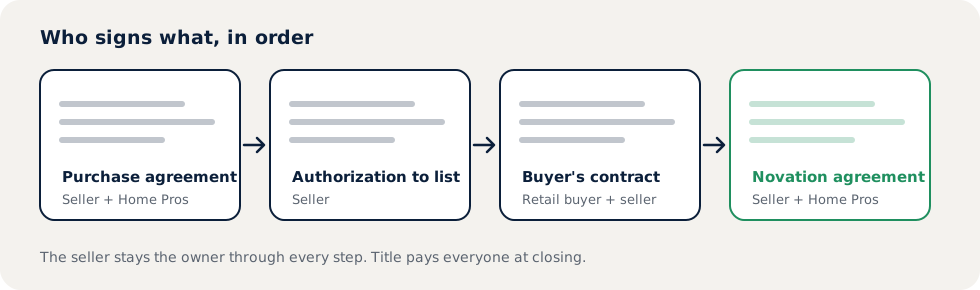
Home Pros asks novation sellers to sign one extra document, a limited authorization that lets partner agents sign listing documents for the house. It's useful when the seller lives out of state or works nights. In Ohio we keep it narrow on purpose. It names the licensed agent and brokerage who'll sign, not an unlicensed investor. It states the list price the seller approved. The deed and the novation agreement stay with the seller.
Ohio's discipline list backs that up. R.C. 4735.18(A)(20) lets the state discipline a licensee for offering property "without the knowledge and consent of the owner or the owner's authorized agent, or on any terms other than those authorized." So the authorization has to say what terms the seller approved. And the agent's duties still run to the seller: under R.C. 4735.62 a licensee representing a client is "a fiduciary of the client" and must disclose "any material facts of the transaction." The investor's spread is a material fact. Tell the seller.
Can an Ohio broker pay part of the commission to an investor?
No, unless the investor is licensed. Ohio closes this door from both sides.
R.C. 4735.20(A) says no licensed broker "shall pay a commission, fee, or other compensation for performing any of the acts specified in section 4735.01" to someone who isn't licensed. The narrow exception in (C) lets a broker pay a licensee's own company, but only if a licensed owner of that company earned the fee and the company itself does no broker acts. Then R.C. 4735.21 says no right of action accrues to collect compensation for those acts "without alleging and proving" a broker's license, and a salesperson "shall not sell, assign, or otherwise transfer" any part of a commission to an unlicensed person.
Read together, a side deal where the listing agent kicks back half the commission to you is a bad plan with no legal floor under it. The broker can't pay it, the agent can't assign it, and you can't sue for it.
Your money on a novation comes from the contract position: the gap between the seller's agreed net and what the retail buyer pays, written into the purchase agreement and the novation agreement. The brokerage earns what the listing agreement says. Two lines, two contracts, two signatures from the seller.
Licensed investors have one more rule. R.C. 4735.18(A)(15) bars acting "in the dual capacity of real estate broker and undisclosed principal." If you hold an Ohio license and you're also the contract holder, put both facts in writing for everyone at the table.
How does the money move on an Ohio novation?
One deed, seller to retail buyer. The sale price pays the mortgage, the title charges, the brokerage commission and the seller's agreed net. The investor's line comes out of what's left, shown on the settlement statement.
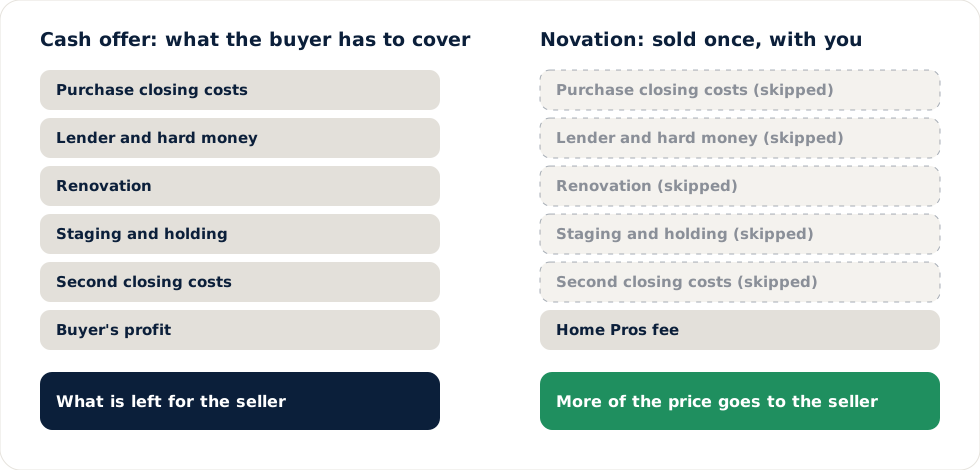
Ohio also changed what happens to earnest money. If an owner cancels under 5301.95(C)(1), the escrow or closing agent "shall disburse any earnest money paid by the wholesaler to the record owner within thirty days." S.B. 155 amended R.C. 4735.24(A)(4) so a broker holding that deposit can release it to the owner on that cancellation.
Here's an illustration, not a real deal. You put $2,500 down on a brick ranch in Parma and skip the form because the seller seemed fine. You list it, run eight weeks of showings, and find a buyer. The week before closing, the seller gets a better offer from a neighbor and cancels. Under (C)(1) they can, "at any time prior to the close of escrow without penalty," and your $2,500 goes to them. That's an expensive way to save one sheet of paper.
When a partner brings a novation to Home Pros, the split is 60% of the net profit to the partner and 40% to Home Pros. The seller pays one $500 transaction coordination fee from proceeds at closing, and Home Pros covers the seller's closing costs. Our novation agreement guide shows where each number lands on paper.
What should you never do on an Ohio novation?
Most Ohio problems come from treating the disclosure as optional or the license law as somebody else's issue.
- Don't sign the purchase agreement before the disclosure. Both signatures and dates on the form first.
- Don't bury the form in your contract. It has to be "separate from the purchase contract or agreement," boldface, 12-point minimum.
- Don't ask the seller to waive it. Division (C)(2) voids the waiver.
- Don't market the house yourself if you're unlicensed. The LSC analysis names "marketing a property to the general public" as licensed activity.
- Don't use a power of attorney as a workaround. 4735.01(A) covers acts done "pursuant to a power of attorney."
- Don't hide the novation, the partner or the fee from the seller. Our scripts disclose all three, every time.
The penalties come from two statutes. On the disclosure side, 5301.95(C)(3) makes any violation "an unfair or deceptive act or practice" under R.C. 1345.02. The owner gets the same relief a consumer gets under R.C. 1345.09, which the LSC summarizes as actual economic damages plus up to $5,000, and the Attorney General can enforce it. For licensees, 4735.18(A)(40) adds discipline for failing to follow 5301.95 while wholesaling; the LSC lists revocation, suspension, a fine of up to $2,500 per violation, or a public reprimand.
On the license side, R.C. 4735.99(A) makes a violation of 4735.02 a first-degree misdemeanor. For that class, R.C. 2929.28 sets a fine of up to $1,000 and R.C. 2929.24 allows up to 180 days in jail. Jail time on the books for an unlicensed listing. That's not a line to test.
How does Home Pros handle an Ohio novation?
Ohio is one of our service states, and the five steps don't change at the state line. The seller and Home Pros agree on a net price. The seller pays no repairs and no commissions, and Home Pros covers closing costs. An Ohio licensee markets the house on terms the seller approved. A retail buyer purchases. The seller gets the agreed net at closing.
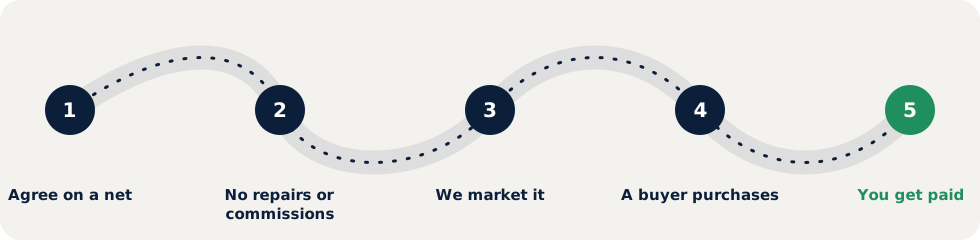
The Ohio difference sits at the very front. The statutory disclosure and our plain-English novation page go to the seller before anyone signs a purchase agreement, and the listing authority goes to a licensed Ohio agent by name. We'd rather slow a signing by twenty minutes than hand a seller a free cancellation right.
We work with 300+ investor-friendly agents and have closed hundreds of deals. Partners can start at the partner section of our novation page or submit a deal directly. If a house is too far gone to list, we'll look at a cash exit through our buyer network or the deal marketplace. Sellers can read the Ohio selling guide, or the pages for Columbus and Cleveland, and see how to verify Home Pros or any buyer. Working deals across the river? The Kentucky version of this page follows a different statute, and so does Pennsylvania. For the seller conversation, our novation pitch scripts explain the structure in plain words. For the novation program, call Trevor Rice at (210) 672-1674.
Send the Ohio deal and we'll tell you which exit fits
Trevor Rice reviews submitted deals for a cash bid and for a novation listing. You'll get both numbers and the Ohio disclosure step in writing.
Get a cash offer List with Home Pros
Wholesaler with a deal under contract? See the Home Pros novation program or submit the deal.
Frequently Asked Questions
Is a novation legal in Ohio?
Yes. R.C. 5301.95, effective March 2, 2026, names novation in its definition of a wholesaler and allows it once the record owner and the wholesaler sign a separate boldface disclosure before the contract binds. Chapter 4735, the license law, still controls who may market and negotiate the sale.
Is there a waiting period after the Ohio wholesaler disclosure?
No. Ohio requires the disclosure to be signed and dated by both sides before a binding contract, but it sets no minimum number of days. Missouri, by contrast, requires 14 calendar days.
Do I need an Ohio real estate license to do a novation?
R.C. 5301.95 doesn't require one, but R.C. 4735.01 treats listing, negotiating, advertising and procuring prospects for another, for pay, as broker acts, including acts done under a power of attorney. The safest setup has an Ohio licensee do all marketing and negotiating.
What happens if I skip the Ohio wholesaler disclosure?
The owner may cancel any time before the close of escrow without penalty, and the escrow or closing agent must pay your earnest money to the owner within 30 days. The violation is also an unfair or deceptive act under the Consumer Sales Practices Act.
Can an Ohio agent pay an unlicensed investor part of the commission?
No. R.C. 4735.20 bars a broker from paying compensation for broker acts to an unlicensed person, and R.C. 4735.21 bars a salesperson from transferring any part of a commission to one. The investor's proceeds come from the purchase contract and the novation agreement.
What is the penalty for unlicensed brokerage in Ohio?
Acting as a broker without a license violates R.C. 4735.02 and is a first-degree misdemeanor under R.C. 4735.99(A). That class carries a fine of up to $1,000 under R.C. 2929.28 and up to 180 days in jail under R.C. 2929.24.
Sources
Sources were read on November 21, 2026.
- R.C. 5301.95, residential real property wholesalers (S.B. 155, 136th General Assembly, effective March 2, 2026), and the S.B. 155 bill page
- Ohio Legislative Service Commission, S.B. 155 final analysis
- R.C. 4735.01, definitions and exemptions, and 4735.02, license required
- R.C. 4735.18, grounds for discipline, 4735.20, compensation to unlicensed persons, 4735.21, actions for compensation, and 4735.24, earnest money
- R.C. 4735.62, duties of a licensee to a client
- R.C. 4735.99, penalties, 2929.24 and 2929.28, misdemeanor jail terms and fines, and 1345.02 and 1345.09, Consumer Sales Practices Act

Trevor Rice is co-founder and CEO of Home Pros (Balint Holdings, LLC) and a licensed Texas real estate agent. He runs the Home Pros novation program. Reach him at (210) 672-1674 or trevor@selltohomepros.com. This article is general information, not legal or tax advice.